
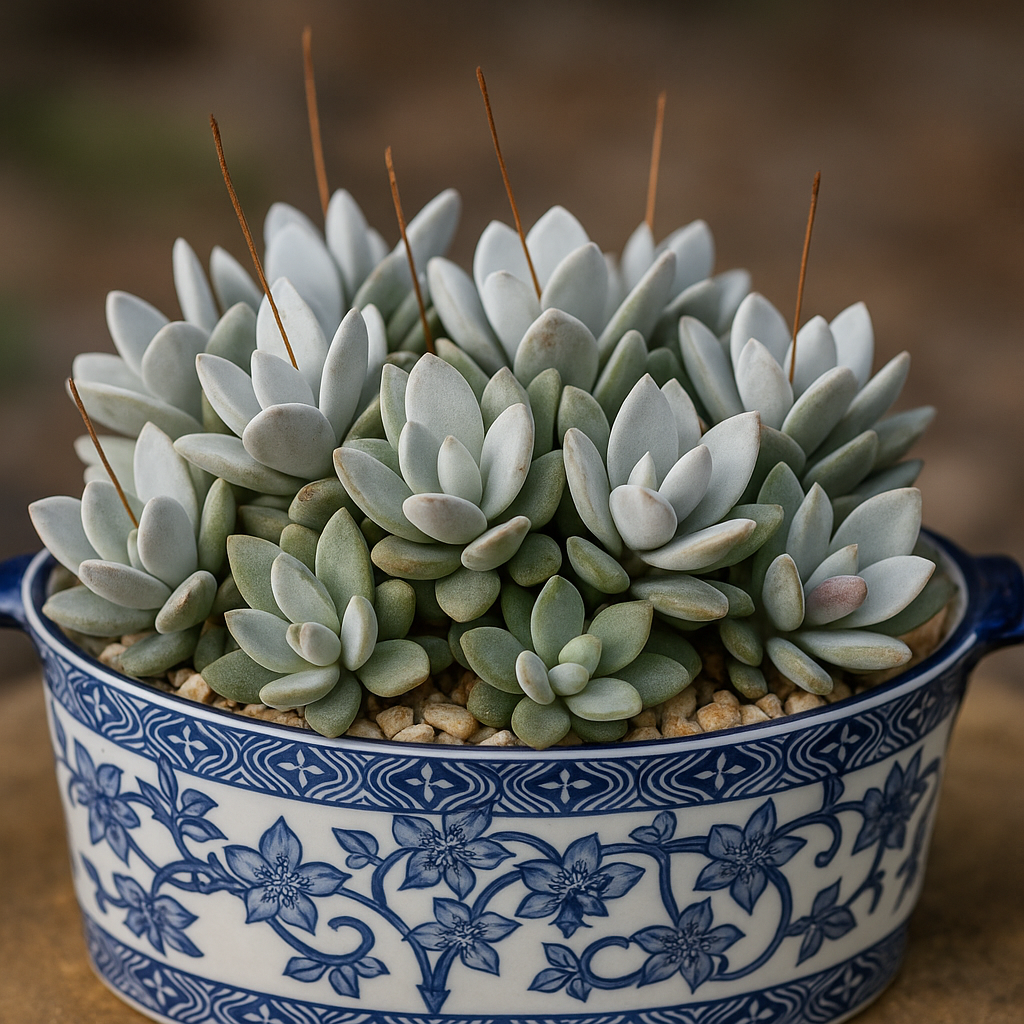
Adromischus leucophyllus – Flour-stonecrop; Witblaarplakkie – 5 Seed Pack
R29,50
INTERNATIONAL CUSTOMERS: Please read our shipping terms and conditions here before placing your order: Shipping Terms and Conditions
4 in stock
Adromischus is a compact but irresistibly diverse genus of leaf-succulent “miniatures” in the stonecrop family, Crassulaceae. The name comes from Greek, with adros meaning “thick” and mischos “stem”, a nod to the chunky little stems that anchor their often bizarre leaves.
All recognised species are endemic to southern Africa, mainly South Africa with some reaching into Namibia, where they inhabit rocky slopes, cliff faces and arid shrublands in both winter- and summer-rainfall regions.
Despite their small size, Adromischus offer tremendous variety: leaves can be spotted or plain, triangular or spindle-shaped, chalky white or deep green, smooth or heavily textured. Many species are cespitose, forming tight mats or clusters of short stems that slowly spread over time.
Their flowers are usually slender, tubular spikes in shades of green, white and pink – modest compared with their leaves, but invaluable for section and species identification. For collectors and beginners alike, they are famously easy to propagate from single leaves, making them ideal subjects for experimentation and sharing.
For South African growers, Adromischus bring the magic of the Karoo and Cape mountains onto a sunny stoep or windowsill. Internationally, they are perfect for bright indoor collections and under-glass culture, thriving in small pots of very gritty mix and tolerating a wide range of climates as long as they are kept dry and well-lit. Their compact size, drought tolerance and fascinating variation also make them excellent subjects for seed-grown collections, where every seedling can show its own unique patterning or leaf shape.
Adromischus leucophyllus – Flour-stonecrop, White-leaf Adromischus; Witblaarplakkie, Meel-boekplakkie
Adromischus leucophyllus, the flour-stonecrop or White-leaf Adromischus, is a dwarf, cluster-forming to pendent species from mountainous regions between Barrydale, Montagu, Robertson and De Doorns in the Western Cape.
It typically grows in shallow, rocky soils in somewhat shaded situations on rugged slopes, often on sandstone or related substrates.
Its charm lies in its pale, rounded, flattened leaves, densely crowded at the tips of short branches and covered in a powdery, whitish bloom that gives them a soft, flour-dusted appearance.
Plants remain small, spreading only a few centimetres high and across, and can trail gently over the rim of a container as stems elongate. In summer, they produce delicate, tubular white flowers on slender stalks – dainty accents above the frosted foliage.
Seed-grown A. leucophyllus offers something truly special for both South African and overseas collectors: a cool-toned, textural miniature that stands out from the usual greens and spots. In local gardens it is perfect for shaded Karoo or fynbos bowls; internationally, it thrives in bright but not harsh light, such as an east or slightly shaded south-facing window. A gritty mix with a high mineral content, careful watering and good airflow will keep the leaves firm and the powdery bloom pristine, allowing this Western Cape endemic to shine as a refined accent plant in any collection.


