

Aloe microstigma – Worcester Aloe, Karoo Aloe – 5 Seed Pack
R13,00
INTERNATIONAL CUSTOMERS: Please read our shipping terms and conditions here before placing your order: Shipping Terms and Conditions
23 in stock
Aloes are very popular and some of the most rewarding plants to cultivate. They make excellent accent plants owing to their often strange and inspiring architectures, as well as the bright flowers that offset the grey-green leaves. They are also very suitable as container plants and small aloes can be used very effectively as border plants at the edge of a bed. Although aloes are most often included in rockeries, their application in horticulture is not limited to this feature and they can be used in almost any setting and in conjunction with most common garden plants. Their natural adaptation to harsh and often arid climates makes aloes outstanding subjects for the water-wise garden. Aloe is a genus in the Asphodeloideae family containing about 600 species of flowering succulent plants. Aloes are sometimes confused with Agaves. Contrarily to Agaves, Aloe leaves contain a gel like sap. Another difference is that Aloes don’t die after blooming as most Agaves do.
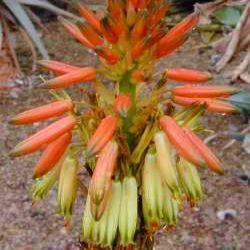
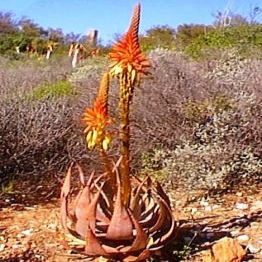
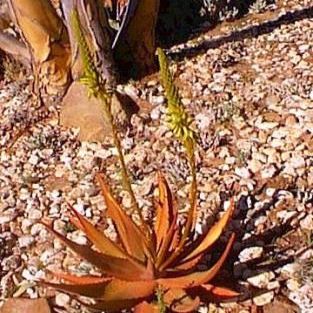
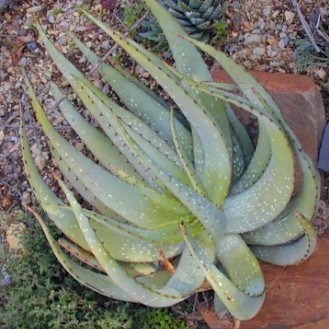
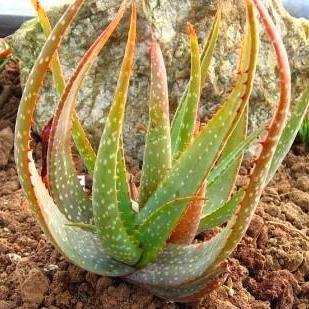
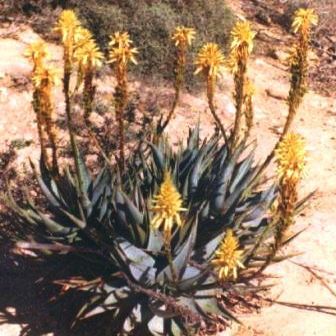
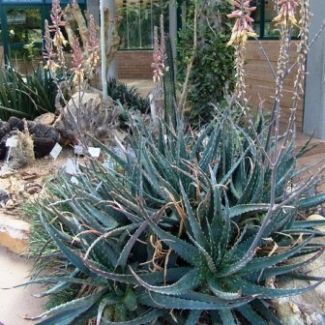
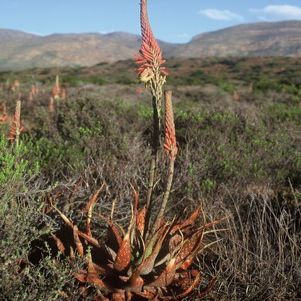
Aloe microstigma commonly known as Karoo Aloe or Worcester Aloe will reach a height of about 60cm and usually occur singularly or in small groups. The leaves are arranged in rosettes and are blue-green but can turn reddish brown if suffering from environmental stress. Conspicuous white spots appear on the leaves, which contrast well with the reddish teeth along the margins. The plant usually produces two or three flowers simultaneously from May to July (Early to Mid-Winter). The inflorescences (stem on which all flowers are borne) are up to 1m. The flowers, which attracts birds to the garden, are bicoloured, with red buds turning orange. In some places, however, the buds and open flowers may be uniformly red or yellow. Aloe microstigma is not threatened. This speckled aloe, being indigenous to South Africa, grows in rocky outcrops in Karoo, desert, semi desert and Namaqua Broken Veld. It is fairly widespread in the western parts of the Eastern Cape, the central areas of the Western Cape and into the Northern Cape, as well as in south-western Namibia.
All orders will receive a discount coupon to be redeemed on your next purchase.
Seeds you may also like
Related Seed Products
Related products
-

Amaranthus caudatus – Love Lies Bleeding Amaranth – 20 Seed Pack
R6,00 -

Albuca maxima – Soldier-in-a-box, Geldbeursie, Wit Tamarak – 5 Seed Pack
R14,25 -

Albuca fragrans – 5 Seed Pack
R21,25 -

Acorus calamus – Sweet Flag Grass, Single-vein Sweetflag, Calamus – 10 Seed Pack
R15,00 -

Albuca kirstenii – 5 Seed Pack
R23,75
