
Calpurnia reflexa – Sotho Laburnum, Reflex Wild Laburnum – 5 Seed Pack
R21,50
INTERNATIONAL CUSTOMERS: Please read our shipping terms and conditions here before placing your order: Shipping Terms and Conditions
16 in stock
Calpurnia is a small, showy genus in the pea family (Fabaceae), best known in South Africa for the striking “wild laburnums” or “golden peas” that light up forest margins and bushveld with cascades of yellow blossom. These are graceful shrubs to small trees, typically multi-stemmed, with soft, imparipinnate leaves and the classic pea-shaped flowers carried in drooping racemes. In the wild, Calpurnia species occur from the Eastern Cape through KwaZulu-Natal and the northern provinces, and further north into tropical Africa and even southern India, where they favour forest edges, kloofs, riverbanks and moist bushveld.
For South African gardeners, the best-known representative is Calpurnia aurea (wild laburnum, geelkeur), a hardy, fast-growing shrub or small tree that quickly forms a graceful, emerald-green canopy. From about its second year it begins to produce generous, pendulous bunches of brilliant yellow, sweetly attractive flowers, often from November through to March, with scattered blooms appearing for much of the year in warm regions. These nectar-rich sprays are highly attractive to carpenter bees and other pollinators, and are followed by thin, papery, straw-coloured pods that rustle in the breeze and add texture to the plant well into winter.
Calpurnia species make excellent subjects for indigenous and wildlife-friendly gardens in South Africa. They thrive in full sun to semi-shade, respond well to pruning, and are tolerant of frost and periods of drought once established, especially when planted in well-drained, compost-rich soil. In smaller gardens they can be maintained as large shrubs or multi-stemmed feature plants, while in larger landscapes they are superb along watercourses, on embankments, or as informal screening. With their luminous yellow flowers, quick growth and strong ecological value, Calpurnia species offer an easy, rewarding way to bring a splash of African forest and bushveld into any South African garden.
Calpurnia reflexa – Reflex Wild Laburnum
Calpurnia reflexa is a distinctive, shrubby wild laburnum known for its compact habit and reflexed, somewhat arching foliage. Indigenous to the grassland and savanna margins of eastern South Africa, it is recorded mainly from the higher-lying areas of the Eastern Cape and KwaZulu-Natal and into parts of the interior plateau. In the veld it often occurs as a multi-stemmed shrub among grasses and rocks, shrugging off wind, cold and fire.
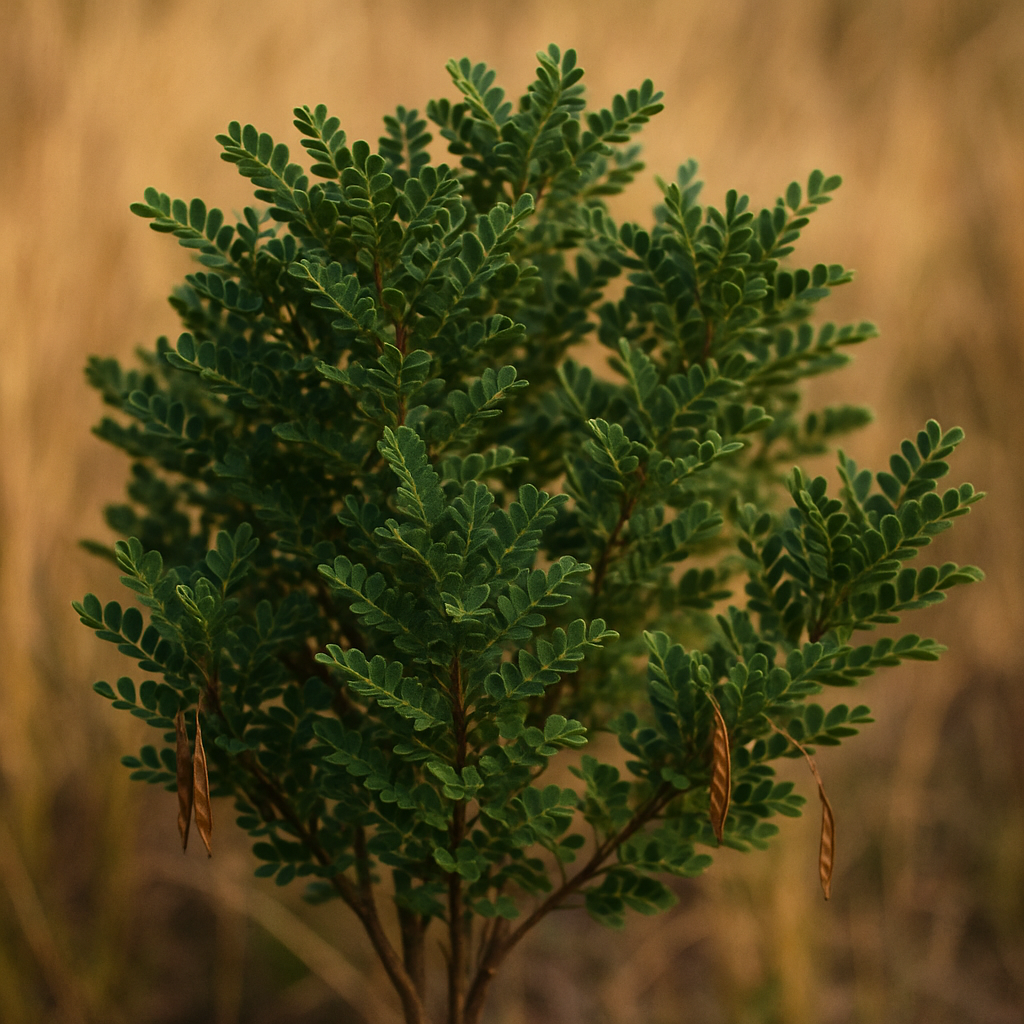
This species forms dense, many-branched shrubs usually 1.5–3 m tall, sometimes taller under ideal conditions. The leaves are divided into numerous small, rounded to oval leaflets carried closely along the rachis, giving an almost boxwood-like texture when viewed from a distance. The foliage is predominantly rich green, and the stems can take on a slightly reddish hue towards the tips, especially in strong sun. Because of its neat and bushy growth, C. reflexa is particularly suited to smaller gardens or for clipping into informal hedges and screens.
The flowers of Calpurnia reflexa are typical of the genus: pea-shaped, golden yellow, and carried in slender, drooping racemes along the outer stems. Flowering usually occurs from spring into early summer, when the shrubs punctuate the grassland with bright colour. As the name “reflexa” suggests, some parts of the flower and pods curve backwards slightly, giving a delicate, sculptural look to the inflorescences. After flowering, narrow pods develop, adding further interest as they ripen and rattle in the wind. For South African gardeners this species offers a tough, frost-tolerant, water-wise shrub that thrives on neglect, making it ideal for Highveld, Drakensberg foothills and other exposed inland gardens.


