
Crassula rubricaulis (Crassula rubricaulis var. muirii) – Red-stem Crassula; Rooistingelplakkie – 10+ Seed Pack
R25,00
INTERNATIONAL CUSTOMERS: Please read our shipping terms and conditions here before placing your order: Shipping Terms and Conditions
19 in stock
The genus Crassula is one of the most diverse succulent genera, varying from tiny moss-like annual plants to 2m tall succulent trees like Crassula ovata. Belonging to the Crassulaceae family, there are more than 300 Crassula species of which approx. 150 are found in southern Africa, where they are widespread but concentrated in the semi-arid winter-rainfall areas. The centre of distribution of this genus is in southern Africa, but they extend beyond Africa into Europe, America, Australia, New Zealand and the southern islands. The name Crassula is the diminutive of the Latin crassus which means thick or fat, referring to the fleshy nature of the genus as a whole. This popular genus offers an extensive array of sizes, growing forms and textures making them perfect for landscaping, rockeries, windowsill plants or to be grown in containers. They can also be grown indoors as house plants. Those that make excellent house plants are the glossy leaf varieties. Crassulas, given a rich, well-drained medium will grow fast and luxuriantly.
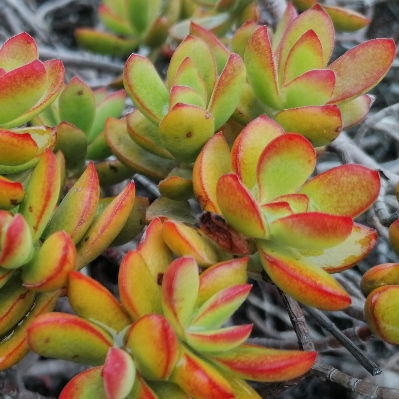
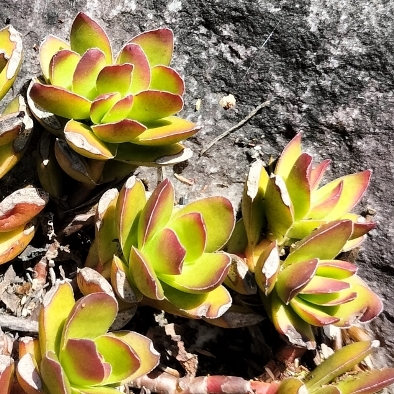
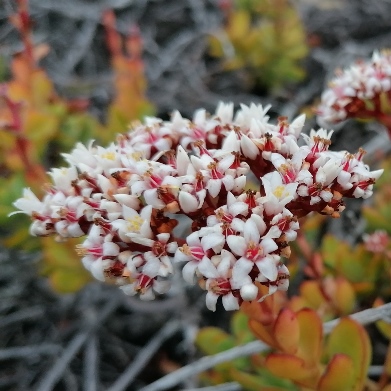
Crassula rubricaulis, synonymously known as Crassula rubricaulis var. muirii and commonly known as Red-stem Crassula in English or Rooistingelplakkie in Afrikaans, is a South African endemic species found in the Eastern Cape and Western Cape provinces, ranging from the Langeberg Mountains to Port Elizabeth growing on rocky outcrops amongst fynbos. Crassula rubricaulis is a lovely succulent perennial with attractive, red-edged leaves and abundant white flowers in mid to late summer, perfect for rockeries, pots and water-wise gardens. Crassula rubricaulis is easy to grow. It requires a position in sun or semi-shade with well-drained soil. The more shade it receives, the less strongly it develops red colouration in its stems and leaf margins. Feed with plenty of well-rotted compost. It does not need a lot of water but should receive about weekly watering to perform at its best, and in the winter-rainfall Western Cape it needs occasional watering during summer as well. This is an excellent water-wise shrublet, well-suited to rockeries, terrace walls, fynbos gardens, and coastal gardens. It does well in containers on a sunny stoep and can be grown on a windowsill or in bright light indoors.


