
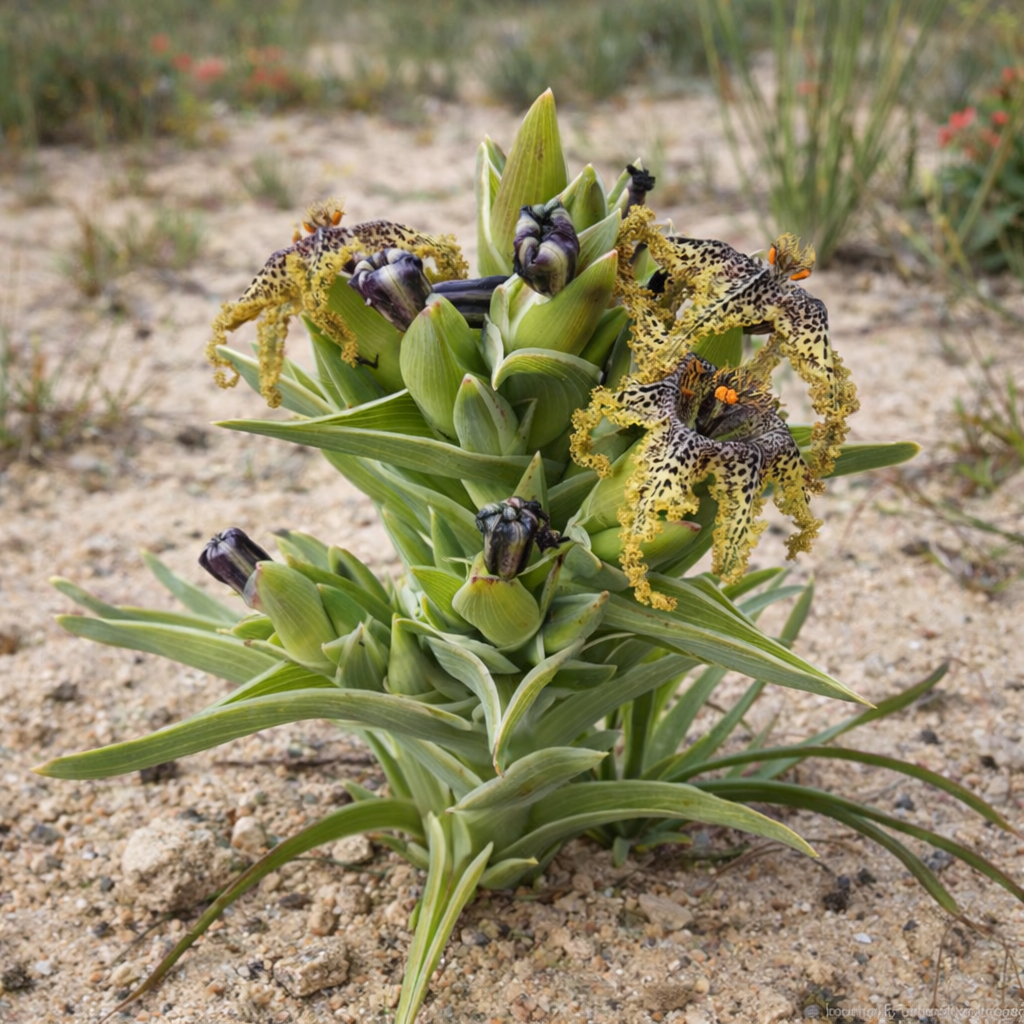
Ferraria foliosa – Beach Spiderlily – 5 Seed Pack
R42,50
INTERNATIONAL CUSTOMERS: Please read our shipping terms and conditions here before placing your order: Shipping Terms and Conditions
15 in stock
The genus Ferraria is one of southern Africa’s most botanically distinctive groups of cormous irids: compact geophytes that retreat underground during the unfavourable season and re-emerge with rains, often flowering rapidly in short seasonal windows. In modern treatments, Ferraria is placed in the tribe Irideae and discussed alongside close African relatives such as Moraea, Dietes, and Bobartia – a lineage recognised for petaloid style branches and striking specialisation in floral form.
Two traits make Ferraria instantly recognisable among irids. First, the tepals typically have crisped or frilled (undulate) limb margins, producing the genus’ signature “ruffled” look. Second, the style divides into three flattened branches that are deeply forked and finely fringed, a combination explicitly highlighted as unique within Iridaceae by modern systematic work and echoed in regional floras.
Ferraria is native to a broad belt of Africa, but its centre of diversity lies in the winter-rainfall west and southwest, where most species occur in the seasonally cool, wet growing period and summer drought. A smaller subset (notably including F. glutinosa) occupies summer-rainfall or seasonally dry tropical regions farther north.
From a conservation standpoint, many Ferraria are geographically narrow endemics of specialised west-coast habitats (sandveld, strandveld, duneveld, quartz fields, granitic slopes).
Ferraria foliosa – Beach Spiderlily
Ferraria foliosa exemplifies the genus’ more dramatic ecological storytelling: a coastal, dune-associated Ferraria whose flowers and scent are explicitly described as fly-attracting. For collectors who want an authentic “wild coast” Ferraria – one that makes botanical sense as well as visual impact – F. foliosa is a compelling seed-grown project, treated as an accepted species by global databases and assessed nationally as Near Threatened due to habitat pressures in parts of its range.
This species is recognisable vegetatively by its long, linear basal leaves that are markedly thickened in the midline (diamond-shaped in cross-section), sometimes drying by flowering time. The flowers are described in systematic treatment as dull purple-brown with a strong, molasses-like to putrid odour, and observers report heavy fly visitation consistent with successful cross-pollination. In cultivated settings, this translates to a flower that reads as richly patterned and “textured,” with crisped margins emphasising the star-like outline.
Ferraria foliosa occurs along the west-coast belt from northern dune systems south to the West Coast, typically on coastal sands close to the sea, and is associated with duneveld/strandveld vegetation types in national habitat summaries. Flowering is recorded mainly from mid-July to September, with occasional extension into early October, placing it among the earlier Ferraria to bloom in a winter-rainfall cycle. International buyers should regard it as a cool-season grower requiring high drainage and a strict summer dry rest to mimic the coastal winter-rainfall regime.


