
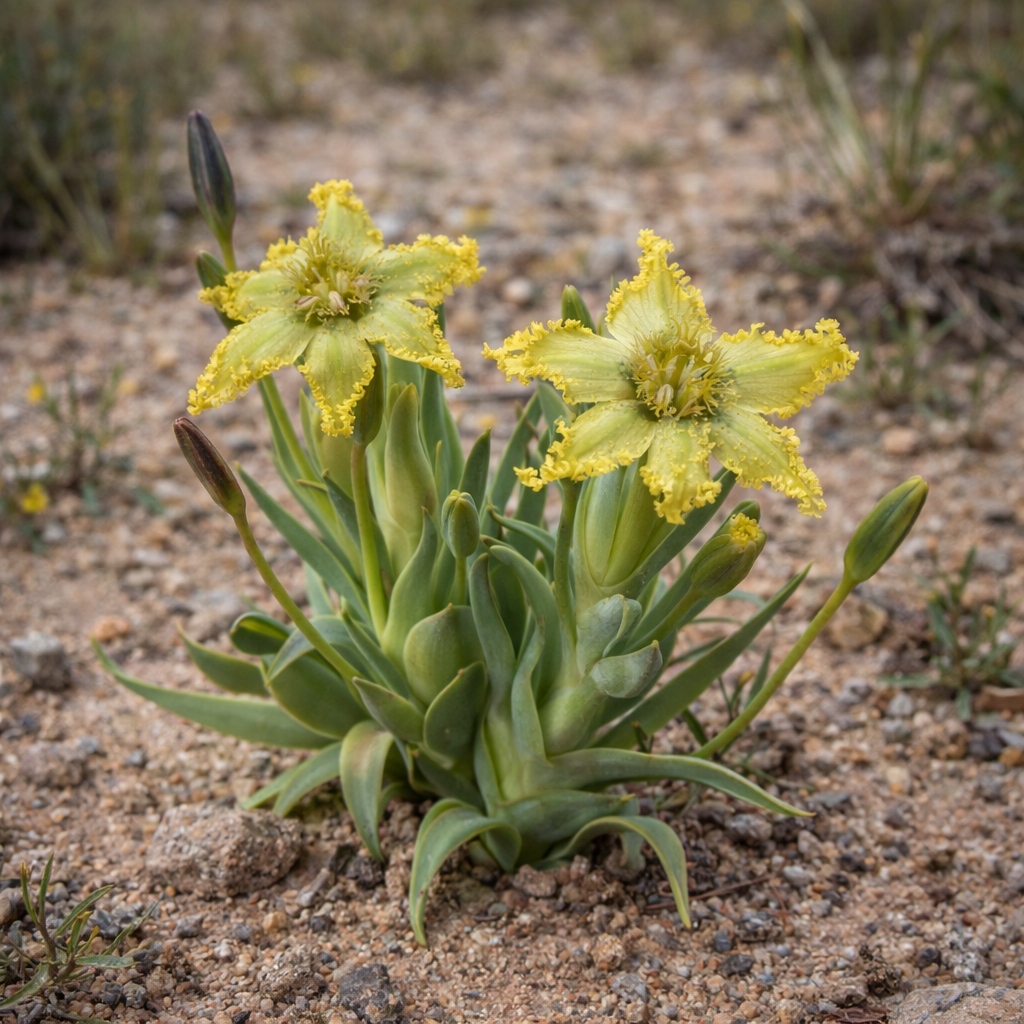
Ferraria macrochlamys subsp. kamiesbergensis (Ferraria kamiesbergensis) – Kamiesberg Spiderlily – 5 Seed Pack
R39,00
INTERNATIONAL CUSTOMERS: Please read our shipping terms and conditions here before placing your order: Shipping Terms and Conditions
8 in stock
The genus Ferraria is one of southern Africa’s most botanically distinctive groups of cormous irids: compact geophytes that retreat underground during the unfavourable season and re-emerge with rains, often flowering rapidly in short seasonal windows. In modern treatments, Ferraria is placed in the tribe Irideae and discussed alongside close African relatives such as Moraea, Dietes, and Bobartia – a lineage recognised for petaloid style branches and striking specialisation in floral form.
Two traits make Ferraria instantly recognisable among irids. First, the tepals typically have crisped or frilled (undulate) limb margins, producing the genus’ signature “ruffled” look. Second, the style divides into three flattened branches that are deeply forked and finely fringed, a combination explicitly highlighted as unique within Iridaceae by modern systematic work and echoed in regional floras.
Ferraria is native to a broad belt of Africa, but its centre of diversity lies in the winter-rainfall west and southwest, where most species occur in the seasonally cool, wet growing period and summer drought. A smaller subset (notably including F. glutinosa) occupies summer-rainfall or seasonally dry tropical regions farther north.
From a conservation standpoint, many Ferraria are geographically narrow endemics of specialised west-coast habitats (sandveld, strandveld, duneveld, quartz fields, granitic slopes).
Ferraria macrochlamys subsp. kamiesbergensis (Ferraria kamiesbergensis) – Kamiesberg Spiderlily
This subspecies represents one of the most fascinating outcomes of modern Ferraria systematics: what was once treated as a separate species (Ferraria kamiesbergensis) is now placed as a subspecies within F. macrochlamys, reflecting a carefully argued pattern of geographic and morphological differentiation. For growers, that taxonomic story matters because it signals a plant with a consistent “macrochlamys-type” floral architecture, but a distinctive vegetative signature linked to its local range.
In subsp. kamiesbergensis, the leaves characteristically have unthickened margins and blades that tend to be curved in one direction, producing a subtly different posture from the more strongly thick-margined forms. Flowers are in the macrochlamys style: pale yellow with a comparatively deep floral cup, and typically with fine spotting or colour zoning around the cup/limb transition that adds complexity without overwhelming the overall soft-yellow impression. Flowering is documented primarily from late August into September, sometimes extending into early October depending on seasonal conditions.
Distribution is centred on the southern Kamiesberg region and adjacent interior Namaqualand landscapes, where plants occur on gritty slopes and open ground rather than lush, competitive vegetation. For South African winter-rainfall gardens, it is ideal in mineral soils, raised beds, and rock-garden pockets where water drains fast. Internationally, it rewards pot culture: keep it bright and cool in the growing season, then dry and airy over summer, allowing the plant to follow its natural rhythm without risk of corm rot.


