
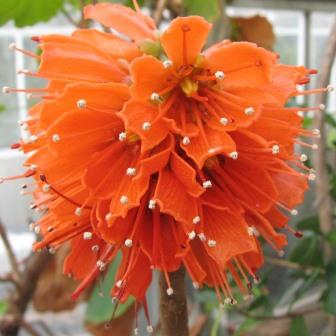
Greyia radlkoferi – Woolly Bottlebrush, Natal Bottlebrush; Wollerige Baakhout – 5 Seed Pack
R30,00
INTERNATIONAL CUSTOMERS: Please read our shipping terms and conditions here before placing your order: Shipping Terms and Conditions
26 in stock
The genus Greyia has been placed ing the Greyiaceae family. The other two species in the Greyiaceae family, Greyia radlkoferi and G. sutherlandii are dormant and leafless in winter, unlike G. flanaganii, which is evergreen. G. radlkoferi is found in Mpumalanga and Limpopo (Northern Province) and G. sutherlandii is from KwaZulu-Natal. The greyias of South Africa do not appear to have close relatives among the extant flora of the world. Greyiaceae belongs in the monotypic order Greyiales that was formerly described and placed between the Saxifragales and Francoyales.
The snarled branches of Greyia radlkoferi make this small tree or shrub an attractive structural element for any garden. In nature, growing in misty gullies along rivers, its scarlet flowers stand out as if painted on the landscape. There are also white forms that are worth cultivating too. G. radlkoferi commonly known as Woolly Bottlebrush or Natal Bottlebrush in English and Wollerige Baakhout in Afrikaans is a small tree or shrub growing up to 5 m in height. The branches have yellowish smooth bark when young, turning grey and deeply furrowed as the tree ages. The leaves are oval to heart-shaped, coarsely toothed and lobed at the base, sparsely hairy above and deeply woolly underneath, a characteristic that gives this tree its common name and distinguishes it from its more commonly planted cousin G. sutherlandii. The petioles of G. radlkoferi are also very hairy and the longest of all three species. The dense clusters of flowers are deep scarlet, blooming in upright racemes. The individual flowers are 20 mm long, with deep red stamens projecting from the mouth of the petal tube, which are slightly narrowed at the base. The 80 mm long racemes are borne at the end of the stems, before or with the young leaves in July to October, which makes them all the more conspicuous. The cylindrical fruit capsules split open at one end to release seed in the autumn.


