
Ixia flagellaris – 5 Seed Pack
R120,00
INTERNATIONAL CUSTOMERS: Please read our shipping terms and conditions here before placing your order: Shipping Terms and Conditions
20 in stock
Few flowering plants capture the extraordinary diversity and breathtaking beauty of South Africa’s indigenous flora quite like the genus Ixia. Commonly known as Corn Lilies or African Corn Lilies, these exquisite perennial geophytes belong to the Iridaceae family, commonly called the Iris family, which also includes such celebrated ornamental plants as Gladiolus, Freesia, Moraea and Crocosmia. Comprising approximately 100 recognised species, Ixia is an exceptionally diverse genus of cormous flowering plants native to southern Africa, with its greatest concentration of species occurring in the winter-rainfall regions of South Africa’s Western, Northern and Eastern Cape provinces. From the spectacular wildflower landscapes of Namaqualand and the rugged Cederberg Mountains to the rocky Roggeveld Escarpment, the rolling renosterveld hills of the Overberg and the dramatic mountain slopes of the Little Karoo, these remarkable plants represent some of the most captivating botanical treasures of the Cape Floristic Region.
The extraordinary ornamental appeal of Ixia lies in its astonishing diversity of flower colours, shapes and arrangements. Depending on the species, the delicate six-petalled blossoms may appear in brilliant shades of golden-yellow, fiery orange, scarlet-red, vivid magenta, soft rose-pink, lavender, violet, pale blue, creamy–white and even striking turquoise-green. Many species feature contrasting dark centres, intricately coloured throats, prominent golden stamens or beautiful markings that give their flowers an almost jewel-like appearance. While some ixias produce broad, open, star-shaped blossoms that face directly towards the sunlight, others display gracefully nodding, bell-shaped flowers, long slender floral tubes or unusual asymmetrical arrangements of their reproductive structures. Certain species release delightful fragrances reminiscent of roses or other sweet floral scents, while others are completely scentless, reflecting their diverse pollination strategies. This remarkable floral variation has evolved through intricate relationships with bees, beetles, butterflies and specialised pollinating flies, making Ixia a fascinating genus for botanists, conservationists and horticultural enthusiasts alike.
Growing from underground corms, Ixia species exhibit an equally fascinating diversity of growth habits and foliage. Some are charming miniature plants standing only a few centimetres above the ground, their brilliant flowers appearing almost directly among low-growing leaves, while others develop tall, elegant flowering stems that may exceed a metre in height. The foliage ranges from narrow, grass-like blades and slender, sword-shaped leaves to unusually rigid, leathery or cylindrical structures, each reflecting adaptations to the plant’s particular natural environment. Many species inhabit sandy fynbos flats, rocky mountain slopes, clay-rich renosterveld or exposed shale outcrops, while others are specially adapted to seasonally moist seeps, marshy depressions and mountain stream margins. Their remarkable ability to survive challenging environmental conditions is made possible by underground corms that store essential reserves, allowing the plants to retreat into dormancy during unfavourable seasons and re-emerge when conditions become suitable for growth.
One of the most captivating characteristics of the genus is its seasonal transformation. Most Ixia species are winter-growing, summer-dormant perennials that respond to the arrival of autumn and winter rainfall by producing fresh foliage and developing flowering stems. Their magnificent floral displays generally occur from late winter through spring, with certain high-altitude and late-flowering species extending the spectacle into early summer. During this relatively brief flowering period, the landscapes of the Cape can become adorned with breathtaking displays of brilliant colour, delicate floral forms and extraordinary botanical diversity. Many species are closely associated with the natural fire cycles of South Africa’s fynbos and renosterveld ecosystems, with flowering sometimes stimulated by the clearing of vegetation following wildfires.
For South African gardeners, Ixia offers a wonderful opportunity to celebrate the exceptional beauty of the country’s indigenous flora, while international growers and collectors can discover an enchanting group of flowering corms unlike anything found in conventional horticulture. Many of the more adaptable species are suitable for Mediterranean-style gardens, sunny borders, rock gardens and decorative containers, while rarer and more demanding varieties reward dedicated enthusiasts who enjoy the challenge of specialised bulb cultivation. Growing Ixia from seed is particularly satisfying, allowing gardeners to experience the complete development of these remarkable plants from delicate seedlings into mature flowering corms. Whether you are captivated by the vivid colours of Ixia maculata, the extraordinary turquoise-green flowers of Ixia viridiflora, the delicate lavender blossoms of Ixia brevituba or the fascinating botanical adaptations of the genus’s rarest mountain species, there is an Ixia to inspire almost every plant enthusiast. Discover the remarkable world of South African Corn Lilies and explore the exceptional diversity, elegance and horticultural potential of one of the Cape’s most extraordinary flowering plant genera.
Ixia flagellaris
Discover the enchanting beauty of Ixia flagellaris, an exceptionally rare and fascinating South African wildflower that combines delicate pink blossoms, unusual botanical adaptations and the rugged beauty of the Cape’s mountainous landscapes. Belonging to the Iridaceae family, this remarkable cormous perennial is endemic to the Western Cape of South Africa, where it has a highly restricted natural distribution in the Cederberg Mountains, with additional records provisionally associated with the Koebee Mountains. Found primarily at middle to higher elevations, particularly around Heuningvlei and Sneeuberg, Ixia flagellaris inhabits moist, sandy flats, seasonal seeps and potentially peaty sandstone soils within the region’s distinctive mountain fynbos vegetation. Formally described in 2012, this extraordinary species is classified as Rare on South Africa’s Red List of Plants, making it particularly interesting to collectors of unusual South African geophytes, indigenous flora enthusiasts and international gardeners seeking distinctive botanical treasures.
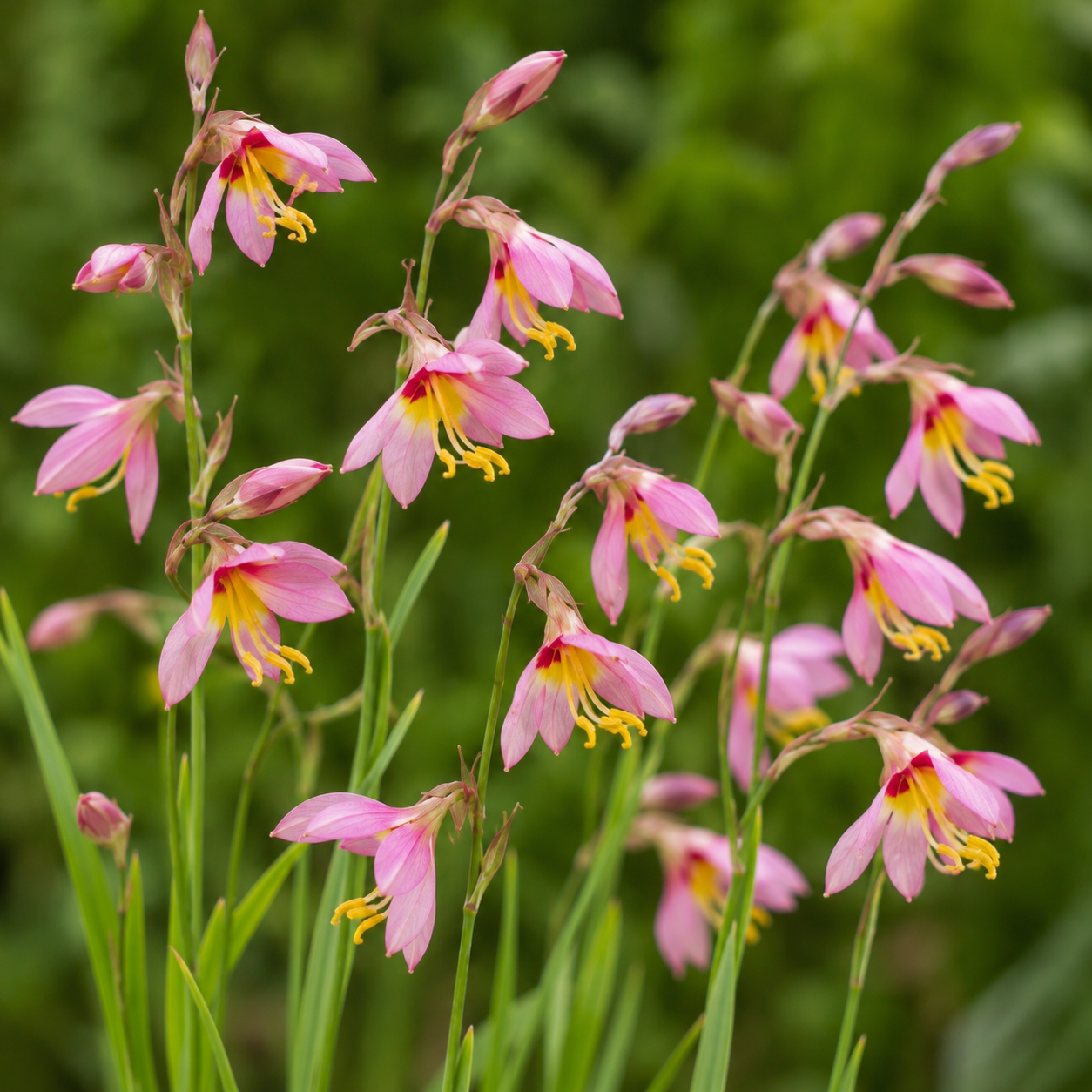
The outstanding ornamental attraction of Ixia flagellaris lies in its exquisite, gently nodding flowers, which display a delightful combination of soft shell-pink, delicate rose and pale blush-pink tones. Each elegant blossom consists of six elongated, slightly spreading petals that form a graceful, downward-facing floral display. The petals are beautifully marked with subtle pink veins, while their bases transition into a striking golden-yellow throat dramatically edged with deep magenta-pink. Prominent golden-yellow anthers extend from the centre of each flower, supported by slender, slightly flattened filaments arranged predominantly towards one side. This unusual one-sided arrangement of the reproductive structures gives the flowers a distinctive, subtly asymmetrical appearance that sets them apart from the more familiar, radially symmetrical garden ixias. The delicate flowers emerge from slender pinkish buds enclosed within translucent, purple-veined bracts, creating a charming succession of developing buds and open blossoms. When several plants are grown together, their graceful flowering spikes produce an enchanting display of nodding pink flowers with brilliant yellow centres.
Growing from a small underground corm, Ixia flagellaris develops a compact, elegant habit, typically reaching approximately 15–33 cm in height. Its slender, upright green stems are generally unbranched, although an occasional plant may produce a single lateral branch. The foliage consists of four leaves, with narrow, sword-shaped to gently curved green blades featuring prominent central veins and subtly thickened margins. These delicate leaves provide an attractive complement to the flowering stems without overwhelming their graceful appearance. Each flowering spike typically carries five to nine blossoms, which open progressively to create a beautiful seasonal display. One of the species’ most fascinating botanical characteristics is its ability to produce slender underground stolons extending up to approximately 5 cm from the parent corm, each terminating in a small daughter corm. This unusual method of vegetative propagation is particularly distinctive within its section of the Ixia genus and provides an additional point of interest for collectors who appreciate rare plants with fascinating growth adaptations.
In its natural Cederberg mountain habitat, Ixia flagellaris flowers during the South African spring, primarily from October through November, when the cooler winter conditions give way to warmer temperatures and increasing daylight. The graceful pink blossoms appear above the fine green foliage, providing delicate splashes of colour among the damp, sandy mountain flats and surrounding fynbos vegetation. Interestingly, the species has also been recorded flowering in the season following a wildfire, highlighting its association with the natural ecological processes of the Cape’s fire-adapted landscapes, although flowering is not known to depend exclusively on fire. As a winter-growing, summer-dormant geophyte, Ixia flagellaris follows the seasonal rhythms characteristic of many Cape bulbs, developing foliage during the cooler, wetter months before gradually retreating into underground dormancy during summer. For South African gardeners and international growers, cultivation should aim to replicate these seasonal conditions, using a well-draining, sandy growing medium that retains some moisture during active growth, together with bright natural light and good air circulation. Unlike many ixias adapted to relatively dry slopes, this moisture-loving mountain species may benefit from more consistent moisture during its winter and spring growing season, provided the roots are never subjected to prolonged stagnation. Container cultivation is particularly useful in regions with summer rainfall, excessive humidity or severe winter conditions, allowing greater control over seasonal watering and the protection of dormant corms.
Whether you are a passionate collector of rare South African bulbs, an indigenous flora enthusiast, a specialist geophyte grower or an international botanical hobbyist searching for something truly distinctive, Ixia flagellaris is an exceptional addition to a carefully curated plant collection. Its beautiful soft pink flowers, contrasting golden-yellow throats, deep magenta markings, graceful nodding habit and unusual stolon-producing corms distinguish it from the more commonly cultivated members of the Ixia genus. Raising this remarkable species from responsibly sourced seed offers the rewarding experience of nurturing a rare mountain geophyte from its earliest growth stages through to the development of mature flowering plants. Check out our online seed store and explore our massive range of rare, indigenous and exotic species, featuring an extensive and diverse selection of extraordinary botanical treasures for collectors, gardeners and horticultural enthusiasts around the world. Buy Now or Add to Cart and begin your journey towards cultivating this enchanting pink-flowered South African mountain wildflower. Seeds and All offers combined South African and International shipping.


