
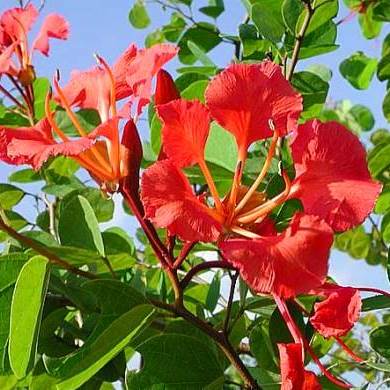

Bauhinia galpinii – Pride of De Kaap; Vlam-van-die-Vlakte – 5 Seed Pack
R21,25
INTERNATIONAL CUSTOMERS: Please read our shipping terms and conditions here before placing your order: Shipping Terms and Conditions
16 in stock
Many of the almost 300 species of Bauhinia are popular garden subjects because of their decorative foliage and ornamental flowers and are widely grown in sub-tropical or tropical regions of the world. Most bauhinias are woody shrubs, some climbing with tendrils or scrambling and some are small trees. The most commonly cultivated is Bauhinia variegata, the orchid tree (not a true orchid), originally from India and China. There are seven bauhinias that are indigenous to southern Africa, and all show horticultural promise. The most well-known and widely cultivated is the pride-of-De Kaap, Bauhinia galpinii, bearing masses of bright orange-red flowers in summer. There is also the yellow bauhinia or bosbeesklou, Bauhinia tomentosa, a large shrub or small tree with bell-shaped yellow flowers; the Kalahari white bauhinia or koffiebeesklou, Bauhinia petersiana, a scrambling shrub or small tree with very crinkled white flowers; the KwaZulu-Natal white bauhinia, Bauhinia natalensis a dainty shrub with bell-shaped white flowers; and the pink bauhinia or sandbeesklou Bauhinia urbaniana a shrub or bushy tree with rose-pink flowers from north-eastern Namibia. After the pride-of-De Kaap, Bauhinia bowkeri is the most striking and although still uncommon in cultivation, it is gaining popularity.
As the common name suggests, anyone could be forgiven for thinking that this plant comes from the Cape. In actual fact it is named after the De Kaap valley, south of Nelspruit in Mpumalanga in the north-eastern region of South Africa. It is much more widespread, however, and though indigenous to South Africa it can also be found right across the moister bushveld areas of the subcontinent. In its wild state this medium to large shrub behaves more as a climber, clambering through the and of the dense thicket vegetation in which it occurs. It doesn’t have to be grown in this fashion in your garden and with just a little pruning and training it can easily be trained into an attractive small tree or large garden shrub. Alternatively it can be encouraged in its clambering habit to cover pergolas or other structures and offer evergreen shade in your garden.


