
Aloe bertemariae – Bertemaria’s Aloe – 5 Seed Pack
R175,00
INTERNATIONAL CUSTOMERS: Please read our shipping terms and conditions here before placing your order: Shipping Terms and Conditions
10 in stock
Aloe is one of the most captivating succulent genera on Earth, celebrated for its bold architectural rosettes, resilient nature, and spectacular seasonal flower displays. From neat, miniature species that tuck themselves into rocky crevices to dramatic, stem-forming giants that dominate dry hillsides, aloes bring an unmistakable sense of place—sunlit, water-wise, and wonderfully wild—wherever they are grown.
What truly sets Aloe apart is the combination of sculptural foliage and nectar-rich blooms. The leaves range from smooth and glaucous to spotted, toothed, and richly textured, often changing colour with sun, drought, or cool weather. When they flower, aloes send up striking spikes or branched candelabras topped with tubular blooms in fiery reds and oranges, soft corals and pinks, or even yellows and greens—magnets for pollinators and a highlight in any garden or collection.
With origins spanning Africa, Madagascar, the Arabian Peninsula and surrounding regions, Aloe has evolved to thrive in demanding environments—making many species naturally suited to xeriscaping, rock gardens, containers, and drought-tolerant landscapes. Whether you’re a first-time grower or a seasoned collector, raising aloes from seed is especially rewarding: every plant tells a slightly different story, and each one matures into a unique, living sculpture that becomes more impressive with every season.
Aloe bertemariae – Bertemaria’s Aloe
Aloe bertemariae is a very localised Ethiopian treasure, described only in 2000 and still known from a small area in the Harerge region of eastern Ethiopia, where it grows on sandy loam in open Acacia woodland at low elevations around 300–400 m.
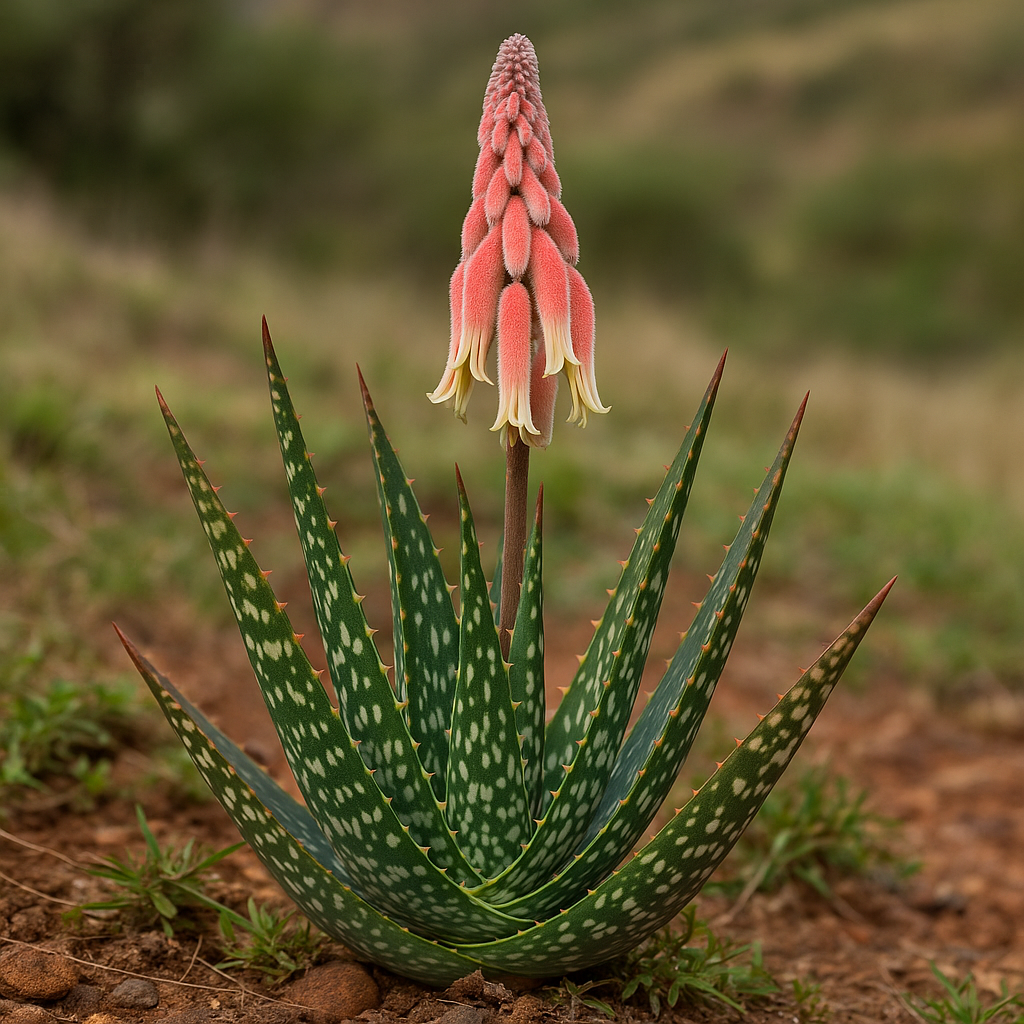
In habitat the plants form tight groups of a few rosettes anchored in gritty soil, their upright leaves dotted with pale, elongated spots that glow against a blue-green background. For collectors in South Africa and abroad, this species offers the thrill of growing a truly rare aloe that still feels very “wild” and untouched by horticultural breeding.
The rosettes are stemless but can eventually offset into small clusters. Each rosette carries about a dozen to fifteen narrow, triangular to lance-shaped leaves, strongly channelled on the upper surface and often becoming tubular in dry weather.
The leaf surfaces are heavily patterned with large whitish-green markings on both sides, giving the plant a striking, mottled look that reads as almost camouflage among stones and dry grasses. Margins are lined with small, evenly spaced brown teeth, just enough armament to look fierce without being unmanageable in pots or rock gardens.
When mature, Aloe bertemariae sends up a tall, simple flower stalk that can reach human height, topped with a long, dense, cylindrical cone of blooms. The tubular flowers are a deep, dark coral-red with a softly contrasting whitish to cream mouth and faintly greenish tips, and they are delicately hairy just above the ovary – exactly the fuzzy, glowing effect seen in the photos.
Flowering in habitat is mainly from late spring to mid-summer, and in cultivation you can expect bloom in the warmer months of your growing season, providing valuable nectar for sunbirds in South Africa and hummingbird or insect interest in suitable climates elsewhere.
For cultivation, give this species what it knows best: a very well-drained, sandy or gritty mix, full sun to bright light, and a pronounced dry rest between waterings. Its origin in warm, lowland woodland means it relishes heat but should be protected from hard frost; South African growers in colder regions and international enthusiasts will do best in containers that can be moved under cover for winter. From seed it is reasonably fast by aloe standards, producing robust, spotty juveniles that already show the characteristic patterning within their first couple of years. With patience and good light, Aloe bertemariae becomes a dramatic, upright, spotted aloe that stands out in any serious succulent collection.


