
Aloe congdonii – 5 Seed Pack
R185,00
INTERNATIONAL CUSTOMERS: Please read our shipping terms and conditions here before placing your order: Shipping Terms and Conditions
13 in stock
Aloe is one of the most captivating succulent genera on Earth, celebrated for its bold architectural rosettes, resilient nature, and spectacular seasonal flower displays. From neat, miniature species that tuck themselves into rocky crevices to dramatic, stem-forming giants that dominate dry hillsides, aloes bring an unmistakable sense of place—sunlit, water-wise, and wonderfully wild—wherever they are grown.
What truly sets Aloe apart is the combination of sculptural foliage and nectar-rich blooms. The leaves range from smooth and glaucous to spotted, toothed, and richly textured, often changing colour with sun, drought, or cool weather. When they flower, aloes send up striking spikes or branched candelabras topped with tubular blooms in fiery reds and oranges, soft corals and pinks, or even yellows and greens—magnets for pollinators and a highlight in any garden or collection.
With origins spanning Africa, Madagascar, the Arabian Peninsula and surrounding regions, Aloe has evolved to thrive in demanding environments—making many species naturally suited to xeriscaping, rock gardens, containers, and drought-tolerant landscapes. Whether you’re a first-time grower or a seasoned collector, raising aloes from seed is especially rewarding: every plant tells a slightly different story, and each one matures into a unique, living sculpture that becomes more impressive with every season.
Aloe congdonii
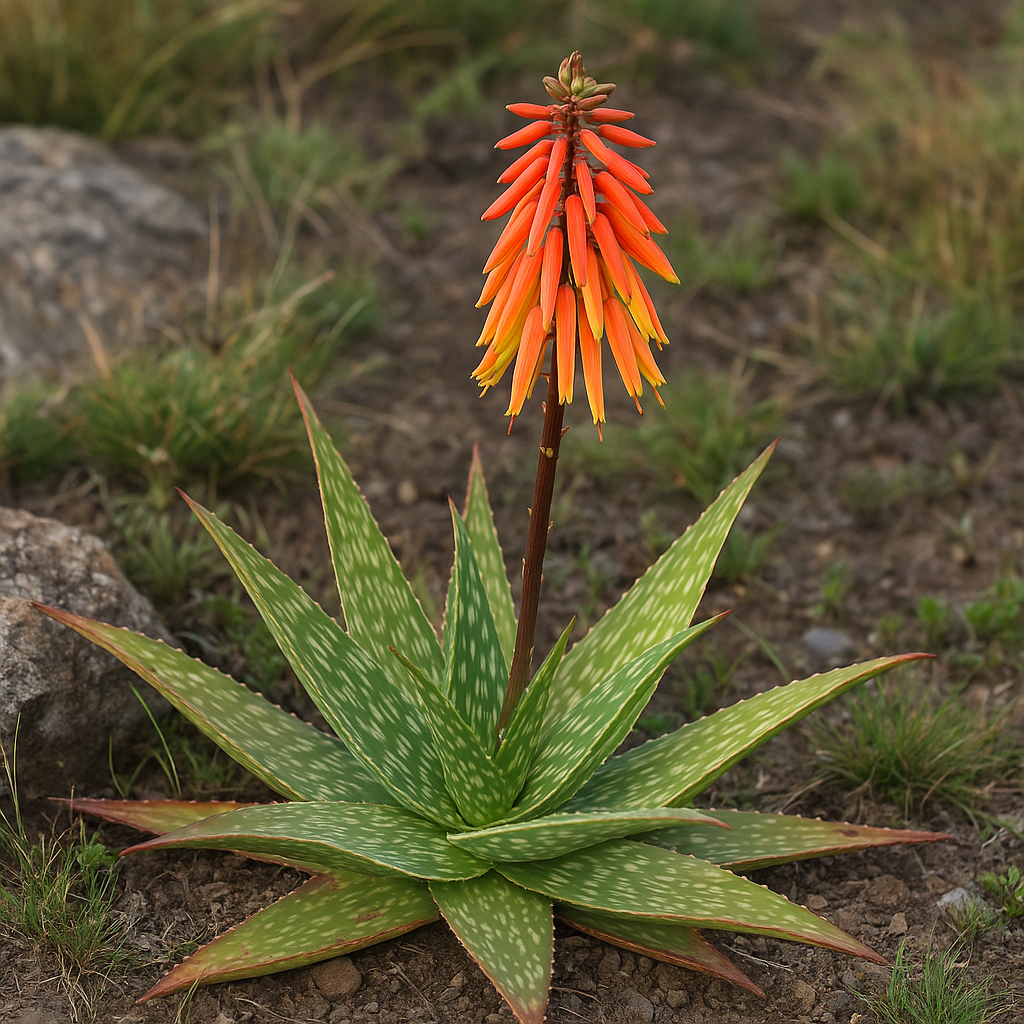
Aloe congdonii is a rare, cliff-hugging aloe from the highlands of Tanzania, where it forms tight clusters on rocky outcrops between roughly 1 500 and 2 300 m above sea level. In cultivation it makes dense groups of stemless rosettes, each rosette built from about eight to ten broad, egg-shaped to lance-shaped leaves. The foliage is a greyish to bluish green often lightly flushed red in strong light, and is beautifully patterned with elongated, whitish spots that form irregular bands across the leaf surface. Short, pale teeth with tiny brown tips line the margins, giving the plant a delicate but unmistakably “aloe” silhouette without looking overly fierce. No well-established common name or horticultural synonym is in use; plants are almost always traded simply under the botanical name Aloe congdonii.
From these handsome rosettes arise slender flower stalks, usually single but sometimes with one or two short branches, that lift the blooms well above the foliage. The inflorescences carry dense, almost head-like to short cylindrical clusters of tubular flowers in glowing orange-pink tones, often with softer greenish or yellowish shading near the tips. Each bloom is relatively large for the plant’s size, and the protruding stamens and style give the flowers a slightly starry, whiskered look when fully open. In its native range, flowering typically occurs in the cooler months, making it a welcome splash of warm colour when many other succulents are resting.
For collectors and gardeners in South Africa and worldwide, Aloe congdonii offers an appealing combination of compact size, striking leaf markings and showy, upright inflorescences. Its rocky origins mean it thrives in very well-drained, gritty soil mixes, whether planted in a crevice garden, on a sunny rock wall or in a container under bright light. Given protection from hard frost and heavy, prolonged winter wet, it adapts well to Mediterranean, subtropical and bright indoor or greenhouse conditions. With time, the plant will offset to form an impressive clump, creating a living cushion of speckled rosettes that brings a touch of Tanzanian mountain drama to any succulent collection.


