


Astrophytum capricorne var. senile – 10 Seed Pack
R35,50
INTERNATIONAL CUSTOMERS: Please read our shipping terms and conditions here before placing your order: Shipping Terms and Conditions
31 in stock
Astrophytum is a genus of six species, native to the Chihuahuan desert and occurring in north and central Mexico and southern Texas in the USA. Of these six species five, namely Astrophytum asterias, Astrophytum capricorne, Astrophytum coahuilense, Astrophytum myriostigma and Astrophytum ornatum are globose to short cylindrical cacti while the fifth, Astrophytum caput-medusae is a sprawling octopus-like plant. The first five species mentioned were discovered between the years 1828 and 1845. Astrophytum asterias, Astrophytum coahuilense and Astrophytum myriostigma are spineless while Astrophytum capricorne and Astrophytum ornatum have prominent spines. All five feature a star-shaped appearance when viewed from above hence the genus name Astrophytum, which means star plant. The sixth member of this genus, Astrophytum caput-madusae, was newly discovered in 2001 and is quite distinct from the other members of the genus. It has long digit-like tubercles that grow something like an octopus and does not appear to be an Astrophytum till it flowers when all doubt is removed. These plants are adapted to the varying extremes of the desert, from high daytime temperatures to frosty nights, and they tolerate dry conditions very well, like other cacti. Gardeners should be careful to avoid over-watering their Astrophytum cacti in the garden. For succulent gardens, rockeries, and other water-wise gardens, Astrophytums can be an excellent choice. Outdoor gardening in containers and pots is also possible. They are summer growers requiring full to part sun. Provide them with lots of water in summer but only moderate water in spring and autumn, and little to no water in winter as they are prone to rot. They are frost tolerant to -10°C.
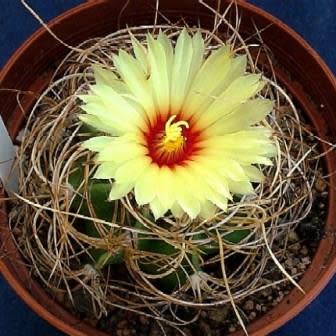
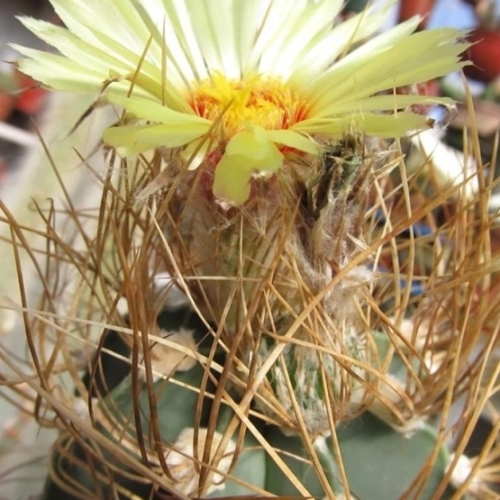
Astrophytum capricorne var. senile is a sphere-shaped to short cylindrical cactus that is so densely wrapped with soft, whitish, dark reddish brown to black spines that the body is hardly visible, and can sometimes look like a dry grass bundle. The flexible, bristly spines which are 3 to 7cm long fade to grey as the plant ages. The spines point in all directions and often form spirals. They are so densely nest wrapped that the body is hardly visible and looks like a dry grass bundle. The lateral spine grows horizontally sideways at first and then buckles while the others point more or less upwards. This Astrophytum rarely produces off-sets and is solely propagated from seed. As you can see from the accompanying photo, Astrophytum capricorne var. seniles flowers are absolutely gorgeous!


