
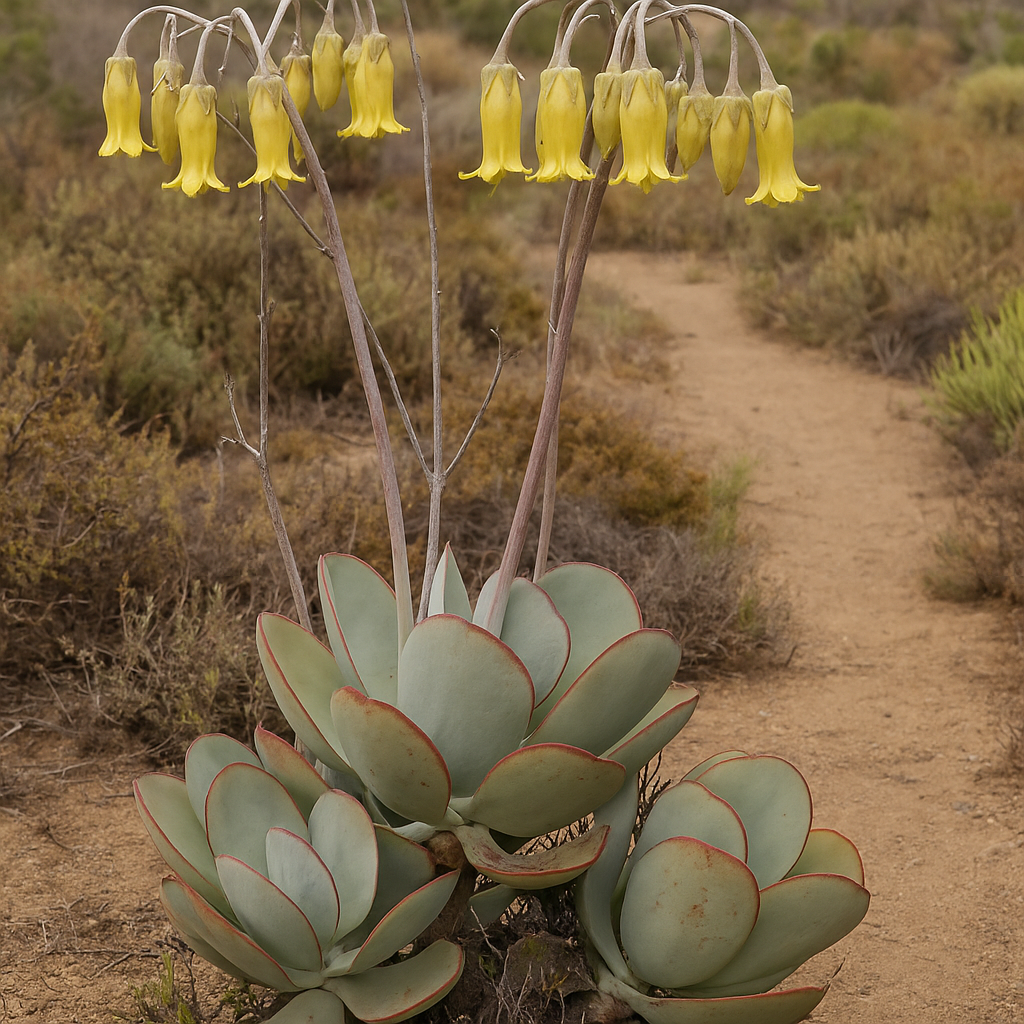
Cotyledon orbiculata var. spuria (Cotyledon purpurea) – 10 Seed Pack
R20,00
INTERNATIONAL CUSTOMERS: Please read our shipping terms and conditions here before placing your order: Shipping Terms and Conditions
33 in stock
Few South African succulents feel as instantly familiar and yet as endlessly surprising as Cotyledon. This is a proudly local genus in the Crassulaceae, centred in Southern Africa and especially rich in South Africa’s winter-rainfall and semi-arid regions. From Namaqualand quartz fields to Karoo koppies and Eastern Cape cliffs, Cotyledon species have adapted to tough landscapes with thick, water-storing leaves, powdery blooms that reflect harsh sun, and rugged stems that shrug off drought.
What makes the genus such a favourite with growers is its variety. Some Cotyledon are neat little cliff creepers, others become chunky shrubs with paddle-shaped “pig’s ear” leaves, and a few — like the beloved bear’s paws — look almost unreal with their soft, velvety texture. Leaf colour ranges from frosted blue-green to lime-green and bronze, often finished with dramatic red margins or tips that intensify in cool, bright weather.
Then come the flowers: tall stalks topped with nodding bells or tubes in fiery reds, oranges, corals and yellows, usually in the cooler months when colour in the veld is at a premium. These blooms are magnets for sunbirds and insects, and they bring real movement and life to a pot, rockery, or wild-style garden. Growing Cotyledon from seed is one of the best ways to experience that diversity firsthand — every seedling is a little story of adaptation waiting to unfold.
Cotyledon orbiculata var. spuria
Synonym often seen: Cotyledon orbiculata subsp./var. spuria.
Var. spuria is a robust, broad-leafed pig’s ear form that looks almost like a living sculpture. Its leaves are large, thick and paddle-shaped, usually coated in a blue-grey bloom that sets off the red edging beautifully. In strong light the margins can glow a deep rosy red, creating a dramatic, high-impact plant even when not flowering.
This variety occurs in arid to semi-arid regions of South Africa, favouring rocky terrain and well-drained slopes. It is especially good for South African gardeners who want a tough indigenous focal plant for a dry bed, a Karoo-style rockery, or a big container where the leaf size can really be appreciated.
Flower stems rise mainly in winter to early spring, carrying drooping tubular blooms in warm orange-red to yellowish shades. The display is generous and brings birds right into the garden. From seed, var. spuria grows strongly and allows you to raise plants that will mature into impressive, long-lived specimens.


