
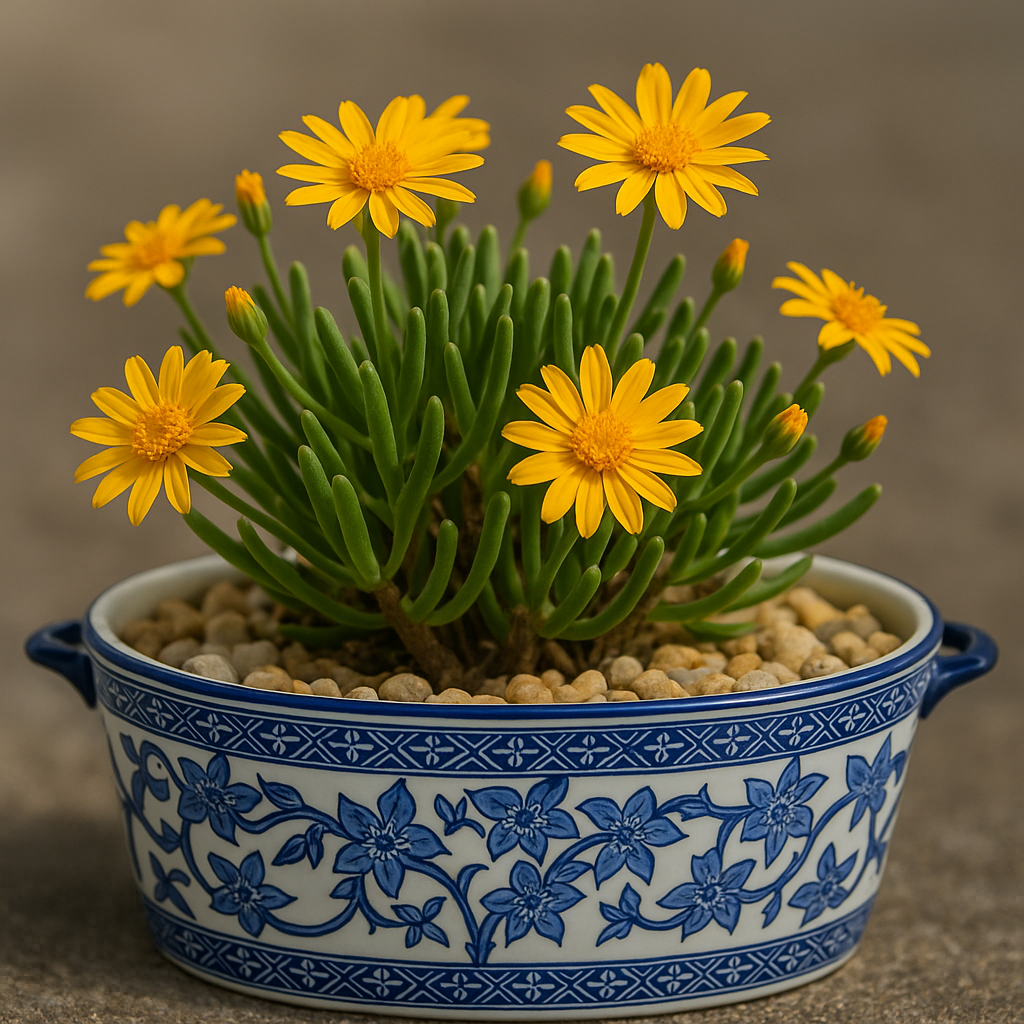
Crassothonna floribunda (Othonna floribunda) – 5 Seed Pack
R22,50
INTERNATIONAL CUSTOMERS: Please read our shipping terms and conditions here before placing your order: Shipping Terms and Conditions
25 in stock
Crassothonna is one of those quietly brilliant southern African succulent groups that hides in plain sight until it flowers. It sits in the daisy family (Asteraceae), and for a long time most of its members were lumped into the broader genus Othonna. In 2012, botanist Bertil Nordenstam split out the strongly succulent, terete-leaved species as a separate genus, Crassothonna, recognising a distinct lineage of about 13 species with a shared “fat-leafed” architecture built for drought.
These plants are mainly creatures of the winter-rainfall west and the Greater Cape Floristic Region, spilling into the Succulent Karoo and southern Namibia.
In habitat they tuck into rocky slopes, quartz fields, sandstone pavements and sandy pockets where water arrives in pulses and disappears fast. Their survival strategy is simple and elegant: plump, cylindrical to finger-like leaves and often woody, gnarled stems that store moisture and shrug off heat, wind and long dry spells.
What makes Crassothonna especially charming for collectors is the contrast between their understated, sculptural foliage and their cheerful, daisy-like blooms. Flowers are typically yellow or white (sometimes pink-tinged in certain taxa), carried on slender stalks above the foliage, often in the cooler months when the rest of the rockery is quiet.
For South African gardeners, they’re a natural fit for low-water pots, karoo-style plantings, and crisp mineral top-dressings that show off their clean lines.
Crassothonna floribunda
Crassothonna floribunda is the accepted name for a plant long known as Othonna floribunda, and it lives up to the “floribunda” tag when happy — a succulent shrublet that lifts its blooms above a sculptural, drought-adapted body.
It forms a branched perennial shrublet, usually about 40–60 cm tall, with fleshy leaves and a sturdy, arid-country constitution that makes it an easy fit for South African gardeners who enjoy true veld succulents.
In the wild, this species is part of the winter-rainfall flora of the west and far north-west, occurring in the Northern Cape and Western Cape and noted as being largely restricted to Namaqualand.
Expect it in rocky, open, sun-baked landscapes where soils are lean, drainage is instant, and moisture comes mainly in the cool season — which is why it performs best in mineral mixes and full sun in cultivation.
Flowering is a winter highlight: from mid-winter into early spring (about July to September), plants produce multiple daisy-like heads in warm tones, most often yellow to orange-yellow, carried on slender stems above the foliage.
The effect is cheerful and airy rather than bulky, and it pairs beautifully with quartz grit top-dressings, Namaqualand bulbs, or other small-scale Karoo succulents. For collectors and indigenous-plant lovers, C. floribunda offers that special mix of rugged habitat authenticity and bright seasonal reward — grown from seed, it’s a satisfying, characterful addition to any low-water collection.


