
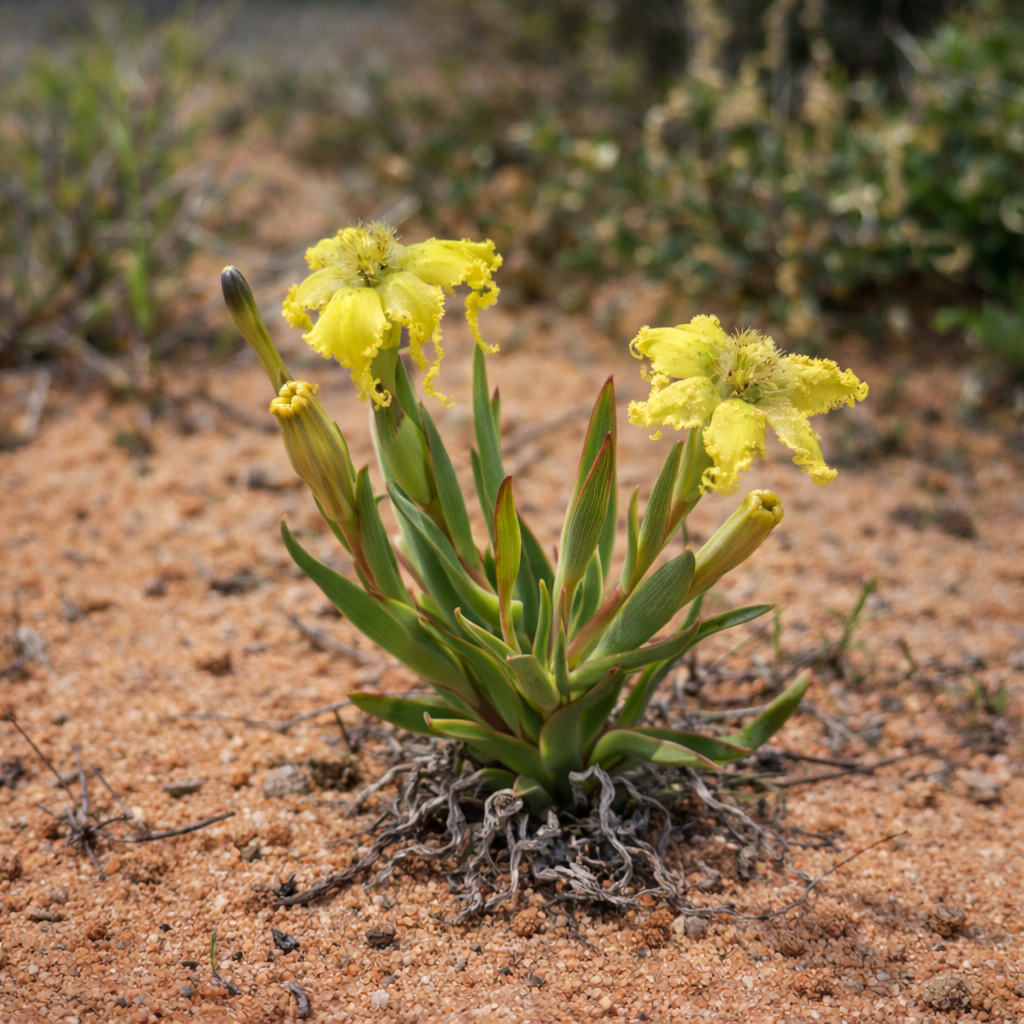
Ferraria macrochlamys subsp. serpentina – Sand Namaqua Spiderlily – 5 Seed Pack
R39,00
INTERNATIONAL CUSTOMERS: Please read our shipping terms and conditions here before placing your order: Shipping Terms and Conditions
12 in stock
The genus Ferraria is one of southern Africa’s most botanically distinctive groups of cormous irids: compact geophytes that retreat underground during the unfavourable season and re-emerge with rains, often flowering rapidly in short seasonal windows. In modern treatments, Ferraria is placed in the tribe Irideae and discussed alongside close African relatives such as Moraea, Dietes, and Bobartia – a lineage recognised for petaloid style branches and striking specialisation in floral form.
Two traits make Ferraria instantly recognisable among irids. First, the tepals typically have crisped or frilled (undulate) limb margins, producing the genus’ signature “ruffled” look. Second, the style divides into three flattened branches that are deeply forked and finely fringed, a combination explicitly highlighted as unique within Iridaceae by modern systematic work and echoed in regional floras.
Ferraria is native to a broad belt of Africa, but its centre of diversity lies in the winter-rainfall west and southwest, where most species occur in the seasonally cool, wet growing period and summer drought. A smaller subset (notably including F. glutinosa) occupies summer-rainfall or seasonally dry tropical regions farther north.
From a conservation standpoint, many Ferraria are geographically narrow endemics of specialised west-coast habitats (sandveld, strandveld, duneveld, quartz fields, granitic slopes).
Ferraria macrochlamys subsp. serpentina – Sand Namaqua Spiderlily
Subsp. serpentina is the most visually self-explanatory member of the macrochlamys trio: its name reflects the serpentine (loosely wavy, concertina-like) leaf blades, a rare and charismatic feature among Ferraria. For collectors, this subspecies offers a double reward: distinctive foliage architecture and the pale-yellow, crisp-edged flowers typical of the macrochlamys line. It is assessed as Least Concern nationally, reflecting a distribution that is local but not currently regarded as precarious.
Plants form rounded, clustered tufts with leaves in a loose fan, usually narrow and notably wavy without thickened margins. The flowers present a narrow, comparatively deep floral cup with pale yellow tepals; in systematic description, the outer tepal tips may be attenuate and even slightly twisted, giving the bloom a dynamic star-like profile. Flowering is recorded mainly from late August and September, occasionally into mid-October, aligned to the spring peak of Namaqualand bulb displays.
This subspecies is restricted to inland, low hills of southern Namaqualand where it grows in gritty soils – on stony slopes or in deep red quartzitic sands – making it naturally suited to cultivation in mineral substrates. For South African buyers, it excels in raised sandy beds or rockery pockets in winter-rainfall areas. For international growers, its leaf form alone justifies careful container culture: give it bright light, cool-season moisture, and a reliably dry summer rest to keep those distinctive wavy blades and crisp flower margins in top condition.


