
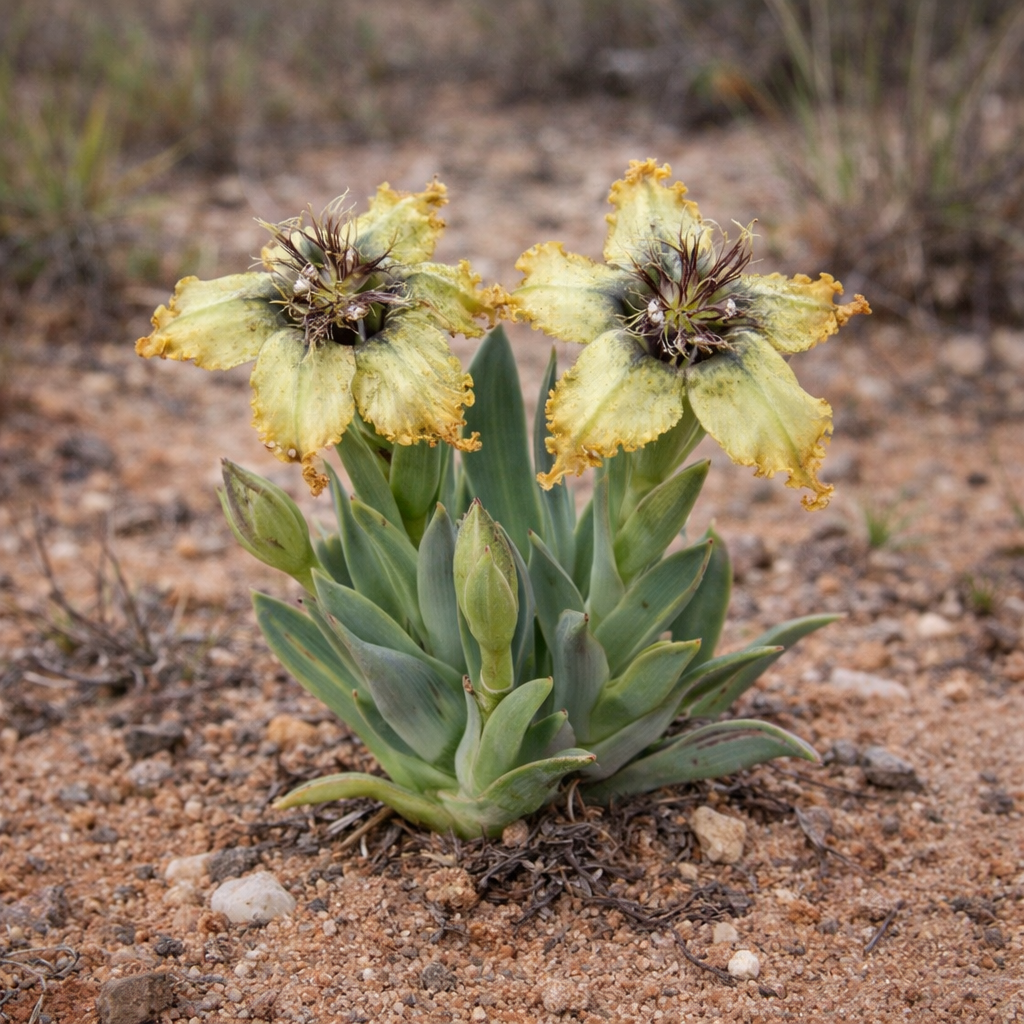
Ferraria ovata (Moraea ovata) – Lost Spiderlily – 5 Seed Pack
R55,00
INTERNATIONAL CUSTOMERS: Please read our shipping terms and conditions here before placing your order: Shipping Terms and Conditions
6 in stock
The genus Ferraria is one of southern Africa’s most botanically distinctive groups of cormous irids: compact geophytes that retreat underground during the unfavourable season and re-emerge with rains, often flowering rapidly in short seasonal windows. In modern treatments, Ferraria is placed in the tribe Irideae and discussed alongside close African relatives such as Moraea, Dietes, and Bobartia – a lineage recognised for petaloid style branches and striking specialisation in floral form.
Two traits make Ferraria instantly recognisable among irids. First, the tepals typically have crisped or frilled (undulate) limb margins, producing the genus’ signature “ruffled” look. Second, the style divides into three flattened branches that are deeply forked and finely fringed, a combination explicitly highlighted as unique within Iridaceae by modern systematic work and echoed in regional floras.
Ferraria is native to a broad belt of Africa, but its centre of diversity lies in the winter-rainfall west and southwest, where most species occur in the seasonally cool, wet growing period and summer drought. A smaller subset (notably including F. glutinosa) occupies summer-rainfall or seasonally dry tropical regions farther north.
From a conservation standpoint, many Ferraria are geographically narrow endemics of specialised west-coast habitats (sandveld, strandveld, duneveld, quartz fields, granitic slopes).
Ferraria ovata (Moraea ovata) – Lost Spiderlily
Ferraria ovata is one of the rarest and most historically intriguing Ferraria: originally described as Moraea ovata and only later recognised as a Ferraria after rediscovery, it remains a very rare plant in national assessment data, though not currently listed as threatened. For seed collectors, this is a high-value, slow-burn project – ideal for growers who appreciate both botanical history and understated floral complexity.
The flowers are described as pale yellow with brown spotting and a distinctly dark brown, closely crisped margin, producing a refined “rimmed” look around the tepal limbs. Systematic description notes an acrid scent and structural details consistent with Ferraria’s fringed style architecture, while habitat notes place it on granitic slopes and gravelly or clay-loam flats where rocks can protect corms. In cultivation, this translates to a plant that responds best to gritty, mineral soils and careful watering that avoids prolonged saturation around the corm.
Ferraria ovata is a winter-flowering species in the genus, with flowering time recorded as June to July – a prime window for collectors seeking off-season Ferraria colour. Its known range lies within Namaqualand–West Coast landscapes (national summaries list Northern Cape and Western Cape provinces and a narrow range), reinforcing its suitability for Mediterranean-cycle cultivation. Internationally, treat it as a cool-season geophyte: sow and grow in bright winter conditions, then hold dry in summer, ideally in containers where the corm can be protected from out-of-season rain.


