


Aloe pluridens – French Aloe – 5 Seed Pack
R7,50
INTERNATIONAL CUSTOMERS: Please read our shipping terms and conditions here before placing your order: Shipping Terms and Conditions
4 in stock
Aloes are very popular and some of the most rewarding plants to cultivate. They make excellent accent plants owing to their often strange and inspiring architectures, as well as the bright flowers that offset the grey-green leaves. They are also very suitable as container plants and small aloes can be used very effectively as border plants at the edge of a bed. Although aloes are most often included in rockeries, their application in horticulture is not limited to this feature and they can be used in almost any setting and in conjunction with most common garden plants. Their natural adaptation to harsh and often arid climates makes aloes outstanding subjects for the water-wise garden. Aloe is a genus in the Asphodeloideae family containing about 600 species of flowering succulent plants. Aloes are sometimes confused with Agaves. Contrarily to Agaves, Aloe leaves contain a gel like sap. Another difference is that Aloes don’t die after blooming as most Agaves do.
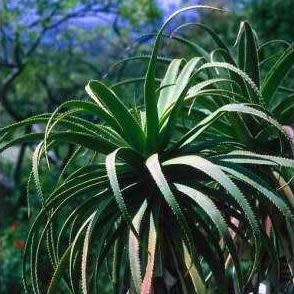
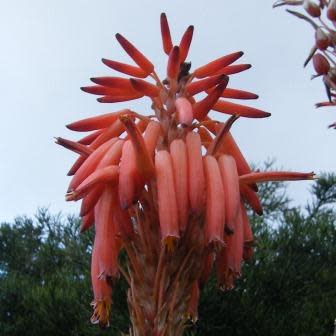
Aloe pluridens commonly known as French Aloe is an attractive plant which bears gracefully recurved leaves in large spiralled rosettes. It may be either single-stemmed or branched and occasionally bears numerous small plantlets on the otherwise smooth stems. This is a tall aloe, occasionally reaching up to 5-6m high. The leaves are bright green to yellowish-green and may be up to 70cm in length. The leaf margin is armed with firm white teeth. The leaf sap is clear with a strong, rhubarb-like smell. Inflorescences are branched and have up to 4 racemes protruding above the leaves. The flowers are usually orange or pinkish-red, but a yellow form is also known. Up to three inflorescences may be borne from each rosette. It flowers during winter attracting birds to the garden. The French aloe is relatively easy to grow and may be propagated by seed, cuttings or truncheons. It makes a spectacular garden subject. On the Highveld it should be planted in semi-shade and protected from severe frost. In its natural thicket environment, the surrounding bushes protect the stems from sun and cold.


