
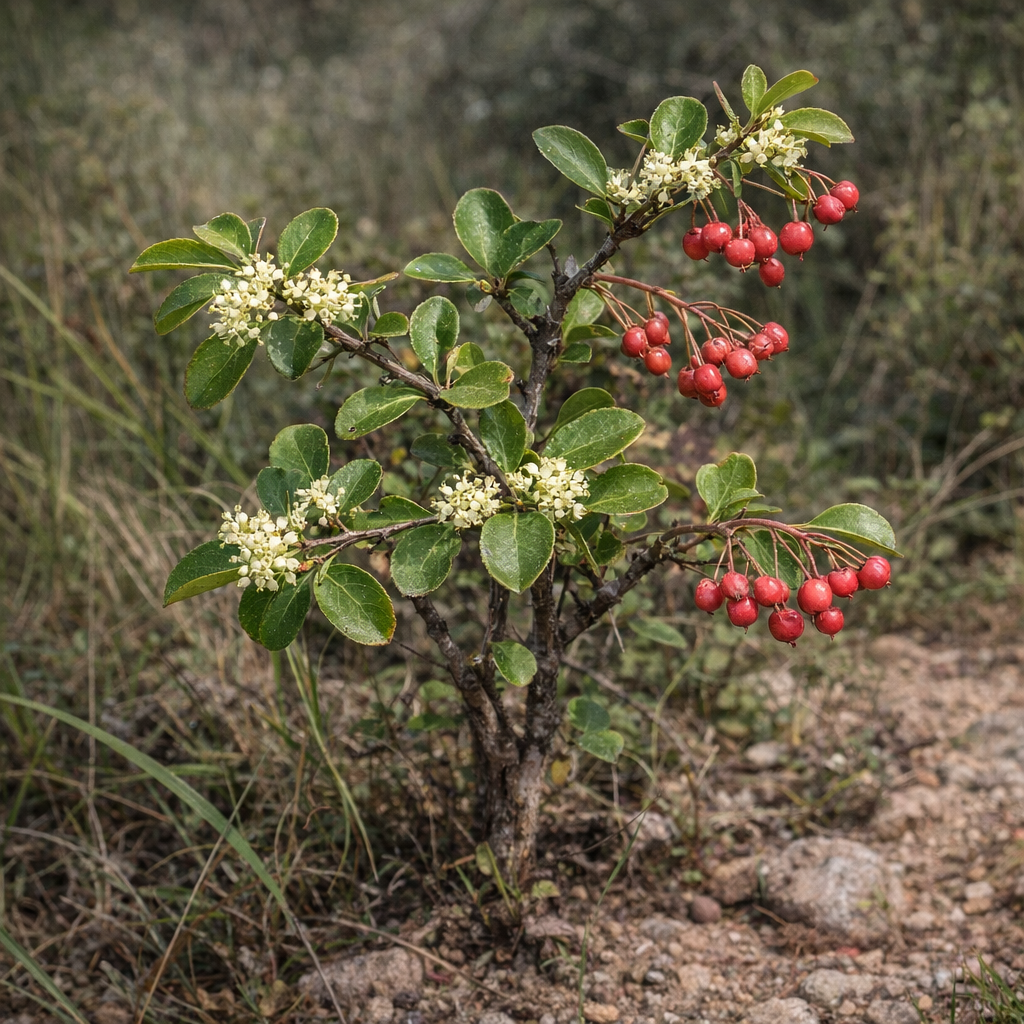
Gymnosporia markwardii (Maytenus heterophylla subsp. arenaria) – Maputaland Spike-Thorn – 5 Seed Pack
R25,00
INTERNATIONAL CUSTOMERS: Please read our shipping terms and conditions here before placing your order: Shipping Terms and Conditions
6 in stock
Gymnosporia is a distinctive genus of spiny shrubs and small trees in the staff-tree family (Celastraceae), best known in southern African landscapes for its “spike-thorn” look: tough, often interlacing branches armed with sharp thorns and dotted with small, glossy leaves. Across its range, members of the genus commonly mature into dense, resilient thickets or sculptural shrubs – plants that look built for browsing pressure, wind exposure, and lean soils.
The genus name is often explained through the way the fruit opens: the capsule splits and the seeds are revealed (often with a fleshy aril), appearing “naked” or exposed at maturity – an image captured in South African interpretive notes for the genus.
In South Africa, Gymnosporia species occupy an extraordinary spread of habitats – from forest margins and shaded ravines (in some taxa) to dry thornveld, rocky hillsides, and coastal dune systems (in others). Internationally, the genus extends broadly through Old World tropical and subtropical regions to parts of the South Pacific, with many species localized to particular landscapes, substrates, and rainfall regimes.
Gymnosporia species are typically shrubs or small trees; branches are often thorny, with leaves arranged alternately or clustered on short shoots (brachyblasts) that can give a tufted, rosette-like look along spiny branchlets. Leaves range from entire to serrate, and foliage may be glabrous or hairy depending on the species.
Flowers are usually small and produced in axillary clusters (commonly a cymose arrangement). Many species bear unisexual flowers (plants functionally male or female), and flowers are frequently described as cream, greenish-white, or pale yellowish – subtle at a distance but often fragrant and insect-attractive up close.
The fruit is characteristically a capsule that can be globose to angular; at maturity it splits open to expose seeds that are often partially covered by a fleshy aril (aril colour and degree of coverage vary among lineages and are taxonomically informative). In the field, the “open capsule + arillate seed” stage is one of the fastest recognition cues for many Gymnosporia, especially when combined with hard spines and clustered leaves.
Ecologically, Gymnosporia shrubs and small trees contribute structural complexity in thicket and woodland systems. Their spines can deter large herbivores and provide refuge for small animals and birds, while the open capsules and arillate seeds are a conspicuous seasonal resource that can draw wildlife into otherwise dry landscapes.
Horticulturally, South African growers value Gymnosporia for durability and architecture: several species can be pruned into dense, defensive hedges, and at least some are well regarded for drought and cold hardiness in appropriate climates. Where growth form, spines, and fruit display are desirable (security planting, wildlife gardens, restoration edges), Gymnosporia can be a high-impact indigenous option – provided the right species is matched to local rainfall pattern and soil drainage.
For an international seed market, Gymnosporia also has “collector value”: many species are geographically restricted or habitat-specific, making them appealing to botanical gardens, restoration practitioners, and specialist growers.
Gymnosporia markwardii (Maytenus heterophylla subsp. arenaria) – Maputaland Spike-Thorn
Gymnosporia markwardii is a South African indigenous species found in the KwaZulu-Natal Province, extending to Mozambique, placing it firmly in the Maputaland–coastal plain biogeographic arena.
Expect a shrub or subshrub with thorny branching and the genus-typical capsule + arillate seed system. In practical terms, this means ripe fruit collection typically occurs around the point of capsule splitting, when seeds become visible and can be removed and cleaned for sowing.
For South African buyers, this is a provenance-rich option for subtropical gardens and restoration edges. Internationally, it should be offered as a warm-climate shrub best trialled in frost-free conditions, with attention to drainage and seasonal watering that mimics a subtropical rainfall rhythm.
All orders will receive a discount coupon to be redeemed on your next purchase.
Seeds you may also like
Related Seed Products
Related products
-

Albuca flaccida – 5 Seed Pack
R21,25 -

Albuca maxima – Soldier-in-a-box, Geldbeursie, Wit Tamarak – 5 Seed Pack
R14,25 -

Albuca namaquensis – Corkscrew Albuca – 5 Seed Pack
R25,00 -

Acorus calamus – Sweet Flag Grass, Single-vein Sweetflag, Calamus – 10 Seed Pack
R15,00 -

Albuca kirstenii – 5 Seed Pack
R23,75
