
Habenaria leptoceras – 10+ Seed Pack
R31,15
INTERNATIONAL CUSTOMERS: Please read our shipping terms and conditions here before placing your order: Shipping Terms and Conditions
8 in stock
The genus Habenaria belongs to the orchid family, Orchidaceae, and represents one of the great terrestrial orchid lineages of the world. These fascinating plants occur across an enormous geographical range, from tropical and subtropical regions of Africa, Asia, the Americas and the Pacific to temperate parts of eastern Asia and southern Siberia. The genus is also well represented in southern Africa, with native species occurring in South Africa in habitats ranging from open grassland and rocky hillsides to marshes, woodland and forest.
Most Habenaria are perennial terrestrial orchids that disappear completely underground during their dormant period. They survive unfavourable seasons by means of fleshy roots or underground tubers, before emerging again when temperature and moisture conditions are suitable. The new growth may consist of anything from a compact rosette of leaves lying close to the soil to a tall, leafy stem carrying an impressive terminal flower spike. This seasonal transformation, from an apparently empty patch of ground to an intricately flowering orchid, is part of their considerable appeal.
The flowers are where Habenaria becomes truly extraordinary. Green and white predominate throughout the genus, but yellow, cream, pink, orange and reddish flowers also occur. Many species possess a deeply divided or three-lobed lip together with a conspicuous nectar-bearing spur. The petals, sepals, lip, column and projecting reproductive structures can combine to create remarkably elaborate flowers, sometimes giving them a delicate, spider-like, fringed or almost otherworldly appearance.
Those unusual floral structures are not merely ornamental. In many Habenaria, long nectar spurs, floral scent and the precise arrangement of the reproductive organs form highly specialised relationships with their pollinators. Hawkmoths and other nocturnal moths pollinate numerous green- and white-flowered species, while some brightly coloured species are visited by butterflies. Research has even demonstrated that differences in spur length and floral architecture can determine exactly where the orchid’s pollinia are attached to the head, eyes, palps or other parts of a visiting insect.
Their ecological diversity is equally impressive. South African species alone can be encountered in well-drained Highveld grasslands, rocky bushveld, coastal and montane forests, riverine woodland and marshy grassland. This diversity means that Habenaria should never be treated as though every species requires identical cultivation. Understanding the habitat and seasonal growth cycle of the particular species is one of the keys to success.
For orchid enthusiasts, specialist collectors and adventurous seed growers, Habenaria offers an irresistible combination of rarity, botanical complexity and extraordinary floral form.
Habenaria leptoceras
Habenaria leptoceras is an unusual Brazilian terrestrial orchid with an architectural, distinctly exotic appearance that makes it particularly appealing to orchid enthusiasts, collectors of geophytic plants and growers who enjoy raising uncommon species from seed. Endemic to Brazil, it is associated especially with the Atlantic Forest region and is recorded from Bahia through southeastern and southern states including Espírito Santo, Minas Gerais, Rio de Janeiro, São Paulo, Paraná and Santa Catarina. It occurs in habitats ranging from seasonally dry tropical vegetation and coastal restinga environments to grassy or scrubby montane sites, with some populations occurring at considerable elevation.
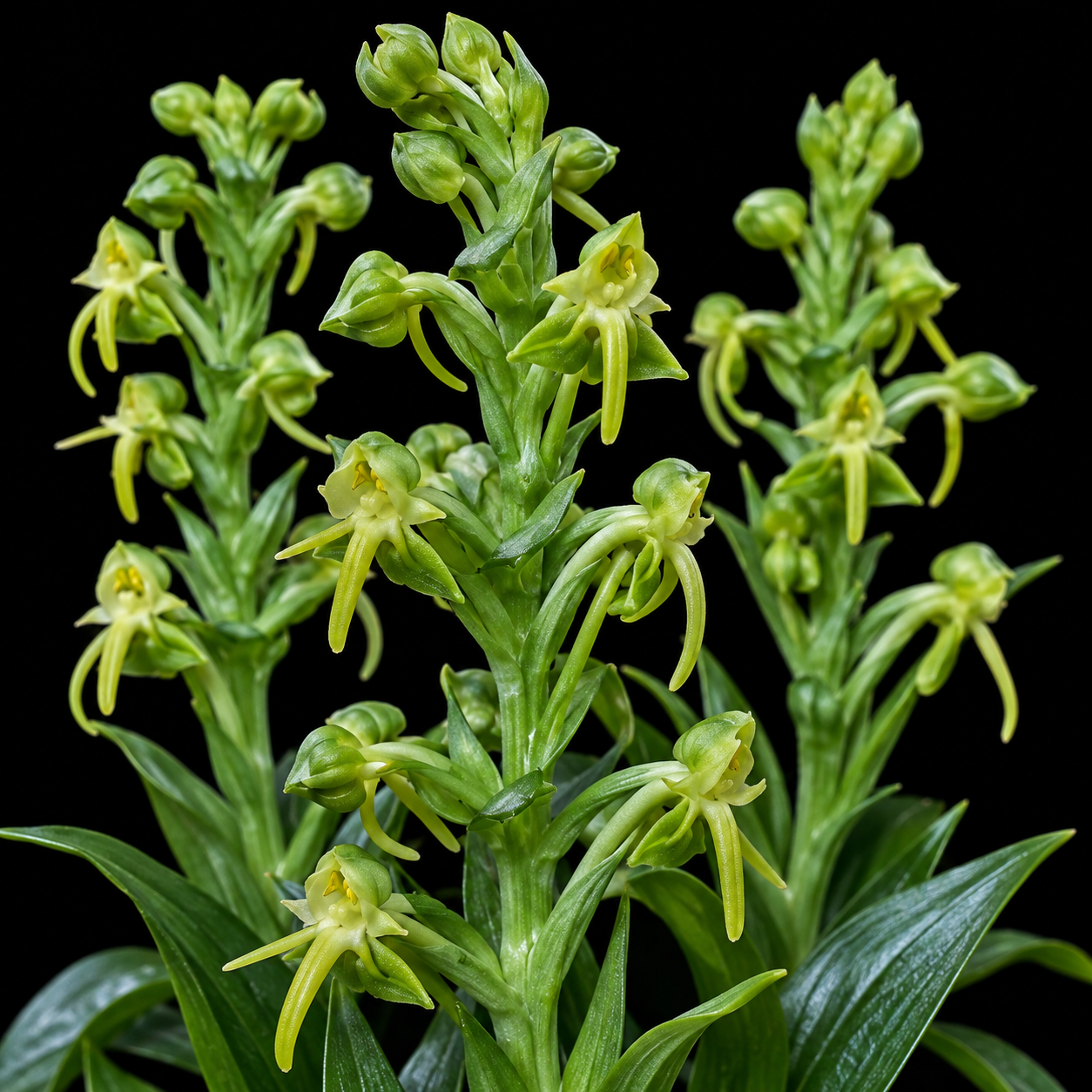
During active growth, Habenaria leptoceras develops sturdy upright green stems clothed with erect, lance-shaped, stem-clasping leaves. The flowering portion forms an elongated, many-flowered raceme, often carrying an impressive succession of buds and open blooms. Each flower is a fascinating combination of pale green, yellow-green and fresh chartreuse tones, with the narrow floral segments projecting outward and downward around a hooded central structure. The characteristic slender spur is especially distinctive and contributes to the intricate, almost sculptural appearance of the flowers. Historical botanical descriptions likewise record greenish flowers with yellowish to yellow-green inner floral parts and a long, slender spur.
Flowering takes place principally during the Brazilian autumn, with herbarium and field records documenting flowering plants particularly during April and May. In habitat, the tall green inflorescences can blend remarkably well into surrounding vegetation until the intricately formed flowers are viewed at close range. This combination of understated colouring and highly specialised floral architecture gives Habenaria leptoceras a character quite unlike the brightly coloured tropical orchids more commonly encountered in cultivation.
For South African growers, specialist terrestrial-orchid collections and international enthusiasts seeking something genuinely different, Habenaria leptoceras seed offers the opportunity to cultivate a seldom-seen Brazilian species with beautiful botanical detail and collector appeal. Visit our online seed store and explore our expansive and diverse selection of unusual species from around the world. Add to Cart or Buy Now to secure Habenaria leptoceras for your collection, and remember that Seeds and All offers combined South African and International shipping.


