
Helichrysum vernum – 5 Seed Pack
R21,25
INTERNATIONAL CUSTOMERS: Please read our shipping terms and conditions here before placing your order: Shipping Terms and Conditions
10 in stock
There’s a reason Helichrysum has earned names like “everlasting,” “strawflower,” and “golden immortelle.” Across Africa, Eurasia, Madagascar, and even parts of Australia, this remarkable genus has adapted into an astonishing range of forms – from compact alpine cushions on windswept peaks to sprawling coastal pioneers on dunes, and tall, aromatic shrubs rising through savanna grassland. Many species seem almost sculpted for harshness: felted leaves that reflect heat, resinous scent glands that reduce water loss, and papery bracts that hold their colour long after flowering.
In southern Africa especially, Helichrysum becomes a signature of wild landscapes. Some species carpet high Drakensberg slopes like silver mats; others form tidy, upright tufts in montane grassland; and some are so specialised that they cling to cliff faces or root into shallow pockets of stony soil. The flowers, often arranged in tight button-clusters or open daisy-like heads, glow in tones of yellow, cream, white, pink, copper, red, and rose – and in many species the “petals” are actually brilliantly coloured bracts that preserve their beauty even when dried.
Beyond their ornamental appeal, Helichrysum carries deep cultural importance. Many species are traditionally used for fragrance, medicinal preparations, ceremonial burning, and as protective plants. For modern growers, they offer the irresistible combination of wild provenance, drought resilience, and striking textures – a true collector’s genus, equally suited to naturalistic gardens, rockeries, alpine troughs and habitat restoration planting.
Helichrysum vernum
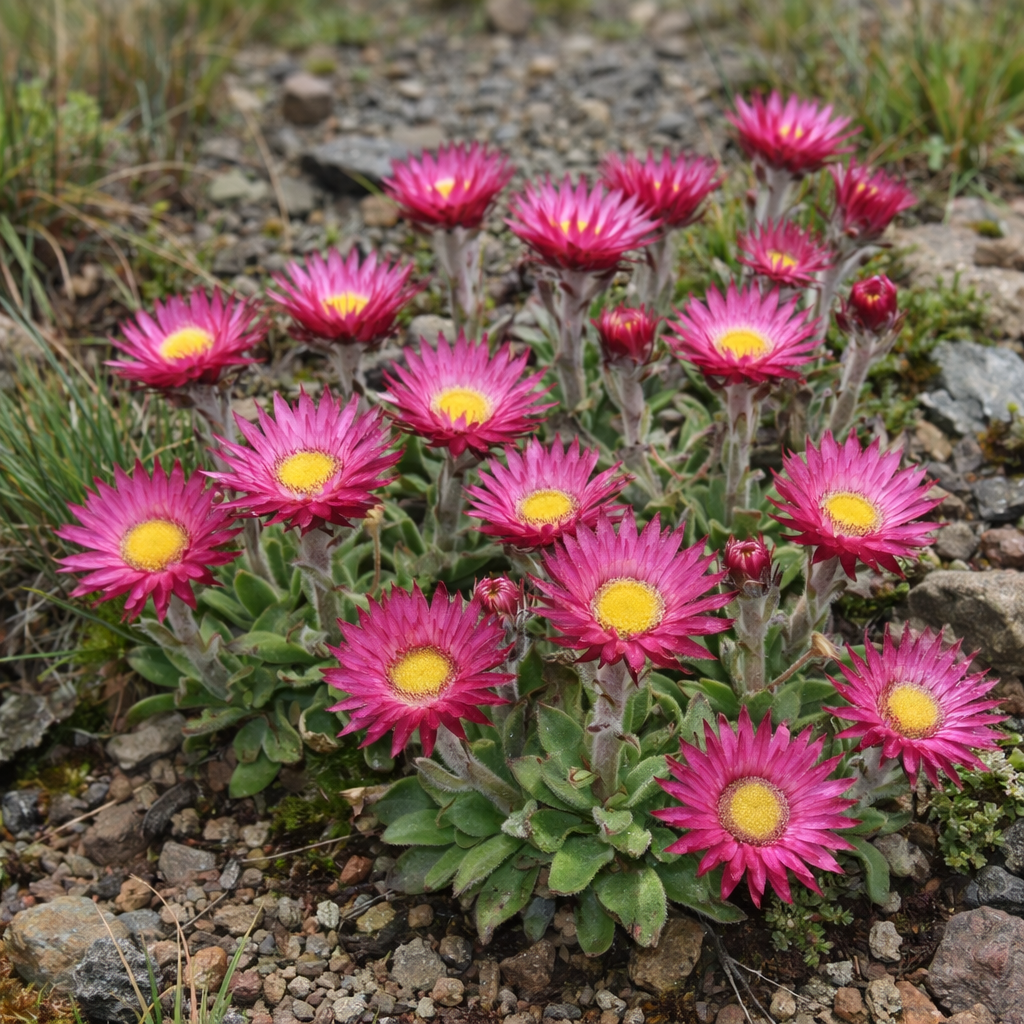
For alpine-style planting and high-altitude collectors, Helichrysum vernum is a showpiece: tight, compact mats studded with large, solitary heads whose bracts shine in rich rose-pink to near-crimson. It’s one of those “small plant, big impact” species that reads beautifully in troughs, rock gardens, and cool grassy borders.
This is a mat-forming perennial with crowded rosettes arising from a woody underground stem. The heads are large and solitary, with glossy rose-pink to crimson bracts, and it’s noted as one of the first plants to flower in spring, typically September to November.
Indigenous to South Africa, in the wild it forms compact mats in stony turf on mountain slopes along the KwaZulu-Natal Drakensberg and its outliers into Lesotho, at roughly 1,675–2,560 m. Give it sun, cool airflow, and excellent drainage; and if you enjoy everlasting crafts, the bracts’ papery nature makes them naturally suited to drying and decorative use.


