
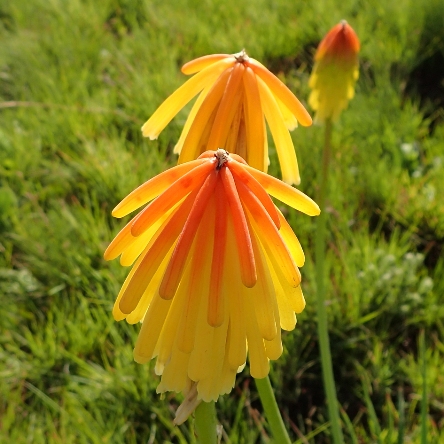
Kniphofia porphyrantha – Dwarf Red-hot Poker, Highveld Red-hot Poker; Hoëveld Vuurpyl – 5 Seed Pack
R25,00
INTERNATIONAL CUSTOMERS: Please read our shipping terms and conditions here before placing your order: Shipping Terms and Conditions
Out of stock
Email when stock available
Kniphofia (Red hot poker, Torch lily, Poker plant) is a genus of plants in the family Asphodelaceae that includes 70 or more species native to Africa. Some species have been commercially used for horticultural use and are commonly known for their bright, rocket-shaped flowers. These plants produce spikes of brightly-coloured, hanging, red-to-orange flowers. This gives names such as “torch” and “red hot poker” to many of them.
Kniphofia porphyrantha, commonly known as a small red-hot poker, is an evergreen, fast-growing perennial that thrives in highveld gardens. It features numerous flowering stems, with upright leaves that gradually become reflexed, and stunning bi-colored flowerheads in shades of orange-red and yellow during early summer. This hardy plant typically grows in clumps, reaching a height of 400-600 mm. The leaves are yellow-green, measuring 300-450 mm long and 6-14 mm wide, initially upright before bending back, with smooth margins and a distinct keel. The inner leaves are shorter and narrower than the outer ones.
The flowerhead is globose to slightly cylindrical, measuring 40-80 mm long and 50 mm wide. Its tubular flowers, ranging from 30-42 mm long, display a fiery red to orange hue with yellow or lemon-yellow tips. Blooms appear from late spring to early summer (October to December), sometimes lasting into midsummer (January to February).
One of only three Kniphofia species found in Gauteng, this plant attracts sugarbirds, sunbirds, honeybees, butterflies, and other pollinators that feed on its nectar and pollen. Its striking flowers add a tropical flair and vibrant color to gardens, making them highly ornamental. Cut flowers are also suitable for indoor decoration in vases.
In traditional medicine, plants from the Kniphofia genus are used for treating female infertility, malaria, hepatitis B, cancer, and as blood purifiers. To propagate, divide the clump into smaller sections or individual plants, cutting the leaves back to just a few centimeters and separating the roots with a garden fork. This process is easy to do, and roots can be shortened with secateurs. Replant the divisions immediately to prevent the roots from drying out, or cover them with damp material.
Seeds should be sown from spring to autumn, germinating in about six weeks. Plant seedlings in the ground when they are five to six months old, and they will start flowering in two to three years. Note that Kniphofia porphyrantha should not be divided or transplanted frequently, as it takes about a year to settle and may not flower well during that time.
For optimal growth, plant in a sunny location with plenty of water during the growing season, ensuring healthy blooms. This species flourishes in compost-rich soil with mulch to help retain moisture. Kniphofia porphyrantha is a tough, hardy plant that is easy to grow.


