

Kalanchoe thyrsiflora – Paddle Plant, Flapjacks – 20 Seed Pack
R24,00
INTERNATIONAL CUSTOMERS: Please read our shipping terms and conditions here before placing your order: Shipping Terms and Conditions
21 in stock
Kalanchoe also written Kalanchöe or Kalanchoë, is a genus of about 125 species of tropical, succulent flowering plants in the Family Crassulaceae.
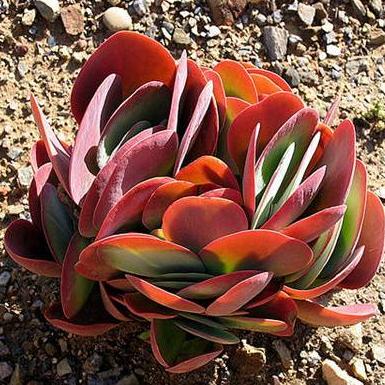
The Afrikaans name, meelplakkie, is most appropriate for this plant as it does indeed look as if the whole plant has been liberally dusted with flour. Other common names include, Paddle Plant, Flapjacks, Desert Cabbage, White Lady, Geelplakkie and Plakkie. Being a succulent perennial, it does not require much attention in sunny dry gardens. These plants are ideal for sunny areas and being perennials, they can be used as semi-permanent features in beds of annuals or bedding plants. Like most of the southern African Kalanchoe species, Kalanchoe thyrsiflora forms a basal rosette of large rounded, fleshy leaves, which are greyish cream with red margins. Plants reach about 60 cm; the erect, upward facing, tightly arranged leaves are without petioles. Kalanchoe thyrsiflora occurs from the central to the southern escarpment and foothills in bushveld habitats. The plants have a preference for open rocky situations or exposed hilltops. In its natural habitat, plants are sometimes exposed to harsh temperatures and have adapted to survive over many years. Besides succulence, the plants always erectly point their leaves upward toward the sun in order to minimise the surface area that is exposed to the sun. This helps the plant to conserve moisture even more. Another clever technique to stay cool is by employing a pale leaf colour. The white floury coating on the leaves and inflorescence helps to reflect the sun away thus keeping the plant cool. Ants, bees and other flying insects, which visit the flower at midday, are responsible for pollinating Kalenchoe. Apart from being used by the Sothos in South Africa as a charm to ease difficulties, no other cultural or traditional uses have been recorded. Horticulturally the plants are very popular in rock gardens, on rocky embankments, and as perennial container plants. They make beautiful displays when planted in mass and their red leaf margins are particularly attractive. Remember that these plants are from rocky areas and prefer a similar garden habitat with plenty of direct sunlight in order to thrive.


