
Parodia fraileoides – 5 Seed Pack
R15,00
INTERNATIONAL CUSTOMERS: Please read our shipping terms and conditions here before placing your order: Shipping Terms and Conditions
5 in stock
The genus Parodia belongs to the cactus family, Cactaceae, and is one of South America’s most rewarding groups of small to medium-sized cacti. At first glance, many species have the classic rounded cactus form, but closer inspection reveals an extraordinary range of characters: perfectly geometric ribs, spiralling tubercles, dense woolly crowns, delicate bristles, hooked central spines, golden armament and, perhaps most memorably, disproportionately large and brilliantly coloured flowers. Modern botanical treatments recognise Parodia as an accepted genus, although exactly how broadly it should be circumscribed continues to attract scientific discussion.
Parodia was established by the Italian-Argentine botanist Carlos Luis Spegazzini in 1923. The name honours Domingo Parodi, an important early investigator of the flora of Paraguay. Its taxonomic story is especially fascinating because numerous plants once familiar to cactus collectors under such genera as Notocactus, Eriocactus, Wigginsia, Brasilicactus and Brasiliparodia have subsequently been incorporated into a broadly defined Parodia. Recent botanical research continues to examine whether all of these groups are best maintained within a single genus, making Parodia a living example of how plant taxonomy evolves as new anatomical and molecular evidence becomes available.
The genus is centred on two particularly important South American regions. One lies along the eastern side of the Andes, particularly in Bolivia and north-western Argentina, where species occupy dry valleys, rocky slopes and upland environments. The second encompasses the grasslands and rocky landscapes of southern Brazil, Uruguay, north-eastern Argentina and eastern Paraguay. The current Kew treatment gives the broader native range as extending from Colombia and Bolivia through southern Brazil and southern South America.
This broad geographical range has produced considerable diversity. Some Parodia remain miniature, almost button-like plants nestled close to the ground, while others eventually develop sizeable globose or cylindrical stems. Species may be solitary or form groups through basal offsets. Stems can carry straight ribs, spiralling ribs or pronounced tubercles, while their areoles may produce everything from short, neat radial spines to long, hair-like, colourful or strongly hooked spines. Recent botanical descriptions emphasise just how variable spine colour, shape and texture can be across the genus.
Then come the flowers. Many Parodia produce an impressive crown of blooms near the stem apex, often appearing remarkably large in relation to the plant itself. Yellow is particularly prominent among many of the species historically associated with Notocactus, but the genus as a whole offers an enticing palette that includes golden yellow, lemon, orange, scarlet, blood-red, pink, magenta and shades approaching violet. Funnel- to bell-shaped flowers, prominent stamens and frequently contrasting stigma lobes give flowering plants exceptional ornamental appeal.
For seed growers, Parodia has another attraction: a surprisingly substantial plant can develop from an almost dust-like seed. Raising them from seed allows collectors to observe natural variation in spine density, body form and eventually flower colour while building collections of species that may be difficult to obtain as established plants. Some species are also threatened in nature, reinforcing the value of responsibly produced, nursery-propagated material rather than wild-collected plants.
Parodia fraileoides
Parodia fraileoides is an exceptionally intriguing and still relatively little-known Bolivian cactus, formally described as a species only in 2023. Belonging to the Cactaceae family, it originates from the high Andes of southern Bolivia, with the type locality in Méndez Province, Department of Tarija, at approximately 3,360 metres above sea level. Here it occupies remarkably austere, almost barren terrain scattered with sandstone pebbles, where wild plants can sit so deeply embedded that their crowns remain almost level with the surrounding ground during the dry season. Its remote high-altitude origin, miniature stature and comparatively recent recognition make this a particularly exciting species for serious Parodia collectors and growers seeking something genuinely uncommon.
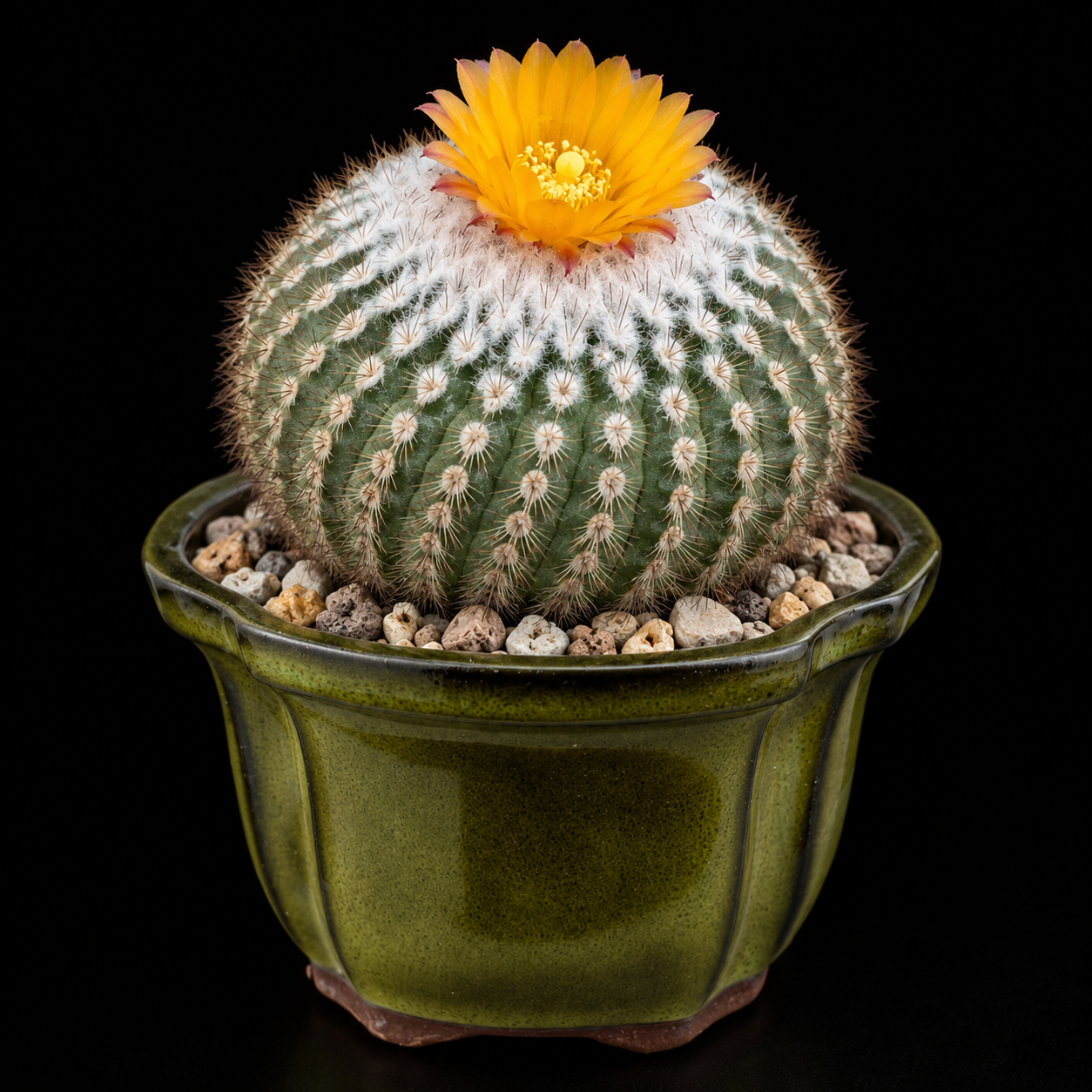
In habitat, Parodia fraileoides is an extraordinarily compact cactus, usually only about 2–6 cm across, with a bluish-green to dark green body divided into strongly tuberculate ribs. Small closely spaced areoles carry numerous fine, pale cream to whitish radial spines together with similarly slender central spines, producing a delicate cobweb-like armour rather than the heavy spination found in many larger Parodia. Under cultivation the plant can gradually become taller and more rounded, eventually reaching approximately 7–8 cm in height while developing copious soft white wool around its sunken crown. This dense wool contrasts beautifully with the darker green body and fine straw-coloured spination, giving established plants a distinctive soft-textured appearance.
Flowering is a spectacular event for such a compact cactus. The blooms emerge directly from the woolly crown and open in glowing yellow-orange to rich golden-orange shades, with the outer tepals frequently carrying warm orange-red or reddish tips. A dense centre of yellow pollen and pale floral structures adds brightness to the flowers, which can appear remarkably large in proportion to the body beneath them. Established cultivated plants are capable of flowering freely throughout the warmer season. In its native Southern Hemisphere range, flowering occurs principally during late spring and summer; the type material itself was collected in flower on 19 November, firmly placing flowering activity within the beginning of the high-Andean summer growing period.
For South African growers, Parodia fraileoides offers a fascinating opportunity to cultivate a true high-altitude Bolivian miniature whose Southern Hemisphere seasonal rhythm corresponds naturally with our own. Its native environment suggests a preference for exceptional drainage, bright light, excellent airflow and pronounced cooling at night. A predominantly mineral cactus mixture containing suitable grit, pumice, coarse sand or similar free-draining material is ideal, with careful watering during active growth and a considerably drier regime during winter. International growers can cultivate it successfully in greenhouses, cactus houses, alpine-style succulent collections or bright protected positions, taking particular care to avoid stagnant moisture around its naturally sunken crown.
For enthusiasts of miniature cacti, newly described species, high-Andean plants and unusual members of the Parodia subterranea alliance, Parodia fraileoides is a seed offering with tremendous collector appeal. Its transformation from a tiny seedling into a compact, woolly-crowned specimen topped with glowing orange-yellow flowers makes growing it from seed especially rewarding. Check out our online seed store and explore our sought-after and diverse selection of cactus, succulent and rare botanical seeds from around the world. Buy Now or Add to Cart and combine Parodia fraileoides with other exceptional South American species to build a truly distinctive collection. Seeds and All offers offers combined South African and International shipping, making it easy for growers, gardeners, collectors and hobbyists locally and worldwide to combine multiple seed varieties into one convenient order.


