
Parodia roseolutea – 10+ Seed Pack
R19,00
INTERNATIONAL CUSTOMERS: Please read our shipping terms and conditions here before placing your order: Shipping Terms and Conditions
18 in stock
The genus Parodia belongs to the cactus family, Cactaceae, and is one of South America’s most rewarding groups of small to medium-sized cacti. At first glance, many species have the classic rounded cactus form, but closer inspection reveals an extraordinary range of characters: perfectly geometric ribs, spiralling tubercles, dense woolly crowns, delicate bristles, hooked central spines, golden armament and, perhaps most memorably, disproportionately large and brilliantly coloured flowers. Modern botanical treatments recognise Parodia as an accepted genus, although exactly how broadly it should be circumscribed continues to attract scientific discussion.
Parodia was established by the Italian-Argentine botanist Carlos Luis Spegazzini in 1923. The name honours Domingo Parodi, an important early investigator of the flora of Paraguay. Its taxonomic story is especially fascinating because numerous plants once familiar to cactus collectors under such genera as Notocactus, Eriocactus, Wigginsia, Brasilicactus and Brasiliparodia have subsequently been incorporated into a broadly defined Parodia. Recent botanical research continues to examine whether all of these groups are best maintained within a single genus, making Parodia a living example of how plant taxonomy evolves as new anatomical and molecular evidence becomes available.
The genus is centred on two particularly important South American regions. One lies along the eastern side of the Andes, particularly in Bolivia and north-western Argentina, where species occupy dry valleys, rocky slopes and upland environments. The second encompasses the grasslands and rocky landscapes of southern Brazil, Uruguay, north-eastern Argentina and eastern Paraguay. The current Kew treatment gives the broader native range as extending from Colombia and Bolivia through southern Brazil and southern South America.
This broad geographical range has produced considerable diversity. Some Parodia remain miniature, almost button-like plants nestled close to the ground, while others eventually develop sizeable globose or cylindrical stems. Species may be solitary or form groups through basal offsets. Stems can carry straight ribs, spiralling ribs or pronounced tubercles, while their areoles may produce everything from short, neat radial spines to long, hair-like, colourful or strongly hooked spines. Recent botanical descriptions emphasise just how variable spine colour, shape and texture can be across the genus.
Then come the flowers. Many Parodia produce an impressive crown of blooms near the stem apex, often appearing remarkably large in relation to the plant itself. Yellow is particularly prominent among many of the species historically associated with Notocactus, but the genus as a whole offers an enticing palette that includes golden yellow, lemon, orange, scarlet, blood-red, pink, magenta and shades approaching violet. Funnel- to bell-shaped flowers, prominent stamens and frequently contrasting stigma lobes give flowering plants exceptional ornamental appeal.
For seed growers, Parodia has another attraction: a surprisingly substantial plant can develop from an almost dust-like seed. Raising them from seed allows collectors to observe natural variation in spine density, body form and eventually flower colour while building collections of species that may be difficult to obtain as established plants. Some species are also threatened in nature, reinforcing the value of responsibly produced, nursery-propagated material rather than wild-collected plants.
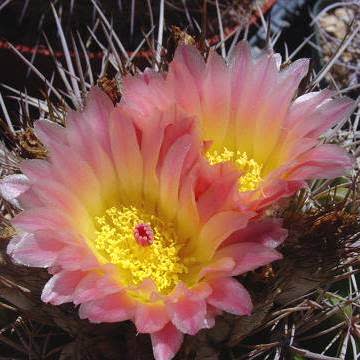
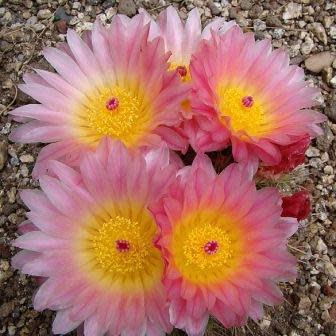
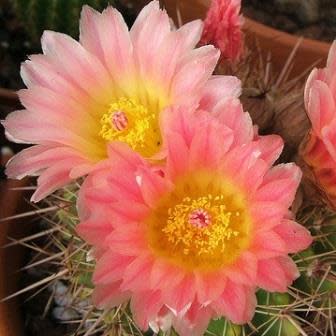
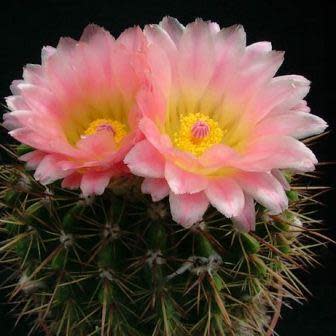
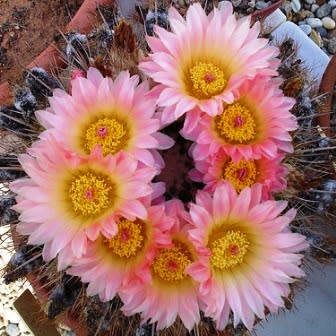
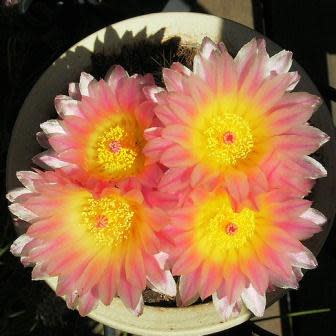
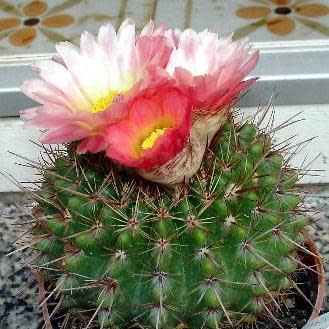
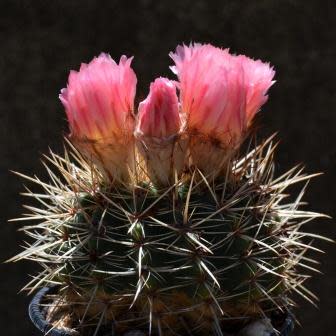
Parodia roseolutea is a solitary globular cactus from southern South America. Parodia roseolutea grows up to 25cm in circumference and is nicely spined. It produces magnificent 7.5cm flowers in late spring. They are red to pink with a yellow throat. This plant seems to incorporate some of the features of both Parodia herteri and Parodia mammulosa. Both flower colour and spination seem to be midway between the two species. The plant can ultimately reach the size of Parodia herteri but it flowers at a much smaller size and withstands some winter coldness.


