
Parodia stockingeri – 5 Seed Pack
R15,00
INTERNATIONAL CUSTOMERS: Please read our shipping terms and conditions here before placing your order: Shipping Terms and Conditions
5 in stock
The genus Parodia belongs to the cactus family, Cactaceae, and is one of South America’s most rewarding groups of small to medium-sized cacti. At first glance, many species have the classic rounded cactus form, but closer inspection reveals an extraordinary range of characters: perfectly geometric ribs, spiralling tubercles, dense woolly crowns, delicate bristles, hooked central spines, golden armament and, perhaps most memorably, disproportionately large and brilliantly coloured flowers. Modern botanical treatments recognise Parodia as an accepted genus, although exactly how broadly it should be circumscribed continues to attract scientific discussion.
Parodia was established by the Italian-Argentine botanist Carlos Luis Spegazzini in 1923. The name honours Domingo Parodi, an important early investigator of the flora of Paraguay. Its taxonomic story is especially fascinating because numerous plants once familiar to cactus collectors under such genera as Notocactus, Eriocactus, Wigginsia, Brasilicactus and Brasiliparodia have subsequently been incorporated into a broadly defined Parodia. Recent botanical research continues to examine whether all of these groups are best maintained within a single genus, making Parodia a living example of how plant taxonomy evolves as new anatomical and molecular evidence becomes available.
The genus is centred on two particularly important South American regions. One lies along the eastern side of the Andes, particularly in Bolivia and north-western Argentina, where species occupy dry valleys, rocky slopes and upland environments. The second encompasses the grasslands and rocky landscapes of southern Brazil, Uruguay, north-eastern Argentina and eastern Paraguay. The current Kew treatment gives the broader native range as extending from Colombia and Bolivia through southern Brazil and southern South America.
This broad geographical range has produced considerable diversity. Some Parodia remain miniature, almost button-like plants nestled close to the ground, while others eventually develop sizeable globose or cylindrical stems. Species may be solitary or form groups through basal offsets. Stems can carry straight ribs, spiralling ribs or pronounced tubercles, while their areoles may produce everything from short, neat radial spines to long, hair-like, colourful or strongly hooked spines. Recent botanical descriptions emphasise just how variable spine colour, shape and texture can be across the genus.
Then come the flowers. Many Parodia produce an impressive crown of blooms near the stem apex, often appearing remarkably large in relation to the plant itself. Yellow is particularly prominent among many of the species historically associated with Notocactus, but the genus as a whole offers an enticing palette that includes golden yellow, lemon, orange, scarlet, blood-red, pink, magenta and shades approaching violet. Funnel- to bell-shaped flowers, prominent stamens and frequently contrasting stigma lobes give flowering plants exceptional ornamental appeal.
For seed growers, Parodia has another attraction: a surprisingly substantial plant can develop from an almost dust-like seed. Raising them from seed allows collectors to observe natural variation in spine density, body form and eventually flower colour while building collections of species that may be difficult to obtain as established plants. Some species are also threatened in nature, reinforcing the value of responsibly produced, nursery-propagated material rather than wild-collected plants.
Parodia stockingeri
Parodia stockingeri is an uncommon and wonderfully characterful cactus endemic to Rio Grande do Sul in southern Brazil, where it is part of the remarkable succulent flora of the Pampa biome. Its natural populations occur among exposed rocky outcrops surrounded by open subtropical grassland, generally at elevations of around 300–400 metres. Rather than occupying deep desert sands, this species exploits shallow mineral pockets and fissures among rock where drainage is rapid and competition from larger vegetation is reduced. Its extremely restricted Brazilian distribution gives it considerable appeal for collectors specialising in geographically distinctive South American cacti.
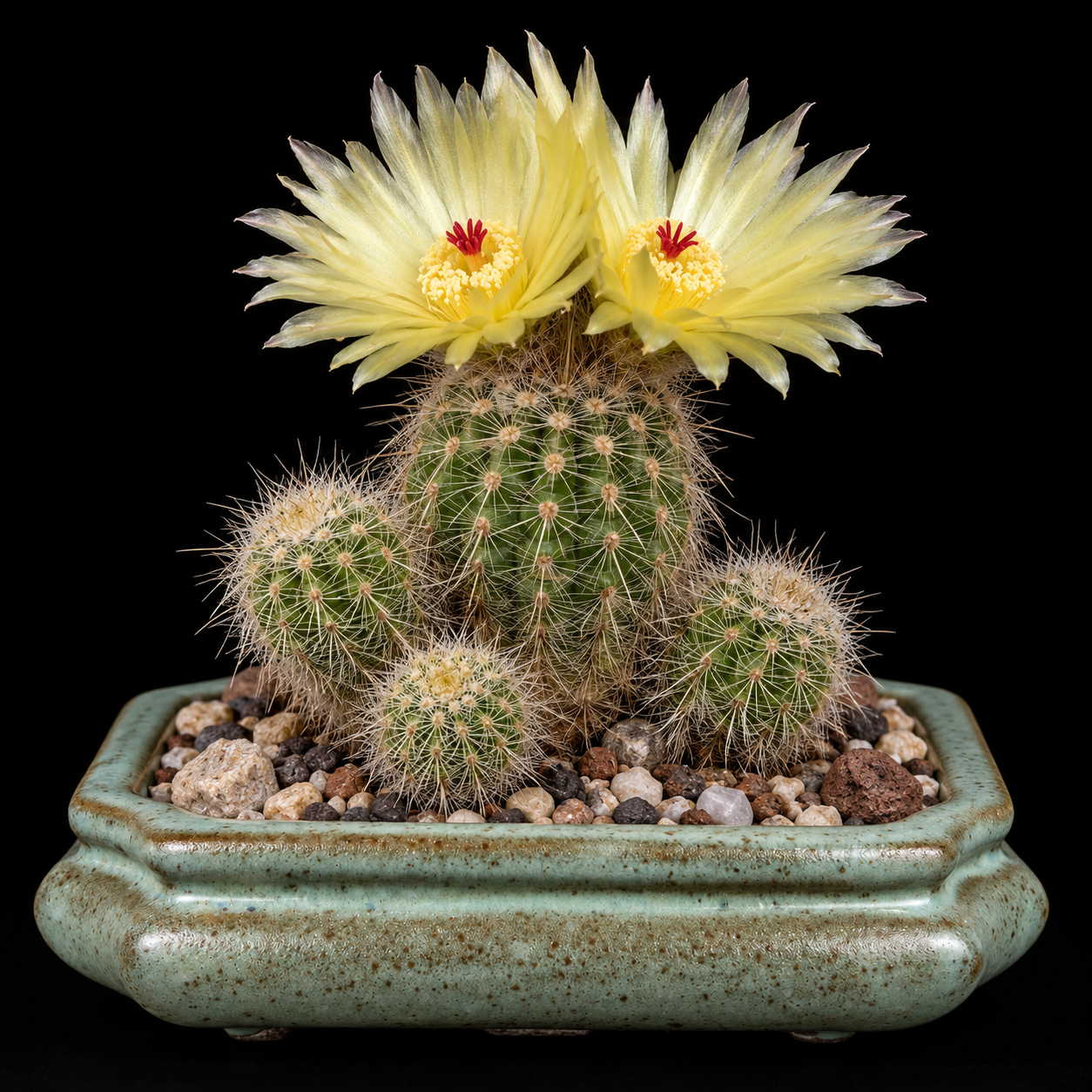
The species may begin with a single stem but commonly develops offsets and ultimately forms an attractive compact colony. Individual stems are globose when young, becoming short cylindrical to somewhat club-shaped, with approximately 12-15 distinct vertical ribs. Closely arranged areoles produce numerous fine, flexible spines that create a delicate veil over the fresh green epidermis. Around 10-14 radial spines radiate in pale yellow, cream and straw shades, while one to four stronger central spines introduce richer golden, reddish or reddish-brown tones. When several stems grow together, the combination of upright green bodies and dense, softly luminous spination creates a beautifully textured specimen with considerable ornamental presence.
Flowering adds a spectacular finishing touch. Mature stems produce short funnel-shaped flowers from the crown, generally around 4-5 cm across, with broad silky petals ranging from soft lemon-yellow and creamy golden-yellow to richer, shining gold. The centres are especially attractive, with masses of pale yellow stamens surrounding a contrasting reddish stigma. Against the fine cream and honey-coloured spines, these luminous flowers appear almost incandescent, and established clumps can produce flowers on more than one stem for an impressive multi-headed display. In its native Rio Grande do Sul habitat, Parodia stockingeri flowers from September through December, corresponding with Southern Hemisphere spring into early summer, and the flowers open during the daytime.
For South African growers, that Southern Hemisphere rhythm makes Parodia stockingeri particularly intuitive to cultivate. Give seedlings and mature plants a very free-draining cactus mixture with a substantial mineral component, excellent airflow and bright light, gradually increasing exposure as plants mature. Water during active spring and summer growth after the substrate has dried sufficiently, while reducing moisture markedly during cooler weather. International growers can enjoy it equally well in greenhouses, conservatories or other bright frost-protected collections. Its natural association with exposed rocky outcrops is an excellent cultivation clue: drainage and root aeration are essential, even though its native Pampa environment receives considerably more seasonal moisture than a classic desert habitat.
For cactus enthusiasts who enjoy species that become more impressive with age, Parodia stockingeri is an exciting plant to raise from seed. The transformation from tiny seedlings into neat ribbed stems, followed by offsetting into a colony of softly spined green heads crowned with luminous yellow flowers, makes every stage rewarding. Check out our online seed store and explore our enormous and diverse range of cactus, succulent and unusual botanical seeds. Buy Now or Add to Cart and add this distinctive Brazilian Pampa cactus to your collection. Seeds and All offers offers combined South African and International shipping, making it easy for collectors, growers, gardeners and hobbyists worldwide to combine Parodia stockingeri with many other sought-after seed varieties in one convenient order.


