


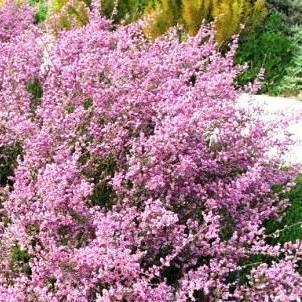


Muraltia spinosa (Nylandtia spinosa) – Tortoise Berry; Skilpadbessie – 5 Seed Pack
R23,25
INTERNATIONAL CUSTOMERS: Please read our shipping terms and conditions here before placing your order: Shipping Terms and Conditions
2 in stock
Muraltia is a genus of plants in the milkwort family (Polygalaceae) which is native to Southern and Eastern Africa. Most of the species are endemic to South Africa, and one species is naturalized in Australia. It is named after Johannes von Muralt, a Swiss botanist and surgeon. In 2006 the genus Nylandtia, which contained two species, was merged into Muraltia. The two species formerly part of Nylandtia are Muraltia scoparia and Muraltia spinosa. Nylandtia are commonly known as “Tortoise berry” plants (“skilpadbessie”). This is because of the bright edible berries that they produce, which are relished by the tortoise species of the fynbos.
Muraltia spinosa commonly known as Tortoise Berry in English and Skilpadbessie in Afrikaans is a striking plant when covered in its masses of dainty purple flowers. Attractive and unusual spiny foliage, pretty red edible fruits and water-wise attributes all combine to make it a great choice for the discerning gardener. A much branched, stiffly erect, rounded shrub, 1 x 1 m, with arching, spine-tipped stems covered in small, narrow deciduous leaves. Sweetpea-like flowers, (purple, pink or white) cover the plant in a beautiful mass starting in autumn and continuing through winter to early spring (Apr. to Oct.). The truly lovely flowers superficially resemble those of the pea and legume family but are actually quite different. All members of this genus have three to five sepals and three to five petals. The two lateral sepals are petal-like, larger than the others, coloured like the petals, and resemble the wing petals of a pea flower. The lower 3 petals are fused in a boat-shaped structure and enclose the seven stamens and the style, and resemble the keel of a pea flower. Another distinguishing difference is that Muraltia does not bear leguminous fruit. The fleshy fruits are bright red when ripe, edible, and produced throughout summer. This shrub has a moderate growth rate and is quite hardy.


