
Tritonia linearifolia – 5 Seed Pack
R32,50
INTERNATIONAL CUSTOMERS: Please read our shipping terms and conditions here before placing your order: Shipping Terms and Conditions
9 in stock
A dazzling celebration of colour, elegance and botanical diversity, Tritonia is a captivating genus of approximately 30 species of deciduous, cormous perennials belonging to the iris family, Iridaceae. Native to tropical and southern Africa, with its greatest diversity concentrated in South Africa’s Cape Floristic Region, this remarkable genus is celebrated for its exquisite flowers in brilliant shades of orange, scarlet, yellow, pink, cream and white. From the rugged, sun-baked landscapes of the Karoo to lush mountain grasslands and coastal fynbos, Tritonia species have evolved extraordinary adaptations to their diverse natural habitats.
Their graceful flowering spikes, often adorned with intricately marked, funnel-shaped or tubular blossoms, are complemented by attractive sword-shaped foliage that may be elegantly pleated, twisted or beautifully undulating. Particularly fascinating are the specialised floral structures that help facilitate pollination. First established in 1802, the genus takes its name from a word meaning weathervane, referring to the variable orientation of its stamens. With their spectacular seasonal displays, fascinating botanical characteristics and remarkable diversity, tritonias are prized by indigenous plant enthusiasts, specialist bulb collectors and gardeners worldwide. Perfect for raised beds, pots and rockeries.
Tritonia linearifolia
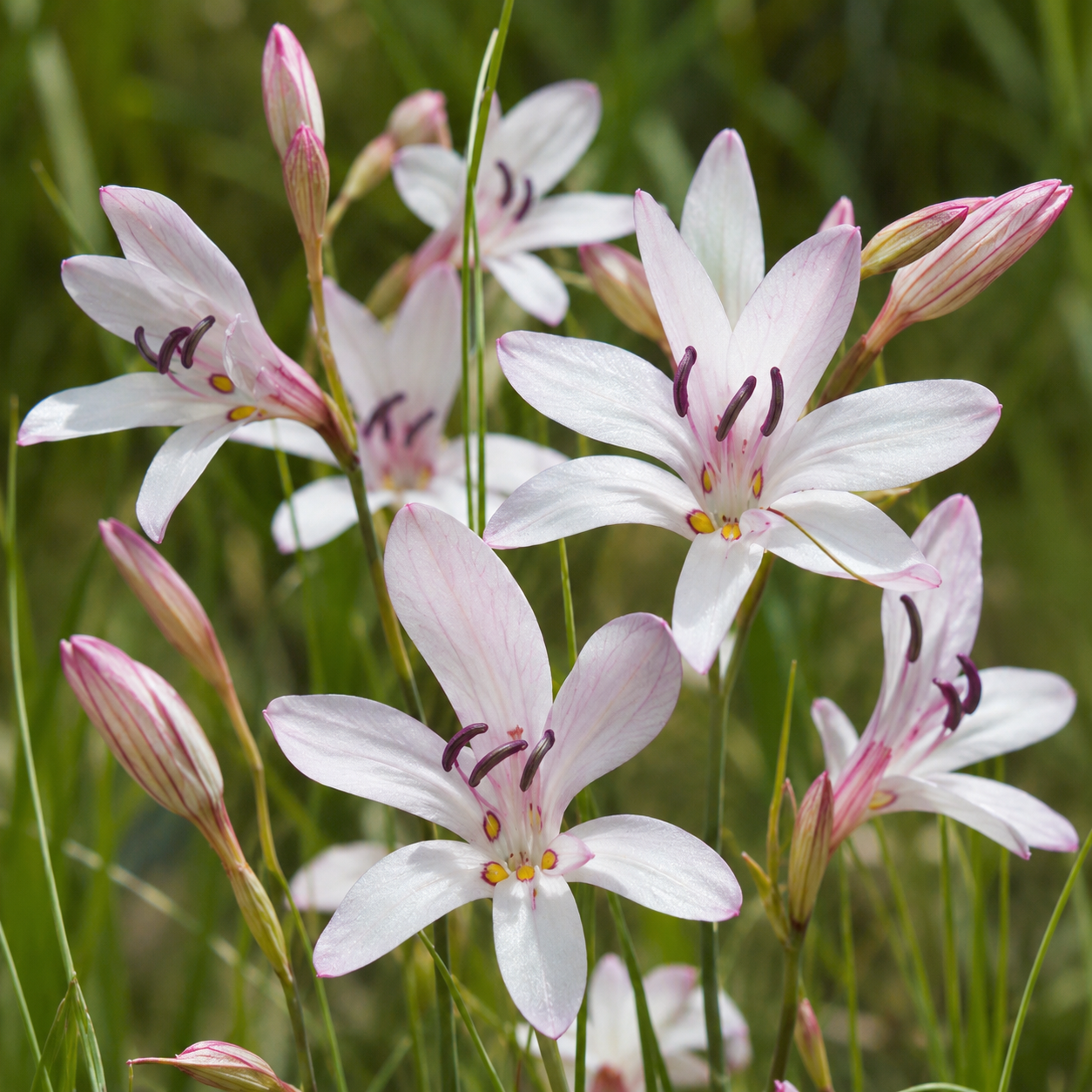
Exquisite, graceful and wonderfully distinctive, Tritonia linearifolia is a captivating South African geophyte celebrated for its elegant ivory-white flowers, delicate pink-purple veining and striking deep violet anthers. Belonging to the Iridaceae family, this enchanting deciduous, cormous perennial possesses a wonderfully refined beauty, producing magnificent, star-like blossoms that appear almost luminous against their surroundings. Its delicate flowers combine soft white and ivory tones with subtle blush-pink highlights, intricate floral markings and gracefully arching reproductive structures, creating an exceptionally attractive botanical display. Unlike the brightly coloured orange, yellow and scarlet flowers associated with many members of the genus Tritonia, this unusual species offers a sophisticated palette of soft, romantic colours. Its distinctive floral architecture, intriguing botanical history and relatively limited natural distribution make it especially appealing to specialist bulb collectors, enthusiasts of South African indigenous plants and gardeners seeking an extraordinary addition to their collections.
Endemic to South Africa, Tritonia linearifolia occurs naturally in the Western and Eastern Cape provinces, particularly along the lower slopes of the Kouga and Baviaanskloof Mountains, with additional records from the northern foothills of the Fouriesberg near the western Outeniqua Mountains. It inhabits cooler, predominantly south-facing sandstone slopes within arid and grassy fynbos vegetation, where its underground corms grow securely wedged between rocks in pockets of accumulated loamy soil. These rugged mountain landscapes provide a fascinating environment for specialised geophytes, combining excellent natural drainage with seasonal moisture and protection within rocky crevices. Although relatively poorly collected, Tritonia linearifolia has been observed growing in colonies along the southern slopes of the Kouga Mountains, where its elegant flowers provide a striking contrast against the surrounding rocky terrain. First formally described by renowned botanists Peter Goldblatt and John Manning in 2011, this fascinating species represents one of the more recently recognised botanical treasures of South Africa’s extraordinary Cape flora.
Typically reaching approximately 15–50 cm in height, occasionally growing as tall as 60 cm, Tritonia linearifolia produces slender, upright flowering stems accompanied by exceptionally narrow, linear, grass-like leaves measuring only 1–2 mm wide. These elongated leaves may equal or exceed the height of the flowering stems, providing an elegant, delicate appearance during the growing season. Interestingly, the foliage generally becomes dry and withered by the time flowering begins, allowing the exquisite blossoms to command attention. The flowering stems carry graceful, slightly inclined spikes bearing approximately four to eight flowers, each emerging from an elongated, subtly pink-veined bud. The magnificent blooms are predominantly white to soft ivory, occasionally displaying delicate blush-pink undertones, with beautifully spreading tepals and subtle purple veining on their outer surfaces. Each flower opens from a remarkably long, slender floral tube measuring approximately 35–45 mm, revealing six delicately formed, slightly unequal petals. Particularly captivating are the deep violet-purple anthers, which contrast dramatically against the pale floral segments, while small, yellowish-green, ridge-like markings decorate the bases of the lower three tepals. In its natural South African habitat, flowering occurs predominantly during early to mid-December, in early summer, when the exquisite blossoms bring delicate colour to the rocky mountain slopes.
One of the most fascinating characteristics of Tritonia linearifolia is its specialised floral structure, which suggests an adaptation to pollination by long-proboscid flies. Its exceptionally elongated floral tube, contrasting purple anthers and carefully positioned reproductive structures are remarkable examples of the intricate relationships that have evolved between South Africa’s indigenous flowering plants and their pollinators. Botanically, the species is closely related to Tritonia pallida, another elegant white-flowered geophyte, but can be distinguished by its much narrower leaves, later flowering season and preference for rocky sandstone habitats rather than shale slopes. It also differs from the superficially similar Tritonia bakeri, whose leaves are more fleshy and almost cylindrical. Another interesting feature is its ability to produce small daughter corms on short underground stolons, allowing established plants to gradually develop into attractive colonies. For South African gardeners, this unusual species offers wonderful potential in carefully prepared indigenous bulb gardens, specialist rockeries and naturalistic fynbos-inspired plantings. International growers and collectors may appreciate its potential as a container-grown specimen in deep pots containing a sharply draining, sandy or gritty growing medium. Its natural habitat suggests that good drainage, suitable seasonal moisture and protection against excessive wetness during dormancy are important considerations for successful cultivation.
Whether you are an experienced collector of South African geophytes, a passionate enthusiast of unusual flowering bulbs or an adventurous gardener searching for an elegant and botanically fascinating addition to your collection, Tritonia linearifolia offers an exceptional opportunity to explore the extraordinary diversity of the Cape’s indigenous flora. Its enchanting ivory-white flowers, delicate pink-purple veining, contrasting violet anthers and fascinating adaptation to rocky mountain environments make it a wonderful addition to specialist seed collections worldwide. When cultivated in groups, its graceful flowering stems and abundance of delicate blossoms can create a breathtaking display of understated beauty and natural sophistication. Check out our online seed store and discover an extraordinary selection of beautiful, unusual and collectible plants! Seeds and All offers combined South African and International shipping, bringing the remarkable diversity of the botanical world closer to passionate gardeners, collectors and plant enthusiasts everywhere.


