
Aloe arenicola – Sand Aloe; Sand-aalwyn – 5 Seed Pack
R95,00
INTERNATIONAL CUSTOMERS: Please read our shipping terms and conditions here before placing your order: Shipping Terms and Conditions
23 in stock
Aloe is one of the most captivating succulent genera on Earth, celebrated for its bold architectural rosettes, resilient nature, and spectacular seasonal flower displays. From neat, miniature species that tuck themselves into rocky crevices to dramatic, stem-forming giants that dominate dry hillsides, aloes bring an unmistakable sense of place—sunlit, water-wise, and wonderfully wild—wherever they are grown.
What truly sets Aloe apart is the combination of sculptural foliage and nectar-rich blooms. The leaves range from smooth and glaucous to spotted, toothed, and richly textured, often changing colour with sun, drought, or cool weather. When they flower, aloes send up striking spikes or branched candelabras topped with tubular blooms in fiery reds and oranges, soft corals and pinks, or even yellows and greens—magnets for pollinators and a highlight in any garden or collection.
With origins spanning Africa, Madagascar, the Arabian Peninsula and surrounding regions, Aloe has evolved to thrive in demanding environments—making many species naturally suited to xeriscaping, rock gardens, containers, and drought-tolerant landscapes. Whether you’re a first-time grower or a seasoned collector, raising aloes from seed is especially rewarding: every plant tells a slightly different story, and each one matures into a unique, living sculpture that becomes more impressive with every season.
Aloe arenicola – Sand Aloe; Sand-aalwyn
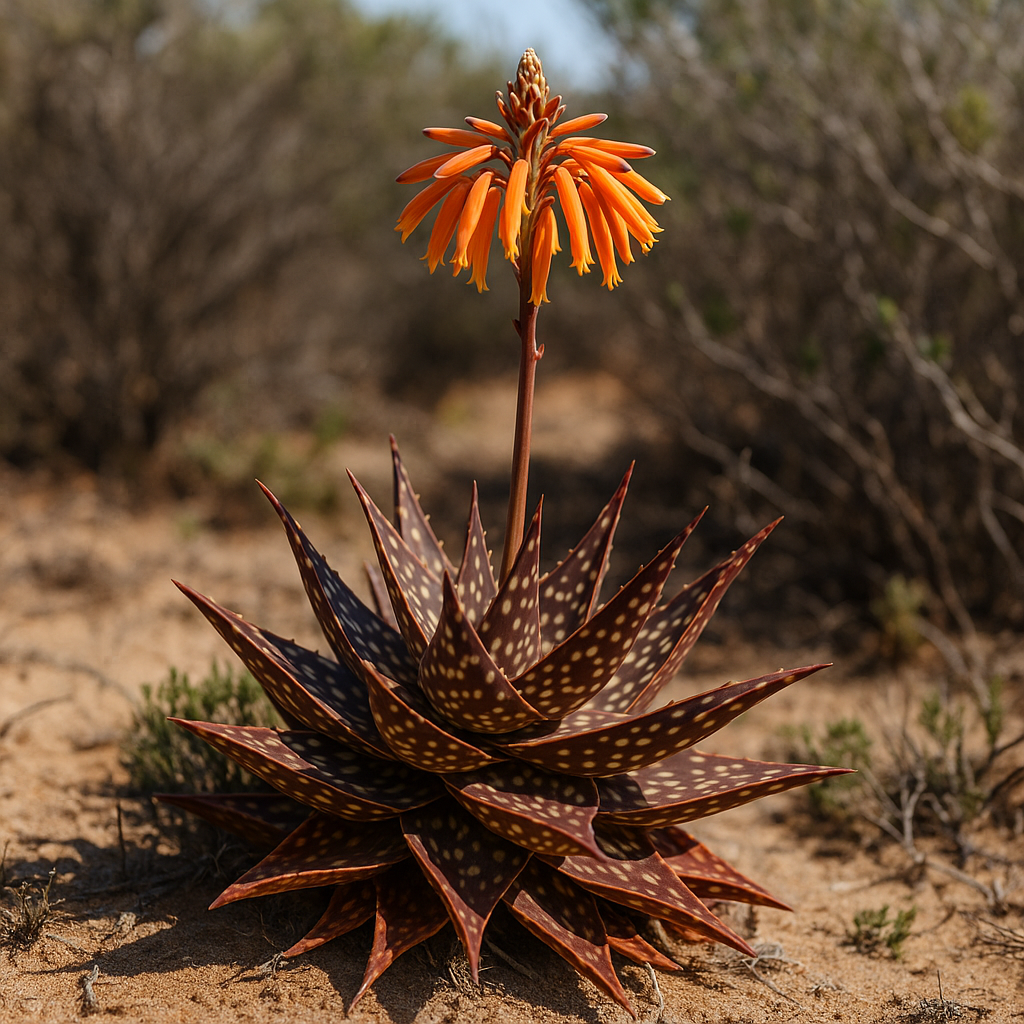
Aloe arenicola, the much-loved Sand Aloe or sand-aalwyn, is one of the most charismatic dwarf aloes from South Africa’s wild Atlantic coast. In nature it forms tight, star-shaped rosettes that sprawl and creep across warm sand and between low scrub. The leaves are narrow, triangular and gently recurved, coloured deep olive-green to dusky reddish-brown, and beautifully patterned with irregular pale spots and bands that glow in strong light. In dry conditions the whole plant takes on rich copper and wine tones, just like the plants in our photographs, making it a striking accent in rock gardens, desert beds and container displays.
In winter to early spring (roughly July to September in South Africa, late winter in the northern hemisphere) the Sand Aloe sends up a slender, upright flower stalk that rises well above the rosettes. The inflorescence carries a compact head of tubular flowers in vivid shades of orange, often with softer yellowish mouths. Against the muted tones of coastal scrub or a gravel garden, these glowing blooms are a magnet for sunbirds and other nectar-feeding wildlife, and in cultivation they bring a welcome splash of colour during the cooler months when many other succulents are resting.
Aloe arenicola is endemic to the arid coastal belt of the Western and Northern Cape, where it grows in deep, wind-blown sands and sandy flats, often just inland from the Atlantic dunes among hardy shrubs. These tough conditions have shaped a plant perfectly adapted to drought: the leaves are thick and water-storing, the roots penetrate quickly into loose soil, and the creeping stems help it anchor shifting sand. In the garden or in pots, it thrives in very well-drained, sandy or gritty mixes, full sun to bright light, and infrequent but deep watering – an ideal choice for water-wise gardens in South Africa, Mediterranean climates, and sunny windowsills or greenhouses worldwide.
Raised from seed, Aloe arenicola quickly develops its characteristic spotted leaves and compact rosettes, making it a rewarding species for collectors, landscapers and beginners alike. In coastal gardens it looks completely at home on dunes, embankments and gravel mounds, while inland it pairs beautifully with other small aloes, mesembs and miniature shrubs. For international growers, it performs excellently in containers, where its creeping habit can eventually spill over the rim in a sculptural cascade. These seeds offer the chance to cultivate an authentic piece of the Namaqualand and Cape coastal flora – a hardy, beautifully marked aloe that is as ornamental as it is resilient.


