
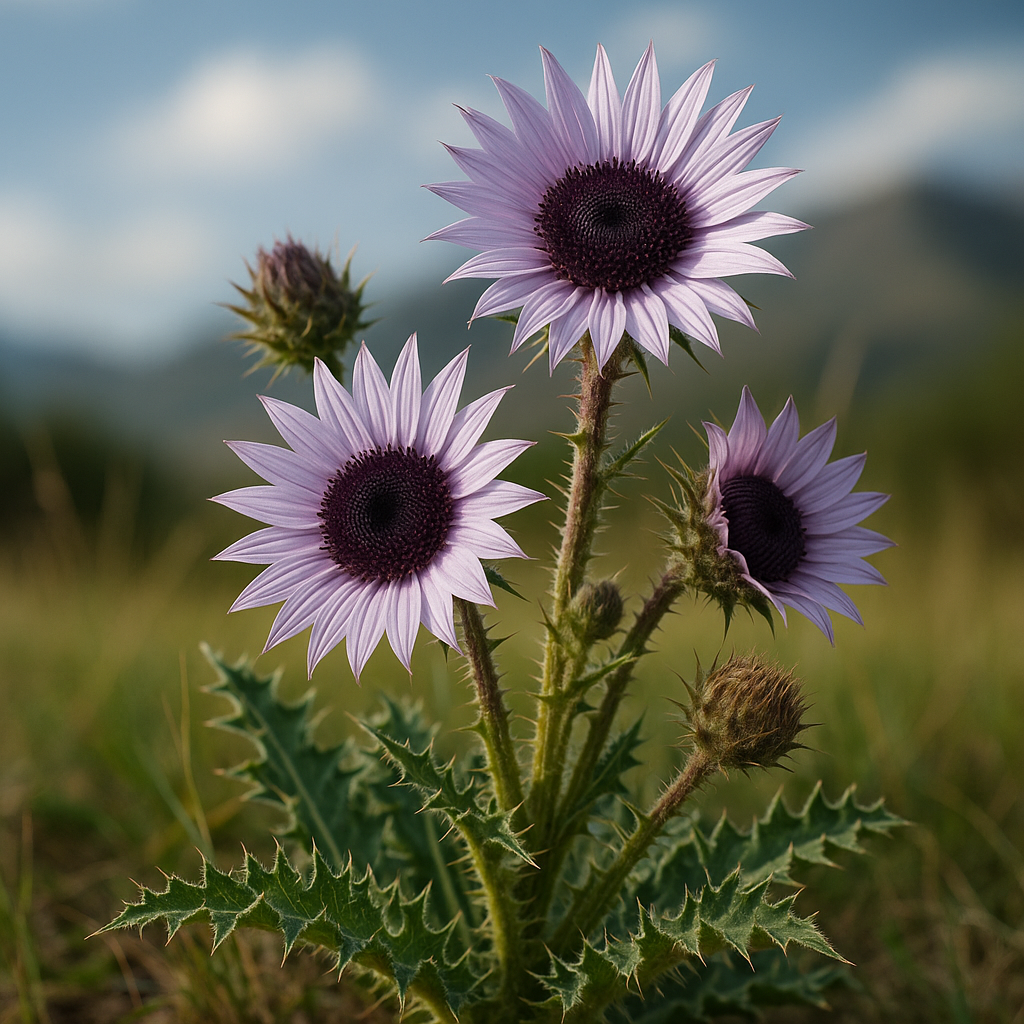
Berkheya purpurea (Stobaea purpurea) – Purple Daisy-Thistle, Purple Berkheya; Bloudisseldoring – 5 Seed Pack
R22,50
INTERNATIONAL CUSTOMERS: Please read our shipping terms and conditions here before placing your order: Shipping Terms and Conditions
13 in stock
Berkheya is a striking South African genus in the daisy family (Asteraceae), celebrated for its bold, spiny rosettes and radiant, long-lasting blooms. With roughly 70–80 species, the genus ranges from the winter-rainfall west through the Karoo to the summer-rainfall grasslands and Drakensberg. Plants typically form low, architectural clumps of toothed or silver-felted leaves that set off showy, sunflower-like capitula in clear yellows, creams or, in a few species such as B. purpurea, unexpected lilacs and mauves. The name honours the Dutch naturalist Jan le Francq van Berkhey.
Ecologically, Berkheya species are tough survivors of rocky slopes, dolerite outcrops and open veld, where their spines deter grazers and their nectar-rich flowers draw bees, beetles and other pollinators. The genus even includes a botanical celebrity—Berkheya coddii—renowned as a nickel hyperaccumulator on ultramafic soils. This natural resilience translates beautifully to water-wise gardening: once established, many species handle heat, wind and summer dry spells with ease.
In cultivation, Berkheya rewards full sun, sharp drainage and modest feeding. Plants are excellent focal points for fynbos, Karoo and rock-garden schemes, pairing well with restios, grasses and other arid-adapted perennials. Most species grow readily from seed and will flower within a season or two, adding texture and luminous colour to South African gardens and landscapes.
Berkheya purpurea — the much-admired “purple daisy-thistle” — brings a hint of Drakensberg drama to South African gardens. Also listed as Stobaea purpurea (syn.), this statuesque perennial forms a handsome basal rosette of spiny, grey-green leaves from which strong, bristled stems rise in summer, each topped with broad daisies. The flowers are unmistakable: cool lavender-mauve rays encircle a darker, purplish chocolate centre, giving striking contrast that reads beautifully in the landscape and in the vase.
Indigenous to our summer-rainfall mountains, Berkheya purpurea occurs naturally on rocky slopes and grasslands of the Drakensberg and eastern escarpment, from the Eastern Cape and KwaZulu-Natal into the eastern Free State and Lesotho. In cultivation it is tough and adaptable, happiest in full sun with well-drained soil and regular summer moisture, shrugging off frost once established and thriving across the Highveld and other cool, summer-rainfall regions.
Plants develop into bold clumps 60–120 cm tall in flower, with attractively toothed foliage that lends a thistle-like texture without becoming unruly. The showy heads open in succession through mid to late summer, typically from December to March, drawing bees and butterflies and providing a long, colourful season just when many perennials pause. Cut stems last well, the fresh blooms are excellent for arrangements, and the sculptural seed heads dry beautifully for winter décor. In mixed borders, prairie or grassland-style plantings, and water-wise rock gardens, purple berkheya supplies vertical accent, pollinator value and a distinctly South African sense of place.


