

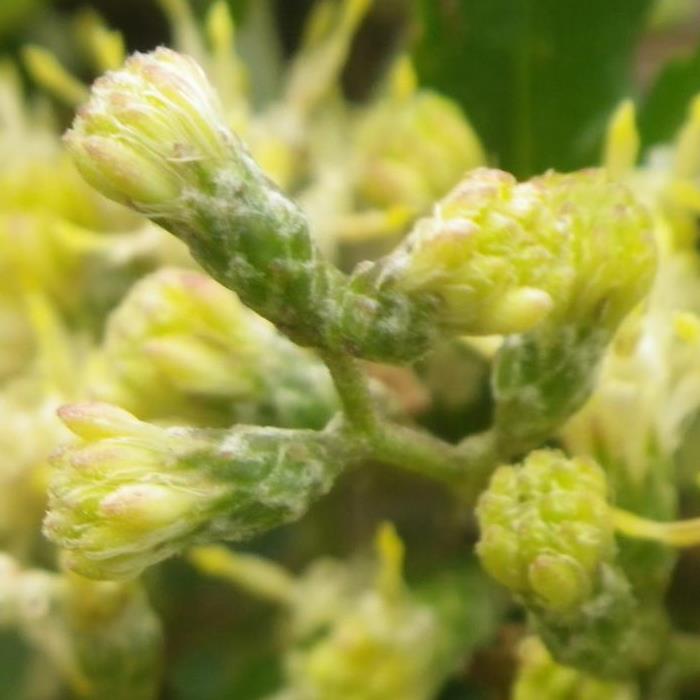

Brachylaena elliptica (Tarchonanthus ellipticus) – Bitterleaved Silver-oak; Bitterblaar – 10 Seed Pack
R17,50
INTERNATIONAL CUSTOMERS: Please read our shipping terms and conditions here before placing your order: Shipping Terms and Conditions
26 in stock
Brachylaena is a genus of flowering plants in the aster family, Asteraceae. Several are endemic to Madagascar, and the others are distributed in mainland Africa, especially the southern regions. These are trees and shrubs with alternately arranged leaves. One of these, Brachylaena merana, is the tallest of all daisy trees at up to 40m. They are dioecious, with male and female flowers occurring on separate individuals. The flower heads are somewhat disc-shaped. Heads with female flowers are larger and produce larger pappi.
Brachylaena elliptica, synonymously known as Brachylaena dentata, Brachylaena dentata var. salicina, Brachylaena elliptica var. salicina or Tarchonanthus ellipticus and commonly known as Bitterleaf, Bitterleaved Silver-oak or Fire-sticks in English, Bitterblaar or Suurbos in Afrikaans is a South African endemic species from the Eastern Cape and KwaZulu-Natal, ranging from Zululand to Uitenhage. This is an attractive small tree or large shrub with interesting aromatic, dark green foliage with greyish silver undersides. Brachylaena elliptica grows into a small tree or a large shrub, 3 to 5 m high, with a spread of up to 2 m. The base can be single- or multi-stemmed. At the young stages of life, the bark is light grey, and matures to brown and becomes rough, as the tree ages. The leaves are lanceolate and elliptic to ovate, aromatic, dark green and glossy above and with felted hairs and prominent veins on the undersides. The flowers are small, creamy white, thistle-like blooms, that are in large sprays in spring, from September to October. The fruit is a small nutlet with bristly hairs, occurring from September onwards. The leaves have a bitter taste and are sometimes browsed by stock. It is used by Xhosa and Zulu people in traditional medicine. The leaves are used to treat diabetes. An infusion of the leaves provides a gargle and mouthwash to treat sore throats, ulcers of the mouth or throat, quinsy and thrush. The roots are also used as an ingredient in a number of traditional remedies. The wood is durable, and poles are suitable for fencing posts, and sticks were used in the past to make fire by friction.


