
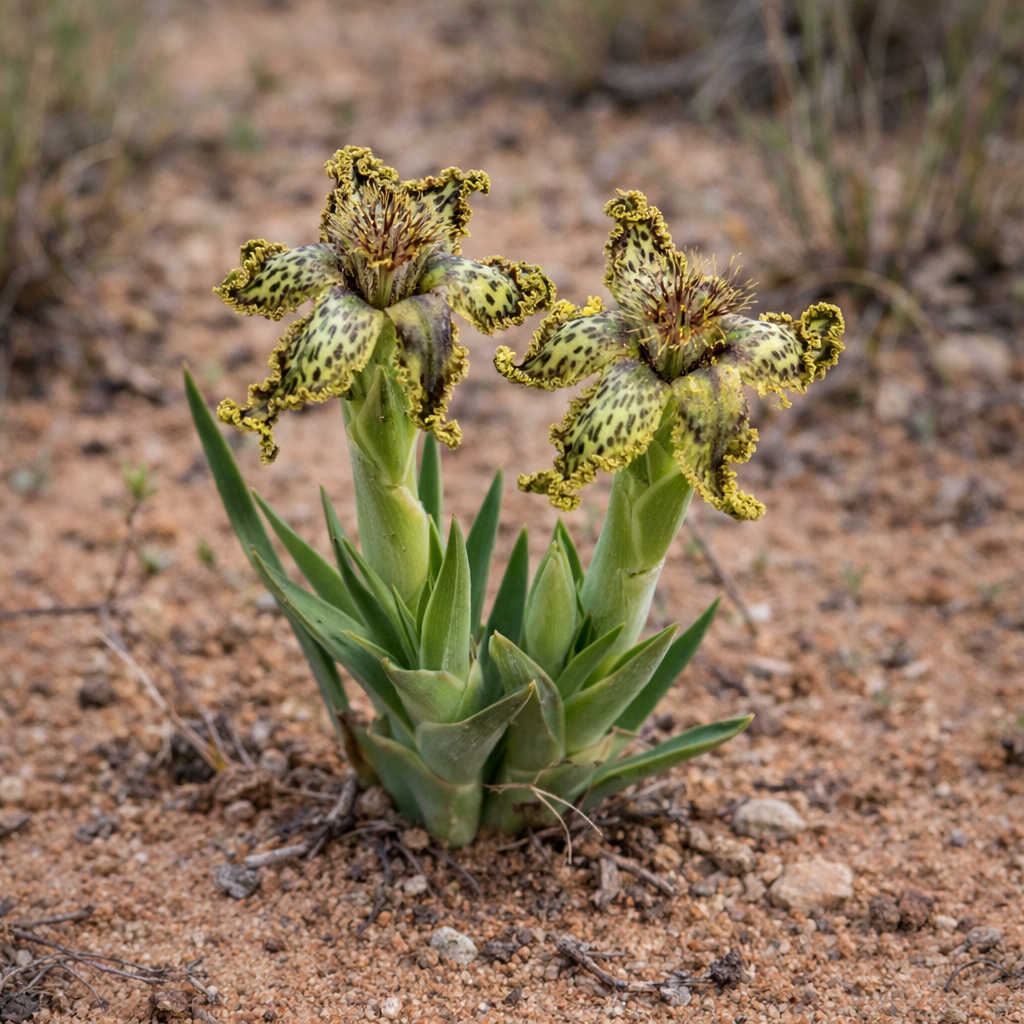
Ferraria parva – Poor Spiderlily – 5 Seed Pack
R75,00
INTERNATIONAL CUSTOMERS: Please read our shipping terms and conditions here before placing your order: Shipping Terms and Conditions
9 in stock
The genus Ferraria is one of southern Africa’s most botanically distinctive groups of cormous irids: compact geophytes that retreat underground during the unfavourable season and re-emerge with rains, often flowering rapidly in short seasonal windows. In modern treatments, Ferraria is placed in the tribe Irideae and discussed alongside close African relatives such as Moraea, Dietes, and Bobartia – a lineage recognised for petaloid style branches and striking specialisation in floral form.
Two traits make Ferraria instantly recognisable among irids. First, the tepals typically have crisped or frilled (undulate) limb margins, producing the genus’ signature “ruffled” look. Second, the style divides into three flattened branches that are deeply forked and finely fringed, a combination explicitly highlighted as unique within Iridaceae by modern systematic work and echoed in regional floras.
Ferraria is native to a broad belt of Africa, but its centre of diversity lies in the winter-rainfall west and southwest, where most species occur in the seasonally cool, wet growing period and summer drought. A smaller subset (notably including F. glutinosa) occupies summer-rainfall or seasonally dry tropical regions farther north.
From a conservation standpoint, many Ferraria are geographically narrow endemics of specialised west-coast habitats (sandveld, strandveld, duneveld, quartz fields, granitic slopes).
Ferraria parva – Poor Spiderlily
Ferraria parva is proof that “small” in Ferraria can still be intensely characterful. Described as having among the smallest flowers in the genus, it is nevertheless richly patterned and scented, with a biogeographically surprising distribution close to well-travelled parts of the West Coast.
Plants are generally 80–150 mm tall and form branched stems with unifacial leaves. The flowers last about two days and are described as dark brown-spotted on a dull yellow to pale greenish background, with buff/khaki crisped margins – a palette that reads natural and dune-adapted rather than garden-bright. Scent is particularly notable: systematic observations describe a sweet fragrance reminiscent of jasmine and coconut in many individuals, with occasional sour notes; nectar is moderately sweet, and pollination is suggested (by analogy and structure) to involve nectar-foraging bees, though detailed field confirmation is limited.
Ferraria parva is associated with West Coast sandveld and limestone-influenced soils (deep sands, calcrete/limestone pavements), and flowering is recorded late August to mid-September, placing it in the spring-flowering cycle. For South African buyers, it belongs in a mineral, fast-draining bed with protection from casual digging and disturbance. For international growers, pots are often the safest choice: you can precisely control moisture, keep the plant dry in summer dormancy, and maintain backup stock – a practical conservation-minded approach for a globally rare West Coast endemic.


