
Freesia andersoniae – Bergaandblommetjie – 5 Seed Pack
R35,00
INTERNATIONAL CUSTOMERS: Please read our shipping terms and conditions here before placing your order: Shipping Terms and Conditions
7 in stock
Freesia is a genus of herbaceous perennial flowering plants in the family Iridaceae, first described as a genus in 1866 by Christian Friedrich Ecklon (1886) and named after the German botanist and medical practitioner, Friedrich Freese (1795-1876). It is native to the eastern side of southern Africa, from Kenya south to South Africa, most species being found in Cape Provinces. Species of the former genus Anomatheca are now included in Freesia.
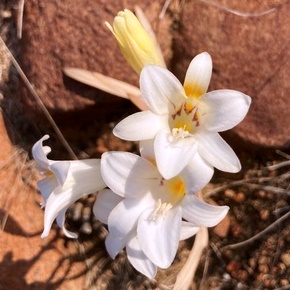
Freesia andersoniae, commonly known as Bergaandblommetjie in Afrikaans, is a South African endemic species found in the Eastern Cape, Free State, Northern Cape and North West provinces. It is wedged among rocks on lower, southern slopes of the dolerite and dolomite outcrops. It is also common on the koppies around Kimberley. Flowering does not occur until spring, August to October but sometimes as early as May. This species is reported to be frost hardy. Growing 10 to 25 cm high, this species has 10 to 14 inclined to suberect leaves and 2 to 5 flowers in a spike. Flowers are 5 to 6 cm long, white to cream coloured with the base of the lowermost tepal and inner edges of lower lateral tepals flushed orange. All three lower tepals have a dark brownish midline with purple chevrons in the tepal sinuses. Flowers are strongly lily scented, even at night which suggests they may be moth pollinated. It is similar to Freesia speciosa but has longer and narrower, acute leaves and internally marked purple lines.


