
Gibbaeum gibbosum – 10 Seed Pack
R47,50
INTERNATIONAL CUSTOMERS: Please read our shipping terms and conditions here before placing your order: Shipping Terms and Conditions
31 in stock
Gibbaeum is a fascinating South African genus of miniature succulents in the family Aizoaceae, the richly diverse vygie or mesemb family. These remarkable little plants are true gems of the arid Cape, especially the Little Karoo and surrounding regions, where they often grow almost hidden among quartz pebbles, stony flats and dry, open ground. Their name comes from the Latin word meaning “hump”, a fitting reference to their thick, rounded, uneven leaf pairs, which give many species a curious sculptural appearance unlike almost anything else in the succulent world.
Part of the appeal of Gibbaeum lies in its subtle beauty. These are not large, showy plants, but close-up treasures for collectors who appreciate texture, form and adaptation. Many species form tight clumps of paired succulent leaves, often grey-green, blue-green, whitish, velvety or softly hairy, allowing them to blend naturally into their harsh, sun-baked habitat. This camouflage, together with their water-storing leaves and seasonal resting habit, makes Gibbaeum a superb example of survival through refinement rather than size.
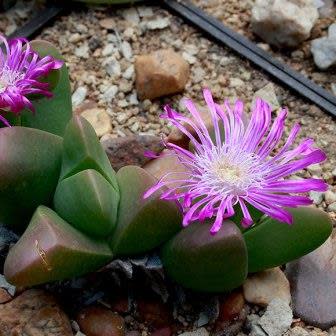
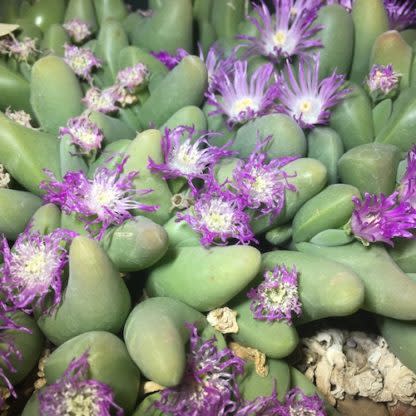
When in flower, Gibbaeum reveals a softer side. The usually solitary blooms appear in shades of pink, white, mauve or purple, often opening in response to seasonal rain and transforming these pebble-like plants into delicate living jewels. For succulent collectors, mesemb enthusiasts, rock-garden growers and lovers of unusual South African flora, Gibbaeum offers all the charm of a rare botanical curiosity: compact, drought-wise, distinctive, and deeply connected to the ancient dry landscapes of the Cape.
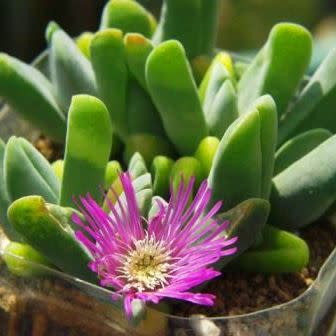
Gibbaeum gibbosum is a compact perennial succulent that grows flat in the ground forming dense clumps up to 10-15 cm in diameter and 3-6 cm above the level of the soil surface. Unequal pairs of smooth deep green to yellowish green leaves (different in shape and size) look like sharks head, the old leaves form white sheaths around the bases of the leaf-pairs. The only known glabrous species with which this can be confused is Gibbaeum marlothii, from which the larger size and much more unequal leaves readily distinguish it. Leaves and flowers, respectively fruits are distributed all over the plants.


