
Habenaria attenuata – 10+ Seed Pack
R43,00
INTERNATIONAL CUSTOMERS: Please read our shipping terms and conditions here before placing your order: Shipping Terms and Conditions
8 in stock
The genus Habenaria belongs to the orchid family, Orchidaceae, and represents one of the great terrestrial orchid lineages of the world. These fascinating plants occur across an enormous geographical range, from tropical and subtropical regions of Africa, Asia, the Americas and the Pacific to temperate parts of eastern Asia and southern Siberia. The genus is also well represented in southern Africa, with native species occurring in South Africa in habitats ranging from open grassland and rocky hillsides to marshes, woodland and forest.
Most Habenaria are perennial terrestrial orchids that disappear completely underground during their dormant period. They survive unfavourable seasons by means of fleshy roots or underground tubers, before emerging again when temperature and moisture conditions are suitable. The new growth may consist of anything from a compact rosette of leaves lying close to the soil to a tall, leafy stem carrying an impressive terminal flower spike. This seasonal transformation, from an apparently empty patch of ground to an intricately flowering orchid, is part of their considerable appeal.
The flowers are where Habenaria becomes truly extraordinary. Green and white predominate throughout the genus, but yellow, cream, pink, orange and reddish flowers also occur. Many species possess a deeply divided or three-lobed lip together with a conspicuous nectar-bearing spur. The petals, sepals, lip, column and projecting reproductive structures can combine to create remarkably elaborate flowers, sometimes giving them a delicate, spider-like, fringed or almost otherworldly appearance.
Those unusual floral structures are not merely ornamental. In many Habenaria, long nectar spurs, floral scent and the precise arrangement of the reproductive organs form highly specialised relationships with their pollinators. Hawkmoths and other nocturnal moths pollinate numerous green- and white-flowered species, while some brightly coloured species are visited by butterflies. Research has even demonstrated that differences in spur length and floral architecture can determine exactly where the orchid’s pollinia are attached to the head, eyes, palps or other parts of a visiting insect.
Their ecological diversity is equally impressive. South African species alone can be encountered in well-drained Highveld grasslands, rocky bushveld, coastal and montane forests, riverine woodland and marshy grassland. This diversity means that Habenaria should never be treated as though every species requires identical cultivation. Understanding the habitat and seasonal growth cycle of the particular species is one of the keys to success.
For orchid enthusiasts, specialist collectors and adventurous seed growers, Habenaria offers an irresistible combination of rarity, botanical complexity and extraordinary floral form.
Habenaria attenuata
Habenaria attenuata is an intriguing high-altitude terrestrial orchid with a remarkably broad but fragmented distribution across tropical Africa and the south-western Arabian Peninsula. Its native range includes Cameroon, the Gulf of Guinea islands, the Democratic Republic of the Congo, Burundi, Rwanda, Uganda, Kenya, Tanzania and Ethiopia, extending across to Yemen. It is primarily associated with cool, moist mountain environments, occurring from roughly 2,100 to 3,800 metres above sea level in upland grasslands, rocky hillsides, montane rainforest, coniferous forest, moorland, gullies and even volcanic lava screes.
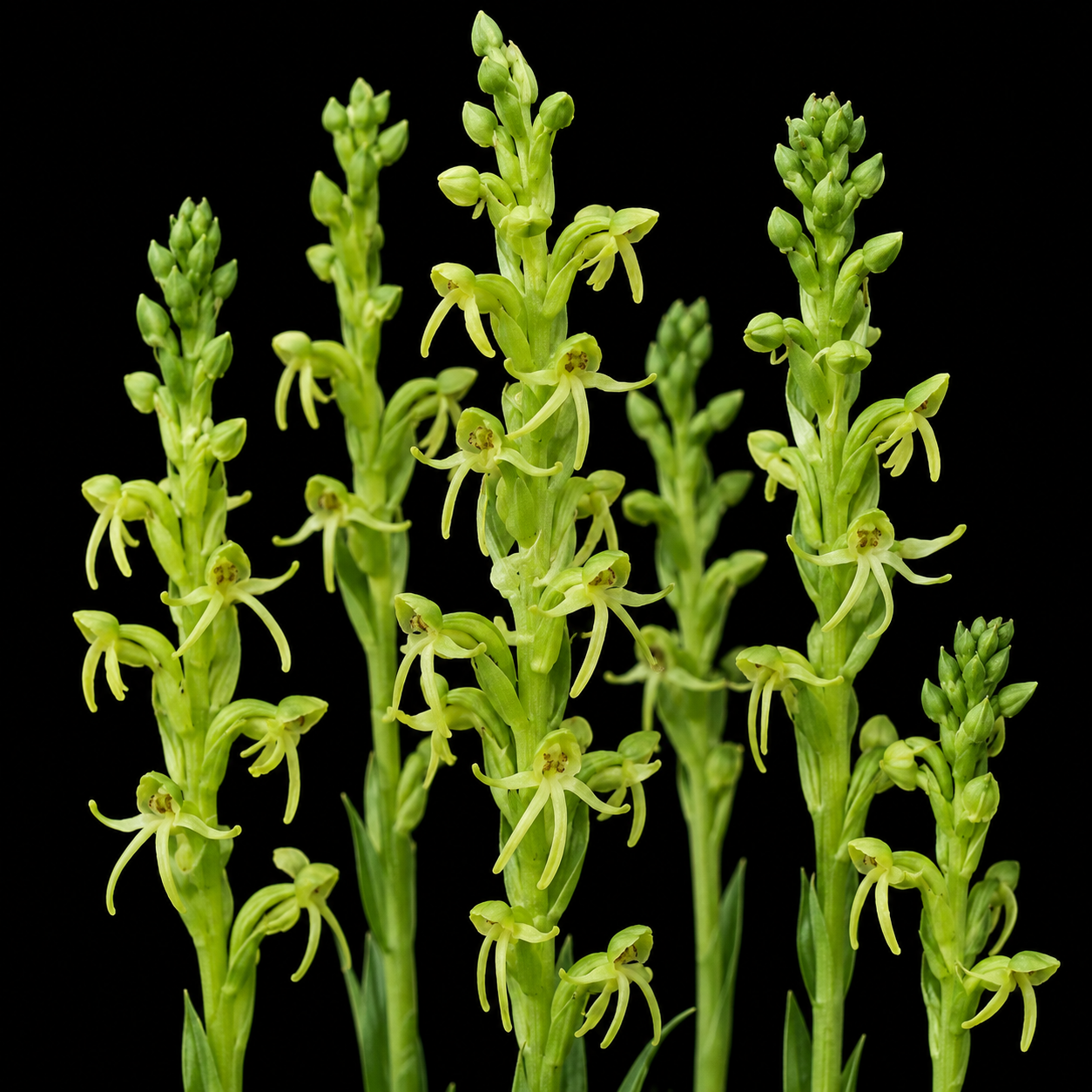
This unusual orchid grows from underground tubers and produces upright, slender green stems clothed with a relatively small number of unequal leaves, the lower foliage becoming broader and lance-shaped while those higher on the stem diminish into narrower sheathing structures. When several plants are grown together they form an elegant group of vertical flowering spikes, each carrying numerous small blossoms at different stages of development. The overall effect is fresh and architectural, with vivid green stems, compact buds and open flowers creating a beautifully layered botanical display.
The flowers are small but wonderfully intricate, ranging from fresh lime-green and yellow-green to softer pale green. Each blossom has a delicate hooded appearance, with the dorsal sepal and petals forming an upper covering while the three-part lip projects below in narrow elongated lobes. Fine curving floral segments give the flowers an almost miniature spider-like quality, and some blossoms reveal subtle cream tones and tiny brownish markings around the centre. In mature specimens, the slender terminal inflorescence may carry up to around twenty flowers, making a colony particularly attractive when numerous spikes bloom simultaneously.
Flowering in habitat is generally associated with spring and summer, although the exact timing varies considerably with elevation, latitude and seasonal rainfall across its extensive African range. Historic high-elevation records from the Ruwenzori region include flowering plants collected in January and February, illustrating how local climatic cycles can shift the flowering period in equatorial populations.
For South African growers, Habenaria attenuata is especially appealing to collectors interested in cool-growing terrestrial orchids and high-altitude African flora. Cultivation should follow its natural seasonal rhythm, with moisture supplied during active growth and flowering, followed by a significantly drier rest once the foliage naturally retreats and the underground tuber becomes dormant. International growers should similarly adapt the cycle to their own hemisphere rather than relying strictly on calendar months. Its naturally cool montane origins also make protection from prolonged extreme heat advisable.
Growing Habenaria attenuata from seed is a rewarding specialist project for experienced orchid enthusiasts. Like most orchids, the dust-like seed lacks substantial stored food reserves and normally requires association with compatible fungi in nature. Controlled sterile flask culture or an appropriate symbiotic germination method therefore offers the best opportunity for successful propagation. For collectors who enjoy raising unusual species from their earliest developmental stage, this distinctive green-flowered highland orchid is an especially fascinating choice.
Check out our online seed store and discover our vast and diverse selection of fascinating South African and International botanical treasures. Buy Now or Add to Cart and introduce the unusual Habenaria attenuata to your specialist orchid collection. Seeds and All offers combined South African and International shipping, allowing growers, collectors, gardeners and botanical hobbyists worldwide to combine multiple exciting species conveniently in one order.


