

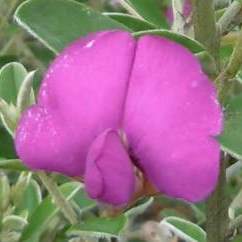
Podalyria buxifolia – Keurtjie – 5 Seed Pack
R22,50
INTERNATIONAL CUSTOMERS: Please read our shipping terms and conditions here before placing your order: Shipping Terms and Conditions
22 in stock
Podalyria is a genus of flowering plants in the legume family, Fabaceae. Members of this genus are often, yet mistakenly, placed in the Sophora genus. The genus Podalyria was named after Podalirius, the son of Asklepios, who was the Roman god of medicine. This is a genus of about 25 species of evergreen shrubs and small trees that occur naturally in the winter rainfall areas of southern Africa. They have oval leaves 35mm long covered with very fine hairs that create a silvery effect. The flowering season varies, but usually starts in very early spring when clusters of mauve or white sweet-pea scented flowers open. The flowers are very attractive to many insects, particularly carpenter bees, and nectar-feeders like honey bees, butterflies and hoverflies. The large, heavy carpenter bees land on the petals and their weight opens the flower, giving them access to the pollen and nectar, whereas the smaller, lighter, honey bee goes to the opening at the base of the petals, gaining access to the nectar. The insects that are attracted by the flowers attract insect-eating birds like the Cape Batis. Plant in light, well-drained soil in full sun; these plants thrive in coastal conditions. Propagate from seed in spring or autumn. A light trimming after flowering keeps the bushes compact.
Podalyria buxifolia commonly known as Keurtjie is a delicately beautiful shrub from the southern Cape Mountains. It has attractive, dark-green, glossy leaves and the most exquisite maroon, pea-like, scented flowers in summer. It is new to horticulture, but we believe it has good potential and is an excellent plant for the gardener wanting to attract bees, butterflies and birds to the garden. Podalyria buxifolia is a spreading, well-branched, resprouting shrub growing to 1 m high with a 2 m spread. The leaves are simple, alternate, elliptic-oblong, 30 mm long and up to 10 mm wide with a pronounced midvein. They are dark, glossy-green on top and have silky white hairs on the lower surfaces that produce a silvery sheen. The stems are thin and wiry and yellowish green. The attractive, magenta, and strongly fragrant flowers are held on long petioles arising from the axils of leaves near the branch ends. Flowering time is from August to April. The flowers are followed by narrowly-inflated, hairy, green pods maturing to brown, approximately 40 × 15 mm. The pods dry to a crisp and split during hot weather to release several small seeds with fleshy, collar-like arils. Podalyria buxifolia is a fynbos plant and occurs in the winter-rainfall Western and Eastern Cape from the western Outeniqua to the Kareedouw Mountains. Podalyria buxifolia has lovely flowers and it can be used for its horticultural potential.


