
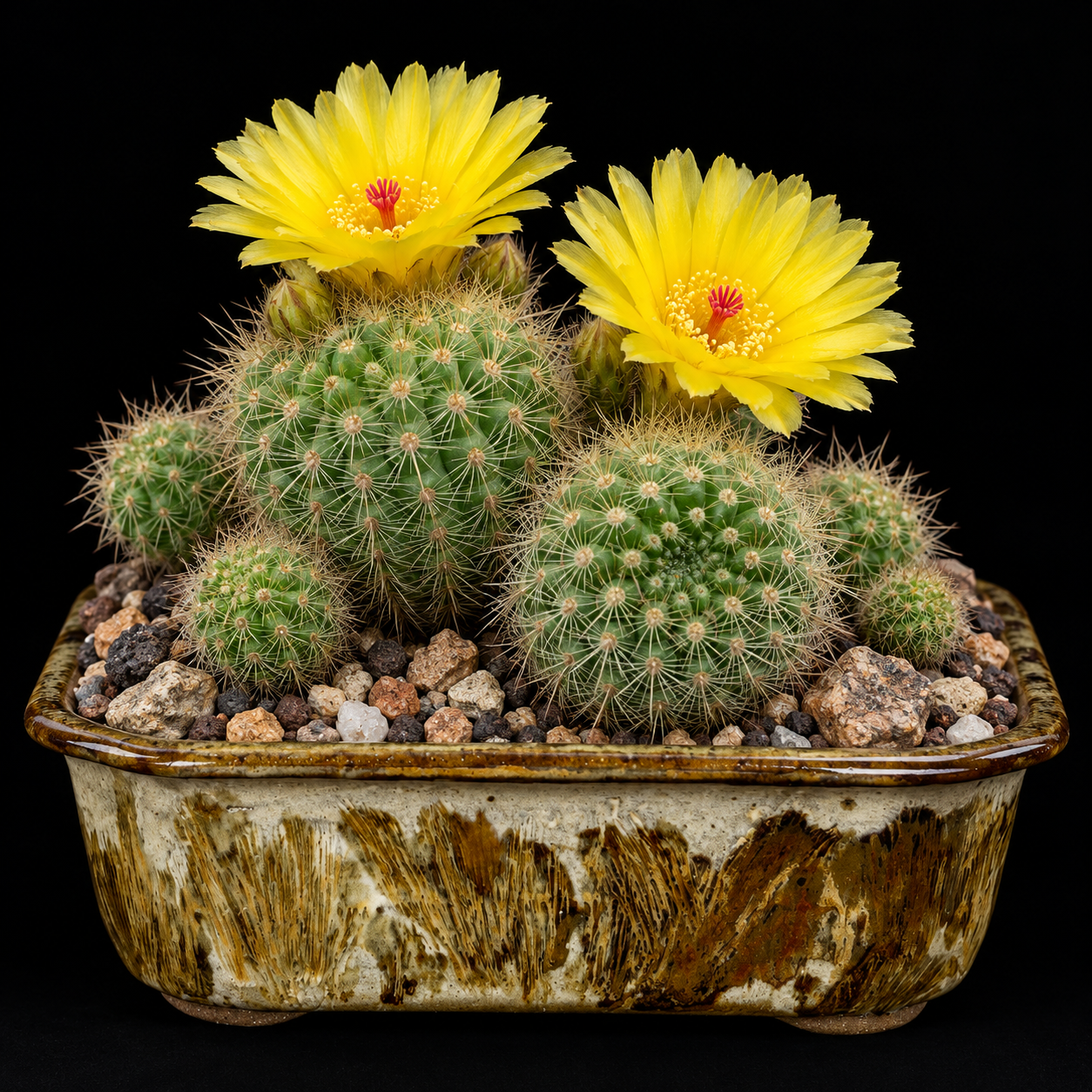
Parodia gaucha – 5 Seed Pack
R9,50
INTERNATIONAL CUSTOMERS: Please read our shipping terms and conditions here before placing your order: Shipping Terms and Conditions
4 in stock
The genus Parodia belongs to the cactus family, Cactaceae, and is one of South America’s most rewarding groups of small to medium-sized cacti. At first glance, many species have the classic rounded cactus form, but closer inspection reveals an extraordinary range of characters: perfectly geometric ribs, spiralling tubercles, dense woolly crowns, delicate bristles, hooked central spines, golden armament and, perhaps most memorably, disproportionately large and brilliantly coloured flowers. Modern botanical treatments recognise Parodia as an accepted genus, although exactly how broadly it should be circumscribed continues to attract scientific discussion.
Parodia was established by the Italian-Argentine botanist Carlos Luis Spegazzini in 1923. The name honours Domingo Parodi, an important early investigator of the flora of Paraguay. Its taxonomic story is especially fascinating because numerous plants once familiar to cactus collectors under such genera as Notocactus, Eriocactus, Wigginsia, Brasilicactus and Brasiliparodia have subsequently been incorporated into a broadly defined Parodia. Recent botanical research continues to examine whether all of these groups are best maintained within a single genus, making Parodia a living example of how plant taxonomy evolves as new anatomical and molecular evidence becomes available.
The genus is centred on two particularly important South American regions. One lies along the eastern side of the Andes, particularly in Bolivia and north-western Argentina, where species occupy dry valleys, rocky slopes and upland environments. The second encompasses the grasslands and rocky landscapes of southern Brazil, Uruguay, north-eastern Argentina and eastern Paraguay. The current Kew treatment gives the broader native range as extending from Colombia and Bolivia through southern Brazil and southern South America.
This broad geographical range has produced considerable diversity. Some Parodia remain miniature, almost button-like plants nestled close to the ground, while others eventually develop sizeable globose or cylindrical stems. Species may be solitary or form groups through basal offsets. Stems can carry straight ribs, spiralling ribs or pronounced tubercles, while their areoles may produce everything from short, neat radial spines to long, hair-like, colourful or strongly hooked spines. Recent botanical descriptions emphasise just how variable spine colour, shape and texture can be across the genus.
Then come the flowers. Many Parodia produce an impressive crown of blooms near the stem apex, often appearing remarkably large in relation to the plant itself. Yellow is particularly prominent among many of the species historically associated with Notocactus, but the genus as a whole offers an enticing palette that includes golden yellow, lemon, orange, scarlet, blood-red, pink, magenta and shades approaching violet. Funnel- to bell-shaped flowers, prominent stamens and frequently contrasting stigma lobes give flowering plants exceptional ornamental appeal.
For seed growers, Parodia has another attraction: a surprisingly substantial plant can develop from an almost dust-like seed. Raising them from seed allows collectors to observe natural variation in spine density, body form and eventually flower colour while building collections of species that may be difficult to obtain as established plants. Some species are also threatened in nature, reinforcing the value of responsibly produced, nursery-propagated material rather than wild-collected plants.
Parodia gaucha
Parodia gaucha is a distinctive and comparatively recently described Brazilian cactus with a wonderfully compact habit, delicate golden spination and disproportionately large, luminous flowers. This member of the Cactaceae is endemic to Rio Grande do Sul in southern Brazil, where it is confined to the Pampa biome and is particularly associated with rocky grasslands and exposed stone outcrops. Wild populations occur from roughly 80 to 850 metres above sea level, including the region around Encruzilhada do Sul. Its restricted natural distribution and specialised habitat give P. gaucha considerable appeal for collectors interested in the remarkable and often overlooked cactus flora of southern Brazil.
Plants may grow as solitary specimens but can also spread by short basal stolons to form attractive groups of several stems. Individual bodies are bright fresh green, initially globose and becoming club-shaped to short cylindrical with maturity, commonly reaching around 9–12 cm tall and 5–8 cm across. Approximately 18–22 well-defined, slightly tuberculate ribs run down each stem, their closely spaced areoles carrying an intricate network of fine needle-like spines. Around 18–26 radial spines accompany several slightly stronger central spines, with colours ranging from pale yellow and straw through golden yellow to warm orange-red. This combination of fresh green ribs and softly glowing spination gives mature clumps an exceptionally decorative appearance even when they are not flowering.
The flowers are the great spectacle of Parodia gaucha. Mature stems produce sizeable, short funnel-shaped blooms near the crown, reaching approximately 4 cm long and as much as 5 cm across. They open in clear, radiant yellow to rich golden-yellow, while reddish to purplish-red colouring within the throat and deep red stigma lobes create an eye-catching contrast amongst the yellow stamens. Several flowering heads in an established colony can produce an exuberant display above the fine golden spines. In its native Southern Hemisphere habitat, Parodia gaucha flowers from October through December, spanning spring into early summer. The blooms are diurnal and may remain open for roughly four hours each day over several successive days.
For South African growers, Parodia gaucha is especially attractive because its natural Southern Hemisphere seasonal rhythm corresponds comfortably with our own spring and summer growing period. Its rocky Pampa origins suggest excellent results in a very free-draining, mineral-rich cactus medium with strong light, good air movement and careful watering during active growth. Allow the substrate to dry well between waterings and keep plants considerably drier during cool winter weather. International growers can enjoy it equally successfully in greenhouses, conservatories, cactus houses or bright protected container collections, where excessive winter moisture and prolonged freezing can be avoided. Growing from seed is particularly rewarding because individual seedlings can gradually develop into compact ribbed stems and, with maturity, potentially build handsome multi-headed colonies through basal stolons.
For enthusiasts of Brazilian cacti, Pampa flora, unusual Parodia or beautifully floriferous compact species, Parodia gaucha offers an irresistible combination of rarity, architectural form and brilliant seasonal colour. Check out our online seed store and explore our vast and diverse selection of cactus, succulent and sought-after botanical seeds from South America and around the world. Buy Now or Add to Cart and combine Parodia gaucha with other fascinating species to create an exceptional seed-grown collection. Seeds and All offers offers combined South African and International shipping, making it convenient for collectors, growers, gardeners and hobbyists locally and worldwide to combine multiple seed varieties into one order.


