
Strophanthus hispidus – 5 Seed Pack
R62,50
INTERNATIONAL CUSTOMERS: Please read our shipping terms and conditions here before placing your order: Shipping Terms and Conditions
34 in stock
Strophanthus is a genus of 35-40 species of flowering plants in the family Apocynaceae, native mainly to tropical Africa, extending to South Africa, with a few species in Asia, from southern India to the Philippines and southern China. The name (strophos anthos, “twisted cord flower”) derives from the long twisted threadlike segments of the corolla, which in one species (S. preussii) attain a length of 30-35 cm. The genus includes vines, shrubs and small trees. The leaves are opposite or whorled, simple broad lanceolate, 2-20 cm long, with an entire margin. Several of the African tribes used Strophanthus as the principal ingredient in arrow poison. Plants from this genus produce toxic alkaloids and cardiac glycosides g-strophanthin (syn. ouabain), k-strophanthin and e-strophanthin. As ordinarily administered, the drug acts on the heart before influencing any other organ or tissue. Often indeed no other action can be observed. It is used to produce the drug Ouabain which was taken as a cardiac stimulant to treat heart failure, and is similar to the drug Digoxin produced from Digitalis purpurea.
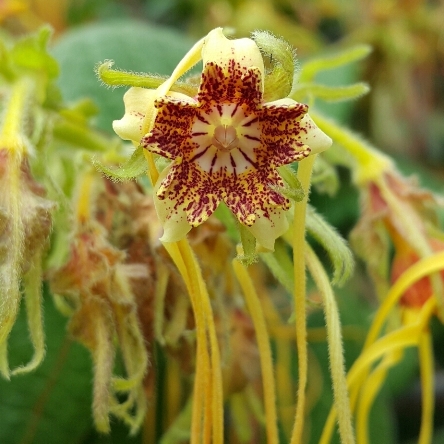
Strophanthus hispidus is a species of climbing shrub native to tropical Africa. This plant is characterized by its dense clusters of striking flowers, typically white or creamy in colour with a pink or purple tinge. Strophanthus hispidus is notable for containing potent cardiac glycosides, including ouabain, a compound historically used in traditional medicine for its effects on heart function. Due to its toxicity, the seeds of this plant have also been utilized as a poison for hunting. While Strophanthus hispidus is often recognized for its medicinal properties, it requires careful handling due to its toxic nature. It remains an important plant in African cultures, both for its therapeutic potential and historical use.


