

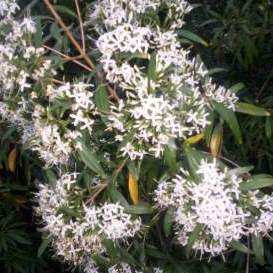
Pavetta lanceolata – Weeping Bride’s Bush, Bridal Bush, Christmas Bush; Treurbruidsbos, Bruidsbos – 5 Seed Pack
R14,25
INTERNATIONAL CUSTOMERS: Please read our shipping terms and conditions here before placing your order: Shipping Terms and Conditions
18 in stock
Pavetta is a genus of flowering plants in the family Rubiaceae. It comprises about 360 species of trees, evergreen shrubs and sub-shrubs. It is found in woodlands, grasslands and thickets in sub-tropical and tropical Africa and Asia. The plants are cultivated for their simple but variable leaves, usually opposite but also occur in triple whorls. The leaves are often membranous with dark bacterial nodules. Pavetta has small, white, tubular flowers, sometimes salviform or funnel-shaped with 4 spreading petal lobes. The flowers are carried on terminal corymbs or cymes.
Pavetta lanceolata commonly known as Weeping Bride’s Bush, Bridal Bush or Christmas Bush in English and Treurbruidsbos or Bruidsbos in Afrikaans in full flower, looks like a bride adorned in pure white, full of expectations and hope for a long and happy life, hence the common name. The alternative common name is also apt as these bushes are in full flower during Christmas time. Pavetta lanceolata is an evergreen tree or shrub, up to 5(7) m high, regularly decussately branched (opposite pair at right angles to next pair). The bark is greyish white. Pavetta lanceolata is fairly common in the summer rainfall areas of South Africa, in Limpopo, Mpumalanga, Swaziland, KwaZulu-Natal and the Eastern Cape. It also occurs in southern Mozambique. It often grows in association with other bushes in bush clumps, on forest margins and river banks. The sweetly scented flowers attract many pollinators such as birds, bees, wasps, beetles and ants. These in turn attract birds and other predators. Birds love the fruits and these are obviously distributed by birds. In the past, the flowers of Pavetta species were probably used in traditional wedding ceremonies (Smith 1966). Several other species are also cultivated in gardens, including P. gardeniifolia.


