
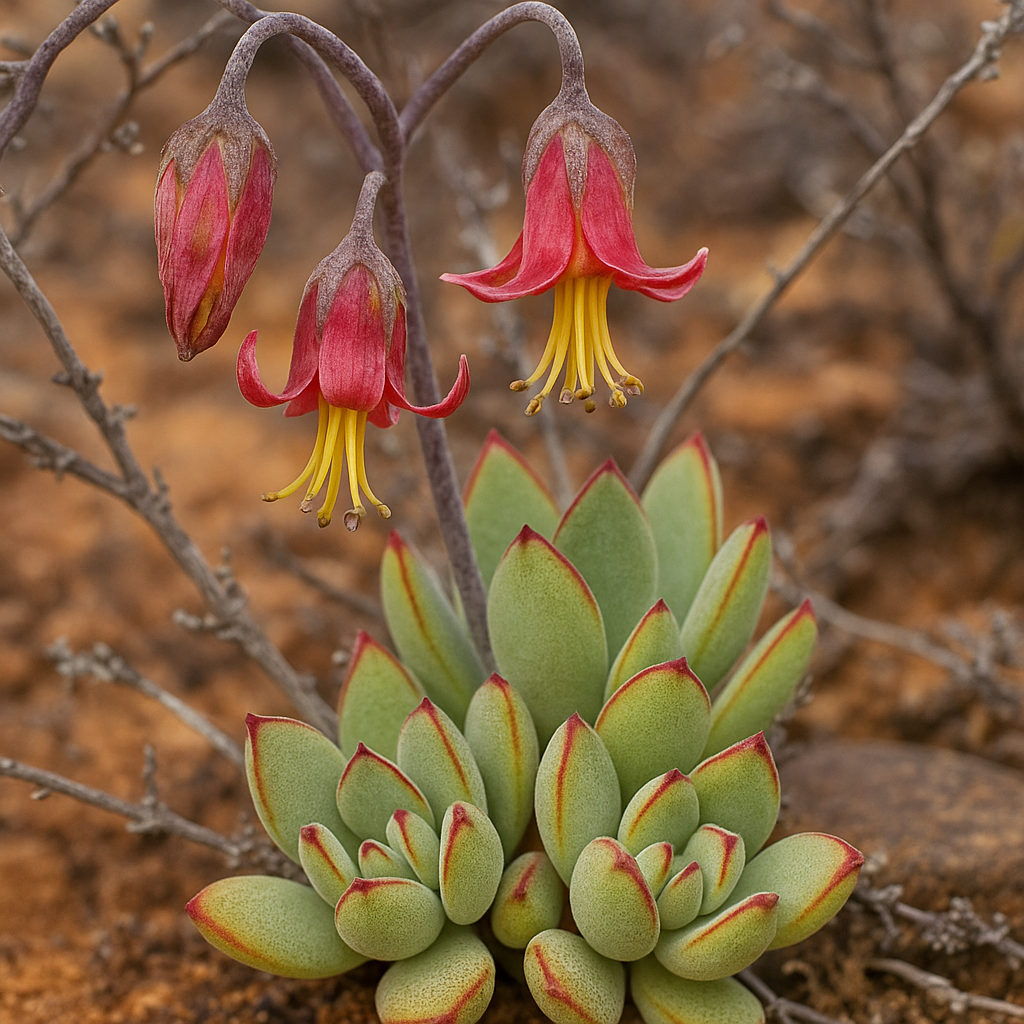
Cotyledon papillaris (Cotyledon teretifolia) – Sprawling Pigsears; Ranknenta – 10 Seed Pack
R20,00
INTERNATIONAL CUSTOMERS: Please read our shipping terms and conditions here before placing your order: Shipping Terms and Conditions
36 in stock
Few South African succulents feel as instantly familiar and yet as endlessly surprising as Cotyledon. This is a proudly local genus in the Crassulaceae, centred in Southern Africa and especially rich in South Africa’s winter-rainfall and semi-arid regions. From Namaqualand quartz fields to Karoo koppies and Eastern Cape cliffs, Cotyledon species have adapted to tough landscapes with thick, water-storing leaves, powdery blooms that reflect harsh sun, and rugged stems that shrug off drought.
What makes the genus such a favourite with growers is its variety. Some Cotyledon are neat little cliff creepers, others become chunky shrubs with paddle-shaped “pig’s ear” leaves, and a few — like the beloved bear’s paws — look almost unreal with their soft, velvety texture. Leaf colour ranges from frosted blue-green to lime-green and bronze, often finished with dramatic red margins or tips that intensify in cool, bright weather.
Then come the flowers: tall stalks topped with nodding bells or tubes in fiery reds, oranges, corals and yellows, usually in the cooler months when colour in the veld is at a premium. These blooms are magnets for sunbirds and insects, and they bring real movement and life to a pot, rockery, or wild-style garden. Growing Cotyledon from seed is one of the best ways to experience that diversity firsthand — every seedling is a little story of adaptation waiting to unfold.
Cotyledon papillaris
Cotyledon papillaris is a small but unforgettable species, known for its curious, club-shaped leaves decorated with tiny surface bumps (papillae) that give the plant a subtly textured, almost velvety appearance. Leaves are usually green to grey-green with reddish tips, and the plant forms low clumps that spread neatly over time.
It is native to dry, rocky habitats in South Africa’s arid interior, where it grows among stones and sparse scrub. This makes it perfectly suited to miniature rock gardens, shallow trays, and bright windowsills, provided the soil is sharply draining and watering is modest.
In the cooler season, typically winter into early spring, it produces slender stalks with pendent tubular flowers in shades of orange-red, sometimes with lighter throats. The flowers are delicate but striking against the compact body. Seeds of C. papillaris are ideal for collectors who love unusual leaf forms, and for growers wanting a small indigenous succulent that adds real texture to a mixed pot or tray.


