
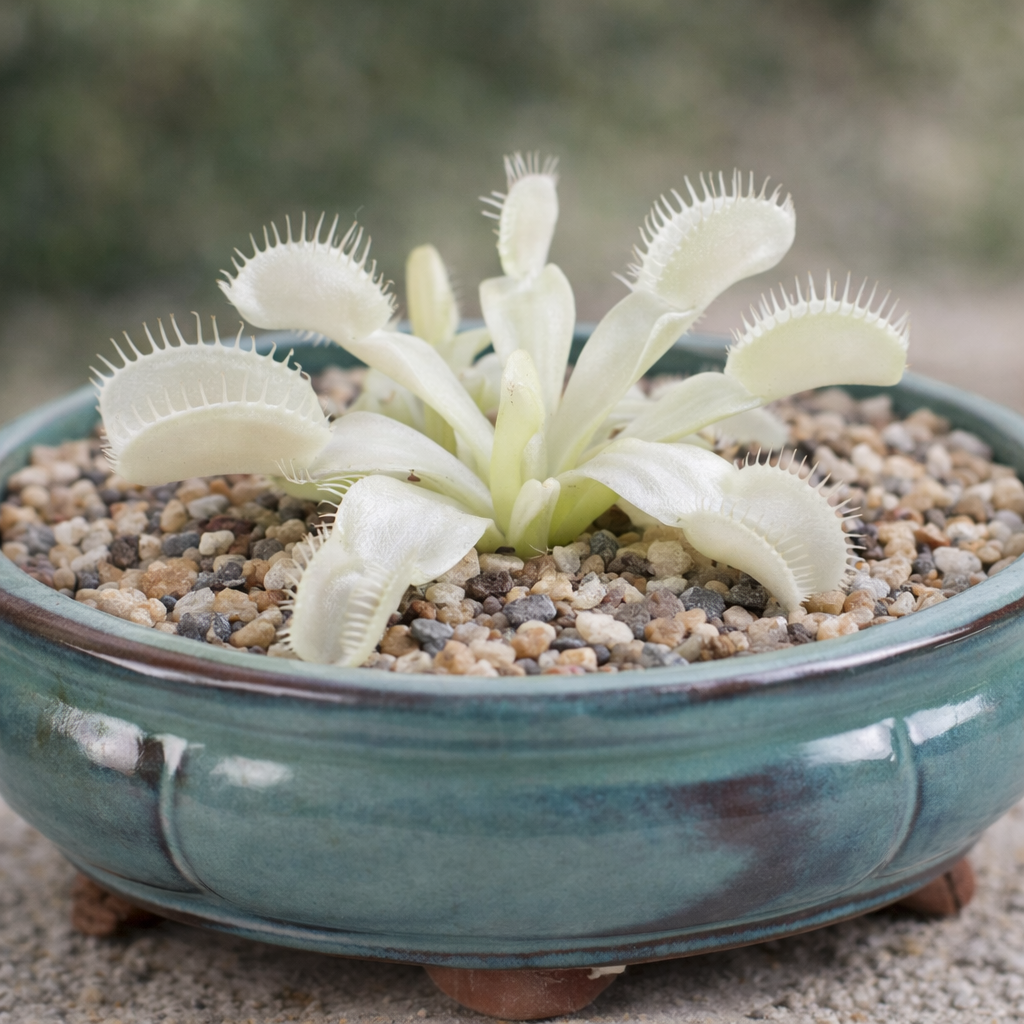
Dionaea muscipula ‘Blanche Hermine’ – Venus Fly Trap Blanche Hermine – 5 Seed Pack
R87,50
INTERNATIONAL CUSTOMERS: Please read our shipping terms and conditions here before placing your order: Shipping Terms and Conditions
18 in stock
Dionaea is a genus that has earned a kind of botanical celebrity status for doing something plants “shouldn’t” do – move with purpose. Best known for the Venus flytrap, Dionaea has evolved a rapid snap-trap that closes in a fraction of a second, turning an ordinary leaf into a living, spring-loaded hunting tool. It’s not aggression, though; it’s survival, a clever workaround for life in soils so poor in nutrients that catching insects becomes the plant’s shortcut to nitrogen and minerals.
Remarkably, Dionaea is a tiny genus in terms of diversity, with its fame resting on a single species, Dionaea muscipula, and the incredible range of cultivated forms selected from it. From deep red rosettes to saw-toothed margins and oversized “big mouth” traps, growers around the world have revealed just how much variation can be coaxed from one wild species – making Dionaea a playground for collectors and a gateway plant for anyone curious about carnivory.
In nature, Dionaea is endemic to a very specific corner of the world: the coastal plain wetlands of North and South Carolina in the United States. There it grows in sunny, acidic bogs and wet savannas, often in habitats shaped by seasonal water and periodic fire. That wild origin explains its love of bright light, pure water, and nutrient-poor substrates – and why, when treated like a true bog plant, it becomes one of the most rewarding carnivores to grow, whether in South Africa or anywhere else.
Dionaea muscipula ‘Blanche Hermine’
Dionaea muscipula ‘Blanche Hermine’ is an elegant and highly sought-after Venus flytrap cultivar, admired for its exceptionally pale to near-white foliage that sets it apart from the more common green and red forms. The name Blanche Hermine – French for “white ermine” – perfectly reflects its refined, ghostly appearance. Under strong light, plants maintain a creamy white to very light green tone, sometimes with faint pastel blushes, giving this cultivar a soft, almost porcelain-like look that appeals strongly to collectors and display growers.
The Venus flytrap species is naturally endemic to a small region of the southeastern United States, restricted to North and South Carolina, where it grows in open, sunny bogs and seasonally wet savannas with acidic, nutrient-poor soils. ‘Blanche Hermine’ is a cultivated selection and does not occur in the wild. Plants form a compact, ground-hugging rosette of modified leaves, each ending in a snap-trap with fine marginal cilia. While the traps function exactly like those of typical Venus flytraps, their pale colouring gives the plant a distinctly delicate and ornamental character, especially when grown in bright, indirect to full sun.
When mature, plants may produce a tall flower stalk in spring to early summer. The flowers are white, sometimes showing subtle greenish veins, and are held well above the traps to protect pollinators from accidental capture. Flowering is most common in spring, though timing may vary slightly depending on climate and cultivation conditions in South Africa versus the Northern Hemisphere.
Important note for seed buyers: The unique pale coloration that defines ‘Blanche Hermine’ does not reliably reproduce from seed. Seed-grown plants will show natural genetic variation and may emerge green, lightly flushed, or only partially pale. This makes seed growing exciting for those who enjoy variation and selection, but collectors seeking a true, consistently pale ‘Blanche Hermine’ must obtain plants through vegetative propagation such as divisions or tissue culture.


