
Lycium cinereum – Blue Honeythorn; Boksdoring – 5 Seed Pack
R22,75
INTERNATIONAL CUSTOMERS: Please read our shipping terms and conditions here before placing your order: Shipping Terms and Conditions
6 in stock
The genus Lycium, commonly known as Boxthorn, Wolfberry or Goji, belongs to the Solanaceae (Nightshade) family, alongside familiar plants such as tomatoes, potatoes and peppers. Comprising approximately 100 species, this fascinating genus is widely distributed across Africa, Asia, Europe and the Americas, particularly in arid and semi-arid environments. Southern Africa is an important centre of diversity, with numerous indigenous species adapted to some of the region’s most demanding landscapes.
Typically forming intricately branched, often thorny shrubs or small trees, Lycium species combine remarkable resilience with understated ornamental beauty. Their delicate, tubular to bell-shaped flowers appear in shades of white, cream, pink, lilac and violet, often followed by colourful berries ranging from golden yellow and orange to brilliant red or even black. Many species provide valuable food and shelter for birds and other wildlife, while their tolerance of drought, wind and challenging soils makes them particularly interesting to growers seeking unusual, hardy plants.
From the formidable South African Lycium ferocissimum (African Boxthorn) to the internationally celebrated Lycium chinense (Goji Berry), this diverse genus offers something for botanical collectors, indigenous plant enthusiasts, wildlife gardeners and growers interested in unusual fruit-bearing shrubs. Whether cultivated for their architectural form, delicate flowers, ecological value or botanical curiosity, Lycium species are rewarding additions to specialised plant collections.
Lycium cinereum (Lycium caespitosum, Lycium engleri, Lycium prunus-spinosa, Lycium roridum, Lycium woodii) – Brownstem Honeythorn, Blue Honeythorn; Boksdoring, Kareebos, Kriedoring, Slangbessie
Discover the captivating beauty of Lycium cinereum, a wonderfully distinctive indigenous southern African shrub belonging to the Solanaceae family. Commonly known as Boksdoring or Kriedoring, this fascinating member of the Honey-thorn group combines delicate violet-purple flowers, attractive grey-green foliage and brilliant scarlet berries with the rugged character of a true dryland survivor. Widely distributed throughout South Africa, including the Northern Cape, Western Cape, Eastern Cape, Free State, North West and other provinces, its natural range also extends into Namibia, Botswana and Lesotho. This remarkably adaptable species inhabits a variety of environments, including the Karoo, Kalahari, dry grasslands, arid savannas, rocky slopes, sandy plains and seasonal drainage lines, where its resilience and distinctive appearance make it an intriguing component of the indigenous vegetation.
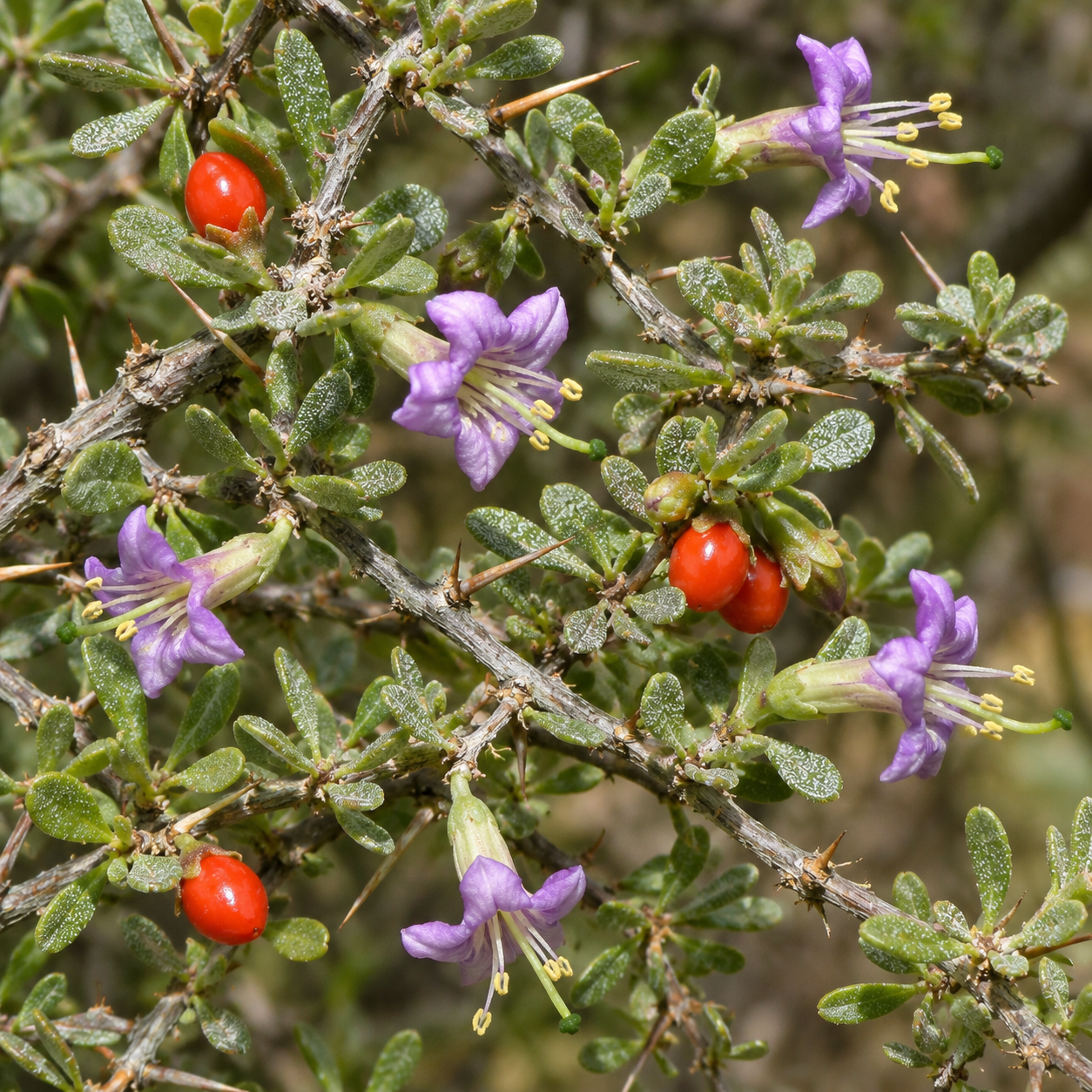
Growing into a rigid, intricately branched and exceptionally thorny shrub reaching approximately 0.3–2 metres in height, Lycium cinereum possesses a beautifully rugged yet surprisingly delicate appearance. Its woody stems develop an attractive combination of greyish-white and purplish-brown bark, often becoming weathered and textured with age. Numerous sharp, slender spines emerge along the branches, interspersed with compact clusters of small, narrow, fleshy leaves. These distinctive leaves range from narrowly oblong to somewhat spoon-shaped, displaying subtle shades of olive-green, sage-green and silvery-grey, often with a finely textured surface that catches the light. Their dense arrangement along the thorny branches creates a fascinating contrast between soft-looking foliage and formidable spines, giving the plant a naturally sculptural character that is particularly appealing to collectors of unusual African shrubs.
The flowers of Lycium cinereum are exquisite miniature treasures, offering a delightful contrast to the plant’s rugged growth habit. Emerging among the tightly clustered leaves, the delicate, tubular blossoms feature creamy-white to pale greenish floral tubes opening into beautifully reflexed violet, lavender-purple or soft lilac lobes. Subtle darker purple veins and markings enhance their intricate appearance, while long, slender stamens extend gracefully beyond the flowers, displaying delicate yellowish anthers and a prominently projecting style. In its natural southern African habitat, flowering is recorded predominantly from August through April, encompassing spring, summer and early autumn, although the precise timing and abundance of blooms depend strongly on seasonal rainfall and local growing conditions. Following pollination, the flowers give way to small, glossy, oval to nearly spherical berries that mature into brilliant orange-red or scarlet, creating a spectacular contrast against the muted green foliage and pale woody branches.
Beyond its delicate floral beauty, Lycium cinereum is a wonderfully resilient species that offers considerable interest to gardeners and botanical enthusiasts seeking distinctive, drought-adapted plants. Its natural preference for dry, sandy, gravelly and well-drained soils makes it particularly suitable for water-wise gardens, indigenous landscaping, naturalistic shrub borders and specialised collections of southern African flora. Once established, it can withstand prolonged dry conditions, while its dense, thorny branches provide valuable protective cover for small wildlife. The combination of delicate purple flowers, colourful berries and attractive foliage ensures ornamental interest across different seasons. South African growers will appreciate its indigenous heritage and suitability for challenging landscapes, while international collectors can enjoy cultivating this unusual species in appropriately dry, sunny climates or in spacious containers with excellent drainage. Its adaptability, intricate growth habit and fascinating floral structure make it especially rewarding for collectors interested in lesser-known members of the Nightshade family.
Introduce the remarkable botanical character of southern Africa’s wild and beautiful landscapes into your own garden with Lycium cinereum. Whether you are captivated by its elegant violet-purple flowers, brilliant scarlet berries, subtly textured grey-green leaves or wonderfully architectural thorny branches, this extraordinary indigenous shrub offers an exciting opportunity to cultivate something genuinely different from seed. An excellent addition to water-wise gardens, indigenous plant collections and specialised dryland plantings, Boksdoring is a fascinating species deserving of greater appreciation among adventurous growers and botanical enthusiasts worldwide. Check out our online seed store and discover our vast and diverse selection of indigenous and exotic plant seeds. Buy Now or Add to Cart and experience the satisfaction of growing this fascinating African shrub from seed! Seeds and All offers combined South African and International shipping.


