
Strophanthus amboensis – Elephant Vine, Knob-stemmed Poisonrope; Knopstamgiftou – 5 Seed Pack
R21,50
INTERNATIONAL CUSTOMERS: Please read our shipping terms and conditions here before placing your order: Shipping Terms and Conditions
42 in stock
Strophanthus is a genus of 35-40 species of flowering plants in the family Apocynaceae, native mainly to tropical Africa, extending to South Africa, with a few species in Asia, from southern India to the Philippines and southern China. The name (strophos anthos, “twisted cord flower”) derives from the long twisted threadlike segments of the corolla, which in one species (S. preussii) attain a length of 30-35 cm. The genus includes vines, shrubs and small trees. The leaves are opposite or whorled, simple broad lanceolate, 2-20 cm long, with an entire margin. Several of the African tribes used Strophanthus as the principal ingredient in arrow poison. Plants from this genus produce toxic alkaloids and cardiac glycosides g-strophanthin (syn. ouabain), k-strophanthin and e-strophanthin. As ordinarily administered, the drug acts on the heart before influencing any other organ or tissue. Often indeed no other action can be observed. It is used to produce the drug Ouabain which was taken as a cardiac stimulant to treat heart failure and is like the drug Digoxin produced from Digitalis purpurea.
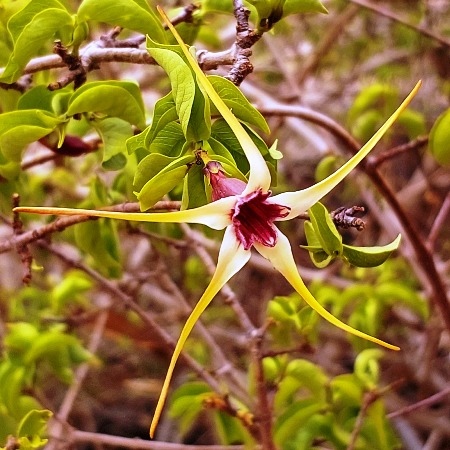
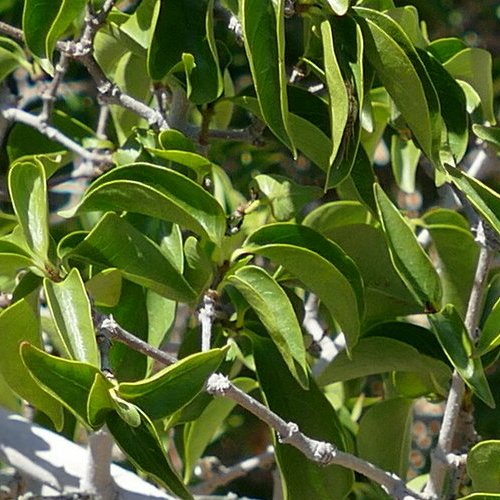
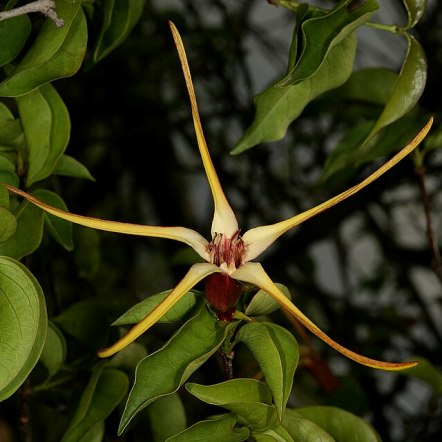
Strophanthus amboensis, commonly known as Elephant Vine or Knob-stemmed Poisonrope in English and Knopstamgiftou in Afrikaans, is exotic to South Africa, occurring in the Democratic Republic of the Congo (DRC), southwards through Angola, to central Namibia. The habitat is usually amongst boulders or in rock fissures on outcrops in savanna woodland, but in the western Caprivi, it is also found on sandy plains. When the Elephant Vine is well maintained, it can grow into a reasonable-sized bushy tree with extraordinary pretty, faintly but sweet-scented flowers that can not only attract pollinators to a garden when in flower but are also an interesting feature plant when carrying its large fruit after pollination.
It has been reported to be cultivated in Uganda, Indonesia and South Africa, but never on large scale commercial endeavours. It is most probably best suited as a container plant in areas outside its natural distribution. In frost free areas it may also be used as a background plant when pruned and trained into a neat shrub.


