

Acrodon bellidiflorus – Common Tiptoothfig – 5 Seed Pack
R12,50
INTERNATIONAL CUSTOMERS: Please read our shipping terms and conditions here before placing your order: Shipping Terms and Conditions
25 in stock
The genus Acrodon is restricted to a swath along the southeast and southern coast of the Western and Eastern Cape Provinces of South Africa. The plants are characterized by three-sided leaves with small teeth growing in rows along the edges and keels as well as their solitary flowers, the petals of which can be striped. They grow in tufts or form small mats. The plants are popular and were first introduced into cultivation in Europe at the end of the 18th century. The genus Acrodon is endemic to South Africa. The name was derived from the Greek words ‘akros’ (point) and ‘odus’ (tooth), referring to the toothed leaves. Acrodon are very hardy, but like frequent watering and an acidy, sandy soil. They naturally grow and flower in late winter but are easily convertible to summer, or indeed to continuous, growth. They are easily propagated by seed and are well suited to pot culture or rockeries.
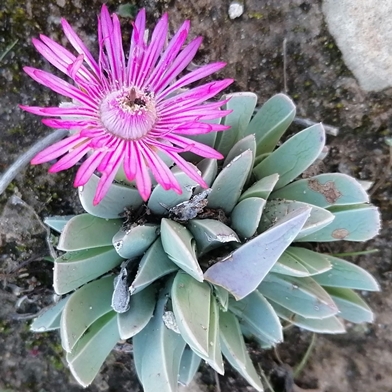
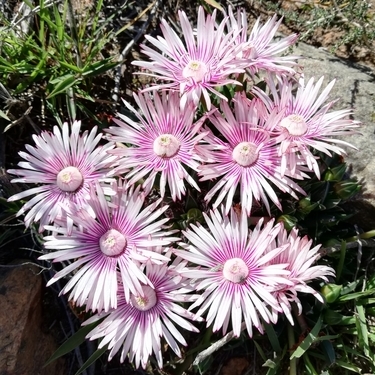
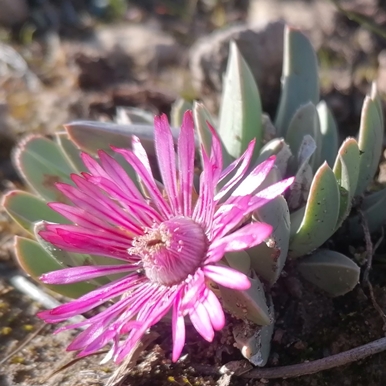
Acrodon bellidiflorus, commonly known as Common Tiptoothfig, is a South African endemic mesemb succulent found in the Western Cape Province. It is found growing between McGregor and Bredasdorp and the Klein Karoo. It grows in areas that have renosterveld, coastal fynbos or grassland biomes. Acrodon bellidiflorus is a compact succulent perennial plant. It has a woody taproot with fine roots growing off it. This is the only species in its genus where this trait is common. The deep green leaves are triangular. They have a persistent seethe that turns black with age. The keel and margins may be smooth or may have three or four flexible teeth with broad bases. The number of teeth may also vary between populations. The eastern populations have short visible internodes. Internodes are not visible in other populations. The flowers are white or pale pink in colour and have a diameter of about 35 mm. There is only a single flower at the tip of each flowering branch. They are present between April and July.


