
Strophanthus congoensis – 3 Seed Pack
R29,75
INTERNATIONAL CUSTOMERS: Please read our shipping terms and conditions here before placing your order: Shipping Terms and Conditions
10 in stock
Few flowering plants combine extraordinary beauty, botanical intrigue and fascinating history quite like Strophanthus. Belonging to the Apocynaceae family, commonly known as the Dogbane or Oleander family, this remarkable genus comprises approximately 39 accepted species of tropical and subtropical shrubs, woody climbers and scrambling vines. Native primarily to Africa, with additional species occurring in Madagascar and tropical Asia, Strophanthus is celebrated for its spectacular, often fragrant flowers, which range from creamy white and pale yellow to pink, red and richly patterned combinations. Some species produce astonishingly long, slender, ribbon-like petals that twist and trail elegantly from the flower, creating an almost otherworldly appearance. Indeed, the name Strophanthus originates from the Greek words strophos, meaning twisted cord, and anthos, meaning flower, a fitting tribute to these extraordinary blooms.
Beyond its ornamental appeal, Strophanthus possesses a captivating ethnobotanical history. Several species, including Strophanthus gratus and Strophanthus kombe, are renowned for producing powerful cardiac glycosides that have attracted considerable scientific and medicinal interest. Traditionally, certain species were also used in the preparation of hunting arrow poisons, highlighting their remarkable chemical properties and extreme toxicity. With their glossy foliage, distinctive flowers and fascinating seed pods that release silky, wind-dispersed seeds, these exceptional plants offer collectors, botanical enthusiasts and adventurous gardeners an opportunity to cultivate some of the most unusual flowering species in the plant kingdom.
Strophanthus congoensis
Discover the extraordinary beauty of Strophanthus congoensis, a fascinating and seldom-cultivated tropical African climber whose intricately patterned flowers and gracefully trailing floral ribbons make it a botanical treasure of exceptional ornamental appeal. Belonging to the Apocynaceae family, commonly known as the Dogbane family, this remarkable woody liana is indigenous to the lush tropical forests of West-Central Africa, with a natural distribution extending across Cameroon, Equatorial Guinea, Gabon, the Republic of the Congo and the Democratic Republic of the Congo. Thriving in primary and secondary evergreen forests, semi-deciduous woodlands and moist riverine forests at elevations ranging from near sea level to approximately 1,000 metres, it develops vigorous woody climbing stems that can extend to considerable lengths through surrounding vegetation. Its attractive, opposite, ovate to elliptic leaves display rich green colouring, smooth surfaces and prominent, delicately branching veins, creating a lush and elegant setting for its extraordinary floral display.
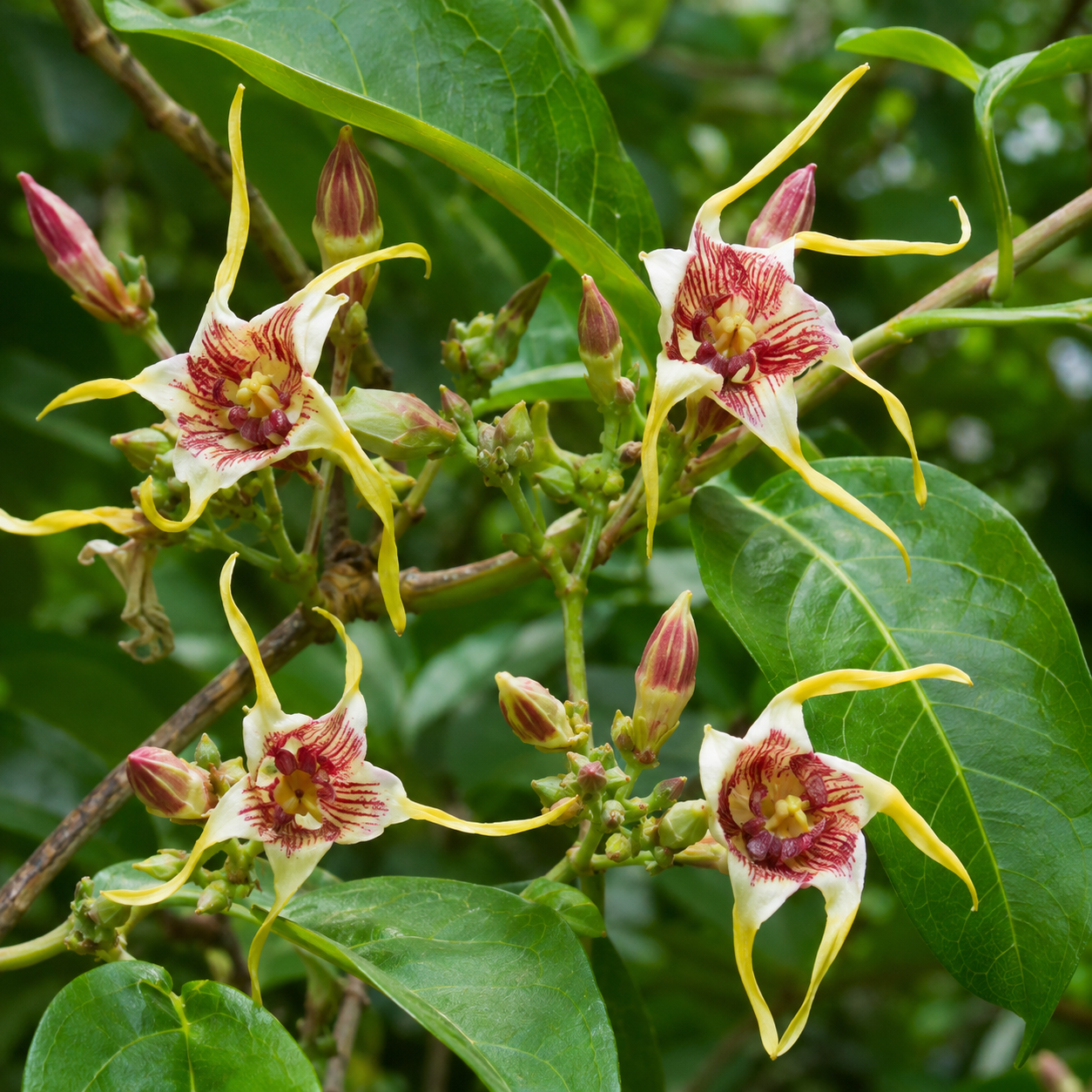
The spectacular flowers of Strophanthus congoensis are true masterpieces of botanical architecture! Produced in clusters of up to 18 blossoms at the ends or forks of the climbing branches, each exquisite flower features a creamy-white to ivory corolla with striking crimson-red to reddish-purple streaks radiating from its intricately structured centre. The narrow tubular base gradually widens into a delicate, star-shaped floral opening, where five spreading corolla lobes abruptly taper into exceptionally slender, golden-yellow ribbon-like extensions measuring approximately 1.4–4.2 cm long. These graceful floral tails twist, curl and extend outward in different directions, giving the blossoms their distinctive exotic appearance. At the centre of each flower, a fascinating crown of fleshy reddish-purple structures surrounds the pale-yellow reproductive organs, producing a captivating contrast against the delicately patterned petals. As the blossoms mature, their initially creamy-white colouring can develop subtle reddish tones, adding further complexity to this extraordinary floral display.
In its natural equatorial African habitat, Strophanthus congoensis follows the seasonal rhythms of the tropical forest, with flowering generally associated with transitions between relatively drier periods and the return of seasonal rainfall, as is characteristic of many members of the genus. Because rainfall patterns vary across its extensive Central African distribution, the flowering season is not necessarily confined to a single calendar period, and blooming may occur at different times in different localities. Following successful pollination, the flowers develop into distinctive pairs of elongated, rigid, woody seed follicles, which can reach approximately 12–23 cm in length. These impressive tapering fruits eventually split open to release numerous slender seeds equipped with beautiful, silky, feather-like tufts, an ingenious adaptation that enables the seeds to disperse on the wind. The combination of its remarkable floral structures, fascinating reproductive biology and elegant climbing habit makes this species especially intriguing to collectors interested in unusual tropical flora.
For South African gardeners and international botanical enthusiasts, Strophanthus congoensis presents an exciting opportunity to cultivate one of Central Africa’s most unusual flowering climbers. Its tropical forest origins make it particularly suitable for warm, humid, frost-free subtropical gardens, sheltered tropical growing environments and heated greenhouses or conservatories in cooler climates. A fertile, freely draining growing medium, consistent moisture during active growth, bright filtered light and sturdy climbing support provide a practical foundation for successful cultivation. With its glossy foliage, extraordinary crimson-striped flowers and elegantly curling golden floral tails, this uncommon African species offers exceptional potential as a collector’s plant, an unusual ornamental climber or a fascinating addition to a specialist Apocynaceae collection. Like other members of the genus, Strophanthus congoensis should be treated as potentially highly poisonous, particularly its seeds and latex, and all plant material should be handled responsibly and kept away from children and pets.
Visit our online seed store and discover the extraordinary botanical diversity waiting to be grown! Buy Now or Add to Cart and explore our vast and diverse collection of rare, unusual and exotic species from around the world. Whether you are a passionate South African gardener or an international botanical collector, Seeds and All offers combined South African and International shipping, making it easier to grow something truly exceptional!


